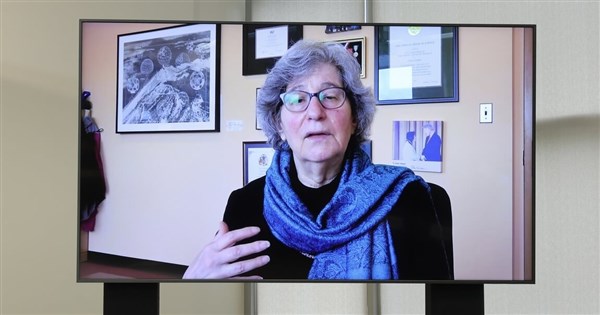
(Central News Agency reporter Wang Shu-fen, Taipei, 15th) The Tang Prize Foundation held a press conference today to announce the seventh recipient of the 2026 Tang Prize for Sustainability: Professor Susan Solomon of the Massachusetts Institute of Technology (MIT). Solomon personally traveled to Antarctica to uncover the mystery of the ozone hole, making profound impacts on scientific understanding and international policy.
Chen Chen-chuan, Executive Director of the Tang Prize Education Foundation, stated that climate change is one of the most critical sustainability issues facing the world today. Susan Solomon has gained international acclaim for her pioneering research on ozone depletion and climate change. She is scheduled to visit Taiwan for the first time in mid-September to receive the award.
The Foundation praised Solomon for combining field observations in Antarctica, innovative modeling simulations, and deep communication with policymakers and the public, playing a pivotal role in the success of the Montreal Protocol and global climate negotiations.
The Foundation highlighted Solomon’s key contributions, including proving that chlorofluorocarbons (CFCs) are the primary cause of the expansion of the Antarctic ozone hole, and proposing a heterogeneous chemical reaction mechanism to explain its formation.
Additionally, Solomon demonstrated that the impacts of carbon dioxide emissions on surface temperature, rainfall, and sea level will persist for over a thousand years. She also co-led the Intergovernmental Panel on Climate Change (IPCC) Fourth Assessment Report, 'The Physical Science Basis,' which comprehensively integrated critical knowledge in climate science.
According to the Tang Prize Foundation, Solomon is currently the Lee and Geraldine Martin Professor of Environmental Studies in the Department of Earth, Atmospheric and Planetary Sciences at MIT.
Solomon began her academic career in 1981 by joining the U.S. National Oceanic and Atmospheric Administration (NOAA). After 30 years at NOAA, she joined MIT in 2012. Throughout her career, she has received nearly 70 international awards, including the U.S. National Medal of Science, the U.S. National Academy of Sciences Award for Chemistry in Service to Society, and Japan’s Blue Planet Prize. This Tang Prize award coincides exactly with the 40th anniversary of her 1986 expedition to Antarctica.
Academician Liu Shao-chien of Academia Sinica attended today’s press conference, sharing that he worked with Solomon at NOAA for 15 years. He witnessed her evolution from a promising young scholar into a world-class scientific genius, excelling not only in natural sciences but also in the humanities—particularly in public communication of science and sustainability, which he described as her innate talent.
The Foundation noted that from 1986 to 1987, Solomon served as Chief Project Scientist at McMurdo Station for the U.S. National Ozone Expedition, leading a team to Antarctica. There, they made the first direct measurements of reactive chlorine compounds in the Antarctic atmosphere, confirming that CFCs were indeed the main cause of the ozone hole’s expansion.
The Foundation emphasized that Solomon’s research became a crucial scientific foundation for the Montreal Protocol—one of the most successful environmental treaties in history, achieved through global cooperation to phase out ozone-depleting substances.
In 2016, Solomon’s MIT research team further discovered signs of ozone layer recovery over Antarctica, demonstrating that international cooperation and the phase-out of CFCs have yielded tangible results—a significant milestone in sustainable science.
In 2009, Solomon published another landmark study showing that the impacts of carbon dioxide emissions on surface temperature, rainfall, and sea level are essentially irreversible on a timescale of over a thousand years, even if emissions cease. This breakthrough revealed the long-term environmental damage caused by global warming, highlighting the urgency of early and sustained climate mitigation efforts, with profound implications for both science and policy.
Solomon also revealed that changes in ozone layer thickness in the Southern Hemisphere affect atmospheric circulation and temperature structure from the upper atmosphere down to the surface. Over more than 40 years, her research on the impact of trace gases from human activities on Earth’s climate system has greatly advanced understanding of the interactions between chemistry and climate within the Earth system.
Solomon’s proposed heterogeneous chemical reaction mechanism explains that polar stratospheric clouds (PSCs) form in the extremely cold Antarctic stratosphere during winter and spring. The ice crystals in these clouds provide an efficient surface for chemical reactions, accelerating the production of chlorine gas (Cl₂) far beyond gas-phase reaction rates. This mechanism has become an indispensable theory in stratospheric chemistry models and is considered a classic achievement in modern environmental science.
From 2002 to 2008, Solomon co-led Working Group I of the IPCC, completing the Fourth Assessment Report, 'The Physical Science Basis.' The IPCC received the 2007 Nobel Peace Prize for this work. The report comprehensively integrated global climate science research, laying a critical foundation for international climate negotiations and providing key scientific evidence for the 2015 Paris Agreement.
The report presented pivotal conclusions such as 'warming of the climate system is unequivocal' and 'it is extremely likely that the observed increase in global average temperatures since the mid-20th century is due to human-induced greenhouse gas concentrations.' These findings became cornerstones for global discussions on adaptation, mitigation, vulnerability, and resilience.
In 1994, the 'Solomon Glacier' and 'Solomon Saddle' in Antarctica were officially named in her honor, recognizing her outstanding leadership and contributions to Antarctic research. For a scientist who has dedicated her life to polar and planetary climate systems, this is a deeply meaningful distinction.
The Tang Prize Foundation noted that beyond scientific research, Solomon has delivered hundreds of lectures worldwide, briefed multiple governments and international institutions, and testified before the U.S. Congress on climate and atmospheric issues multiple times, actively promoting the linkage between scientific knowledge and public policy. (Editor: Chang Ya-ching) 1150615
FACT BOX
- Source: CNA (Central News Agency)
- Category: Taiwan
- Organizations: NOAA / IPCC