2026 World Cup Key News
Central Report
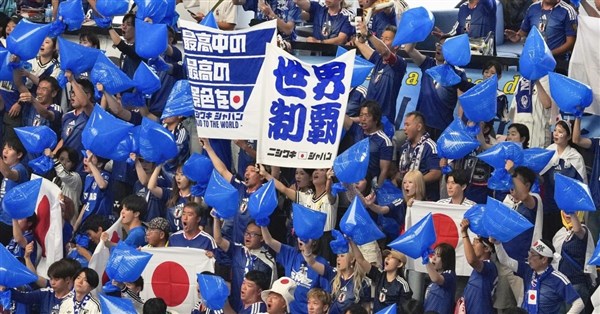
(Arlington, Texas, April 14 — CNA via international wire services) Japan held the Netherlands to a draw in their opening World Cup match today thanks to a crucial header goal, sparking jubilant cheers from the Blue Samurai fans. As usual, after the game, fans cleaned their seating areas, using the blue plastic bags they waved during cheering to collect paper scraps, bottles, and food wrappers, leaving the stadium spotless.
The Japanese proverb 'when a bird departs, it leaves no trace' may perfectly describe this admirable tradition. According to reports from the Associated Press and ESPN, Japanese fans first drew global attention during the 1998 France World Cup when they voluntarily cleaned the stadium after matches. Today, this scene has become a familiar sight whenever Japan participates in major international tournaments.
Today, Japanese fans waved their self-brought blue plastic bags throughout the game, turning the stadium into a sea of blue with every goal — such as when Koki Nakamura equalized in the second half, and when Daichi Kamada scored the decisive equalizer against the Netherlands.
After the match, hundreds of fans used these blue bags to pick up discarded PET bottles, food wrappers, and tissues, thoroughly cleaning the entire stands.
During the 2022 Qatar World Cup, Japanese fans cleaned their seats after Japan’s 2-1 victory over Germany. They even participated in cleaning after the opening match between host Qatar and Ecuador — a game that had nothing to do with Japan.
Koichi Nakano, a political science professor at Sophia University in Japan, said: 'Japanese fans cleaning stadiums at international events are simply reproducing the way they were taught to appreciate sports from childhood. For most ordinary fans, playing soccer at school is no different from other sports — the focus is not just on physical training, but also on moral education.'
Another core concept in Japanese social etiquette is avoiding 'meiwaku' — not causing trouble for others. Leaving large amounts of trash for stadium staff to clean up is considered extremely rude in Japanese culture.
Barbara Holthus of the German Institute for Japanese Studies explained: 'From an academic perspective, a reasonable explanation is that Japanese people happen to have a different form of socialization. If you grow up internalizing certain behavioral patterns, you naturally apply them to actions like post-match stadium cleaning.'
Stadium staff typically face extensive cleaning duties after games, but Japanese fans leave behind only memories of passionate support — never garbage. (Compiled by: Hsu Hsiang-ping) 1150615
Choose to stand with facts. Every sponsorship you give is a force protecting press freedom.
Download the CNA 'First News' app to instantly access the latest updates.
Text, images, and videos on this website may not be reproduced, broadcast, or transmitted without authorization.
FACT BOX
- Source: CNA (Central News Agency)
- Category: Event