Central News Agency Report
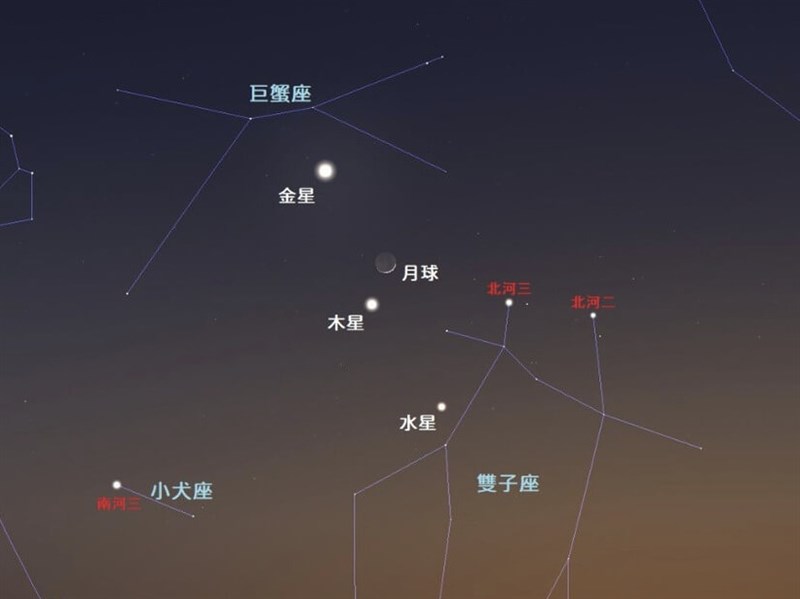
(Taipei, June 14 — Reporter Yang Shu-min) The Taipei Astronomical Museum announced today that there are two excellent opportunities to observe Mercury in the coming days: the first is the eastern elongation on June 16, followed by a celestial alignment known as 'three planets with the moon' on the evening of June 17, when Venus, Jupiter, the Moon, and Mercury will line up in the western sky, visible to the naked eye.
The museum issued a press release reminding astronomy enthusiasts that Mercury, which is usually difficult to spot due to its proximity to the Sun, will be particularly visible during these two events.
According to the museum, June 16 marks Mercury's 'eastern elongation.' Because Mercury orbits inside Earth's path, it typically remains close to the Sun and is often obscured by sunlight. The best time to view Mercury is when its angular distance from the Sun reaches its maximum—known as 'greatest elongation.' During this eastern elongation, Mercury will be 24.5 degrees from the Sun, reaching its highest elevation at sunset this year—about 22 degrees above the horizon—making it one of the best viewing opportunities of the year.
When Mercury is located east of the Sun, it is called 'eastern elongation' and appears in the western sky after sunset. When it is west of the Sun, it is called 'western elongation' and appears in the eastern sky before sunrise.
Additionally, Venus and Jupiter have been visible in the western sky in recent days. On the evening of June 17, a thin crescent moon will join the planetary lineup. From bottom to top, viewers can see Mercury, Jupiter, the Moon, and Venus in a clear, layered arrangement—ideal for both observation and astrophotography.
The museum recommends the best viewing window between 7:00 PM and 8:30 PM. Observers should choose a location with an unobstructed view of the western horizon, free from tall buildings or trees. During twilight in mid-June, Mercury will appear low in the western sky at a brightness of about magnitude 0.5, appearing white. Using binoculars will make it easier to spot. (Edited by Li Shu-hua) 1150614
FACT BOX
- Source: CNA (Central News Agency)
- Category: Event