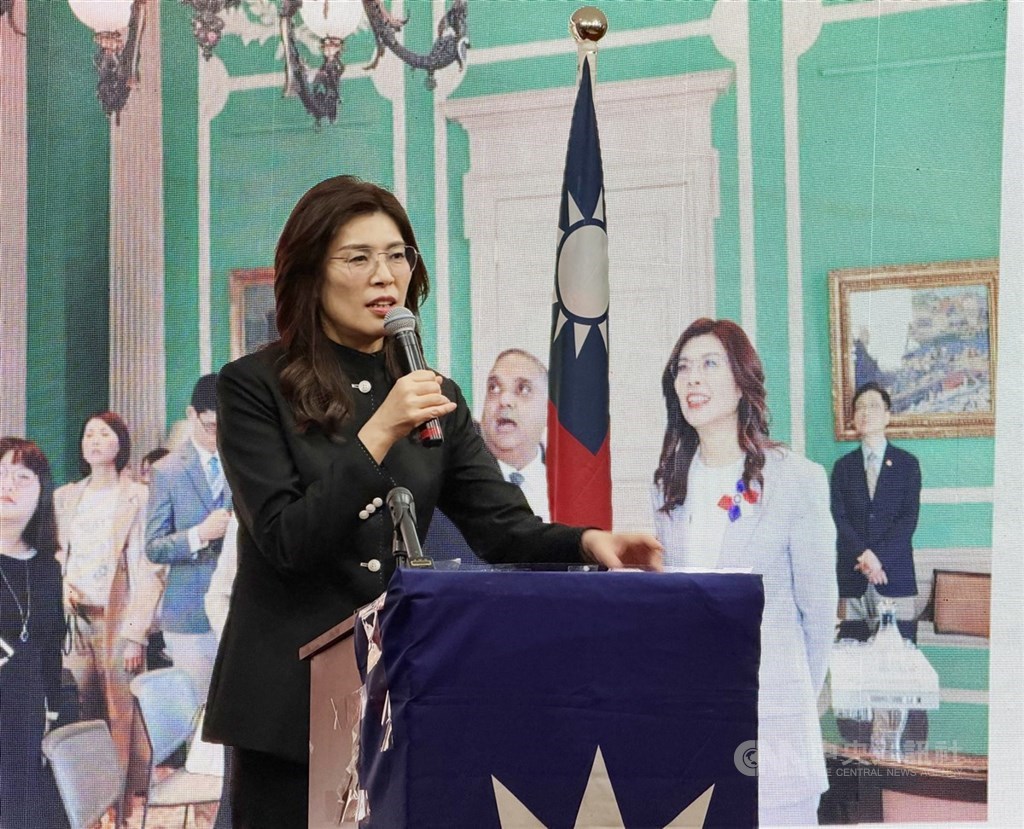
KMT Chairperson Lai visited the United States. Singapore's Straits Times recently published an in-depth analysis titled 'Charismatic but naive: Taiwanese opposition KMT chief's peacemaker pitch leaves US unimpressed,' highlighting that while Lai possesses personal charm, her narrative as a cross-strait peacemaker failed to resonate with American audiences. The article also notes Washington's skepticism toward her advocacy for enhanced engagement with Beijing.
On April 13, 2025, the Straits Times published the analysis in its 'News Analysis' section. It mentioned Lai's recent meeting with Chinese President Xi Jinping. The report observed a notably lukewarm response from Washington, with no high-level official reception extended to her.
Who did Lai meet during her visit? A planned meeting with President Trump did not materialize. Lai herself acknowledged this, stating it was 'always difficult.' More disappointing, however, was the cancellation of a scheduled meeting with White House National Security Council officials.
The KMT emphasized that all meetings with the US administration were strictly confidential, accusing certain media outlets of deliberate defamation. Lai did meet with US lawmakers, including Senator Dan Sullivan, Representatives Don Bacon and Young Kim. Sullivan is a member of the Senate Armed Services Committee, Bacon of the House Armed Services Committee, and Kim chairs the House Foreign Affairs Subcommittee on the Indo-Pacific.
The article highlighted Lai's warm reception among overseas Taiwanese communities, drawing over a hundred attendees at a banquet and attracting enthusiastic audiences at elite universities. Yet, 'her attempt to position herself as a cross-strait peacemaker is being closely scrutinized, with some viewing her arguments as unconvincing.' The piece notes that Washington largely views her push for deeper Beijing engagement with suspicion, even deeming her approach overly naive.
Dennis Wilder, a former NSC official now teaching at Georgetown and Texas A&M Universities, stated that Lai's articulation of cross-strait relations impressed some American listeners, but concerns persist that she might be used by Beijing. He suggested this reflects broader US doubts about Xi Jinping's genuine commitment to peaceful unification.
Wilder noted that some in Washington see Lai as diverging too far from traditional KMT positions, while others argue such views may be too narrow, given that many democracies have recently elected atypical leaders. Nevertheless, he stressed that the US should take her seriously, if only because she could become an effective tool for Beijing.
Bonnie Glaser, Director of the Indo-Pacific Program at the German Marshall Fund of the United States, stated that the idea of a Taiwanese leader negotiating simultaneously with Beijing and Washington to secure Taiwan's best interests is unrealistic.
Amanda Hsiao, Taiwan Lead at Eurasia Group, said Lai's trip is unlikely to change the minds of those already skeptical of her cross-strait and defense positions. 'Without a clearer defense strategy from the KMT, many in Washington will see Lai's optimism about managing cross-strait differences as overly naive.'
William Yang, Senior Northeast Asia Analyst at the International Crisis Group, observed that Lai is attempting a delicate balancing act between a pro-China stance and gaining Washington's approval. However, 'some of her statements during the trip may not have helped improve external perceptions of her positions and methods, as the claims she made under the banner of 'peace' lacked concrete substance to support them.'
The Straits Times is Singapore's leading English-language newspaper and the flagship publication of SPH Media.
FACT BOX
- Source: CNA (Central News Agency)
- Category: Taiwan
- Organizations: German Marshall Fund of the United States / Eurasia Group / International Crisis Group