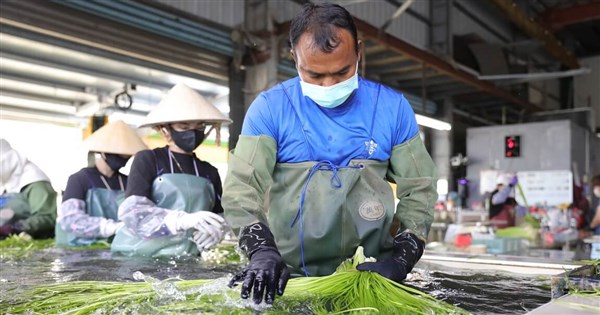
Yelian, one of the three treasures of Meinong District in Kaohsiung, is a green crop packaged in bundles that generates hundreds of millions of dollars annually. In recent years, the legal and systematic introduction of foreign workers has gradually reduced illegal labor and alleviated labor shortages, transforming rural culture and industrial structure. The once-tranquil Hakka village now features diverse languages, cuisines, and lifestyles.
By Central News Agency reporters Hung Hsueh-Kuang and Chang Yi-Lien, Kaohsiung, June 14 — Standing waist-deep in water, 45-year-old Thai migrant worker Kangcai skillfully harvests yelian, occasionally pausing to gaze at the distant green mountains of Meinong. About 80% of Taiwan’s yelian is produced in Meinong, and for Kangcai, this foreign rural landscape—reminiscent of his hometown in Thailand—has become his second home.
Yelian (water morning glory) originally grew wild in Meinong Lake. Through refined and large-scale farming practices, its edible long stems have become prized for their crisp texture and sweet flavor, making it a staple on Taiwanese dining tables.
According to Kaohsiung City’s Bureau of Agriculture, Meinong produces about 80% of Taiwan’s annual yelian output of 22,900 metric tons. In 2025, cultivation area in Meinong reached 223 hectares, about 75% of the national total. The annual output value in Meinong is approximately NT$540 million, accounting for 80% of the national total. Based on crop conversion registration data from Meinong District Office, around 400 households currently grow yelian.
Taiwan’s rural areas face a chronic labor shortage. Meinong’s yelian industry has increasingly relied on legally imported agricultural workers to fill the gap. These migrant workers, who spend long hours in water, not only sustain this labor-intensive industry but are also quietly reshaping the traditional Hakka village into a multicultural community.
Walking through Meinong today, one sees not only traditional Hakka rice noodles but also Vietnamese banh mi and Thai restaurants as part of everyday life. 'Vietnamese people are everywhere in Meinong,' says local farm owner Ms. Fan. In supermarkets and night markets, Southeast Asian languages are commonly heard, and even fried chicken stalls display multilingual signs. During Lunar New Year, migrant workers dress in traditional attire and visit Fo Guang Shan Temple together, forming their own unique cultural practices.
Reflecting on the labor shortage history of Meinong’s yelian industry, Ms. Fan, whose family shifted from a metal workshop to yelian farming in 2002, notes that the job requires long hours in water, with risks of cuts and skin diseases, making it unattractive to local youth. Before migrant labor was legalized, farm owners and undocumented workers often formed close, almost revolutionary bonds out of necessity.
Ms. Fan recalls instances where workers were caught by police, and farm owners immediately paid fines to ensure their safe return home. 'After working together for so long, you develop feelings. At the very least, we want them to leave Taiwan with good memories.'
With the legalization of migrant labor, rural areas have gained a stable workforce. Ms. Fan marvels at the resilience and ingenuity of these workers—they buy their own arm protectors, attach floaters to harvesting knives, catch fish in ditches for extra meals, and hang hammocks under trees. Over time, trust grows, and workers even help patrol fields voluntarily.
Thai worker Kangcai exemplifies this cross-border bond. Working tirelessly to support his family back home, he is now on his sixth consecutive contract. Starting early in the morning, he works nonstop until evening with only a short midday break. Despite skin rashes from prolonged water exposure and premature graying from overwork, he never complains. His daily routine: swallowing a vitamin before work and washing and applying medicine after—simple yet disciplined self-care.
Touched by his diligence, Ms. Fan’s family treats him like one of their own—buying him a scooter for transportation, arranging driving lessons, and even personally funding round-trip tickets and gifts for his visits home. 'I’m truly grateful you came here, that you appeared in our lives,' Ms. Fan says emotionally. The farm plans to train Kangcai as a technical mentor, helping him settle permanently in Taiwan.
'Meinong feels just like my hometown in Thailand. My Taiwanese employer treats me with such care, like family,' Kangcai shares. While some of his countrymen left due to difficulty adapting, he finds peace in the mountain views. Homesickness is inevitable, but he transforms it into responsibility. For him, seeing his wife and children’s smiles on his phone screen during breaks makes all fatigue vanish.
At the end of the interview, Kangcai sends his distant family a blessing using his favorite English word: 'Happy.' He hopes to responsibly support his family and enable everyone to live a simple, contented, and 'Happy' life.
FACT BOX
- Source: CNA (Central News Agency)
- Category: Taiwan