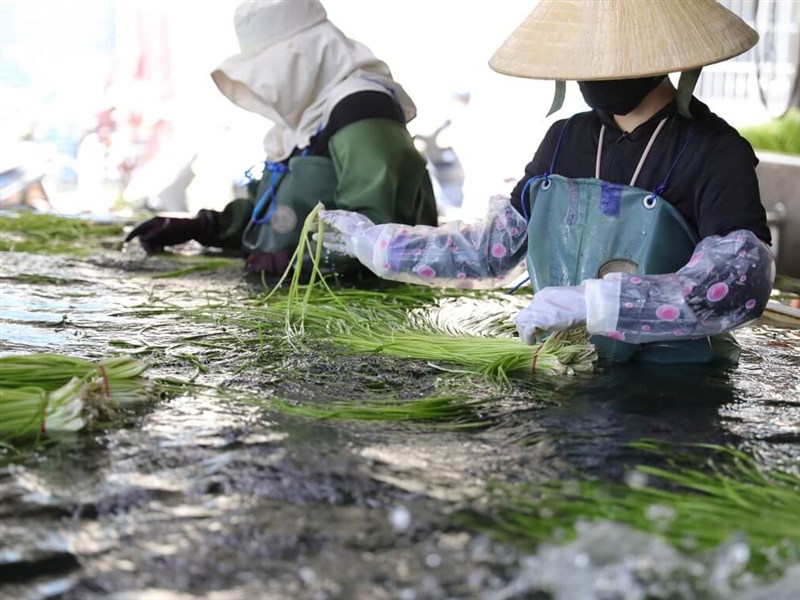
Water spinach, known as one of the 'Three Treasures of Meinong' in Kaohsiung, is a high-value crop often referred to as 'green gold,' generating hundreds of millions of dollars annually. In recent years, the systematic introduction of legal foreign workers has gradually reduced illegal labor and alleviated labor shortages, triggering transformations in rural culture and industrial structure. The once-tranquil Hakka village now features diverse languages, cuisines, and lifestyles.
This special report explores how labor shortages are reshaping a rural community, documenting the journey through the personal stories of migrant workers, on-site observations of rural transformation, and discussions on the sustainability of the agricultural industry.
According to CNA reporter Chang Yi-Lien, reporting from Kaohsiung on the 14th, signs of foreign-owned businesses are increasingly visible in Meinong. Liu Bi-Hua, who once worked in China and later returned home to manage agricultural labor affairs, has witnessed the village's transformation. However, she emphasizes that balancing regulatory compliance and climate change pressures remains an unavoidable challenge for the future of rural development.
Born and raised in Meinong, Liu graduated from university and worked in Pingtung and Taipei before taking a managerial role in China. 'Back then, I was just out to learn everything,' she recalls. In 2015, she returned home due to a family illness, coinciding with the Ministry of Agriculture's launch of the 'Agricultural Master' program in 2017 and the introduction of the 'Outreach Agricultural Labor Service' in 2019. At a time when Meinong faced a critical labor shortage and lacked HR expertise, Liu was recommended by an acquaintance and joined the Meinong Farmers' Association with her background in production and facility management.
While managing complex domestic and international labor affairs, Liu also studied diligently, passing the farmers' association's full-time staff exam in 2024 as the 'oldest candidate.' Though she has since stepped down from leading the outreach program and moved to other roles, she remains a vital 'information hub' in the community. Farmers and association staff still turn to her for advice, and she continues to contribute her accumulated experience to rural transformation.
Since returning home to manage foreign agricultural labor, Liu has observed how institutional changes are reshaping the village. 'In the past three years, Vietnamese restaurants, buffet-style eateries, and convenience stores have multiplied,' she notes. Even at the Kaohsiung City Government's 'Meinong Wild Vegetable Festival,' migrant workers now proudly wear traditional attire from their home countries. 'It's truly beautiful,' she says, as the once-simple Hakka farming village embraces cultural diversity.
Liu points out that the 'Outreach Agricultural Labor Service' program has been in place for nearly seven years. While administrative procedures have been established, the rural community's long-standing reliance on personal relationships and tacit understanding has made the shift toward formal, regulation-based management challenging. Adjustments are still ongoing.
'The program follows the Labor Standards Act, but in practice, it doesn't always fit rural realities,' Liu explains. Farming schedules are highly dependent on weather and harvest cycles, vastly different from fixed working hours. Applying labor laws rigidly often leads to compliance difficulties. Minor management oversights can result in fines of hundreds of thousands of dollars, or even cause migrant workers to leave farms for other industries.
For example, during harvest season, labor is needed from early morning until late night. Strict adherence to labor hour regulations makes it impossible to meet agricultural demands. 'It's simply impractical,' Liu says. She urges relevant authorities to consult experts and scholars to develop a labor framework that truly fits the rhythms of farming and can be effectively implemented.
After nearly seven years of trial and error, Liu is heartened to hear farmers say the program has 'solved' labor shortages. 'Those two words carry great weight,' she reflects. While labor stability and production are gradually becoming more legal and sustainable, she also highlights challenges: extreme rainfall and typhoons due to climate change frequently damage water spinach farms, and the high costs of excavating ponds and reclaiming fallow land—often amounting to millions of dollars—continue to drive up operational expenses.
Liu notes that while farming in Meinong generates significant revenue, profits fluctuate yearly due to weather, market conditions, and labor costs. Achieving balance among regulations, labor shortages, and climate pressures remains the key challenge for the region's future development. (Edited by Huang Ming-Hsi)
FACT BOX
- Source: CNA (Central News Agency)
- Category: Taiwan