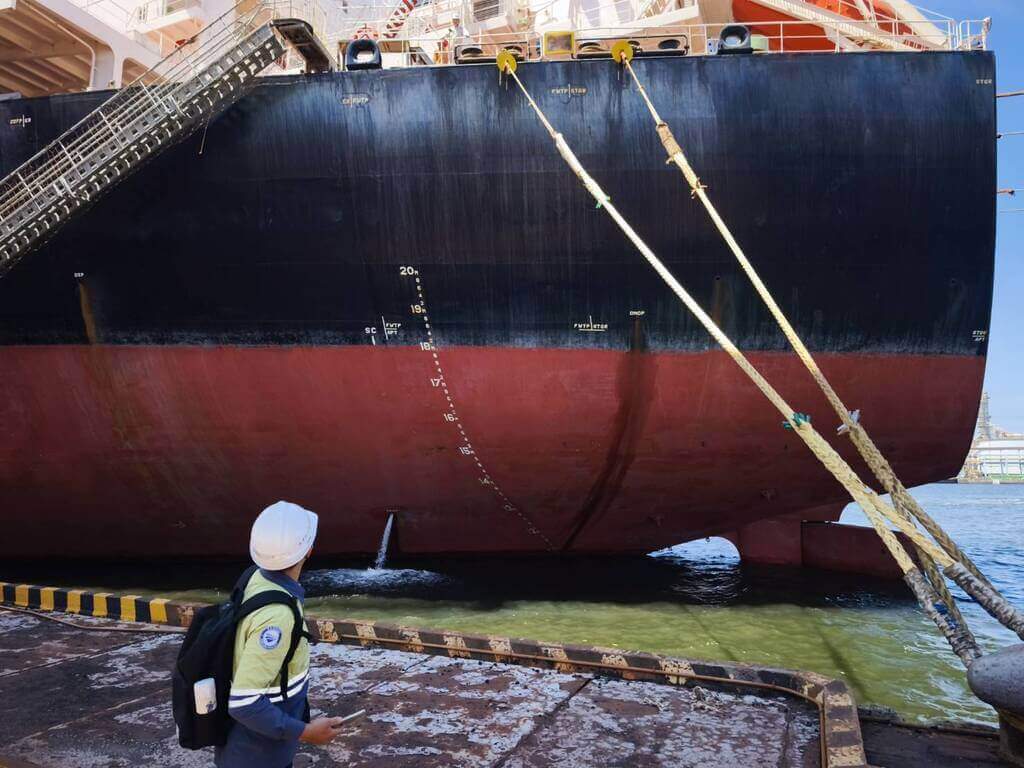
(Taipei, April 14 — Reporter Yu Hsiao-han) A Hong Kong-registered bulk carrier collided with a terminal during departure operations at Kaohsiung Port last year, damaging its rudder and the dock, and causing a nearby workboat to capsize and sink. The Aviation Safety and Reliability Council (ASRS) recently released its final investigation report, issuing five safety improvement recommendations, including enhancing pilot capabilities.
The Hong Kong-registered bulk carrier 'Ming Hong' struck the terminal while leaving Kaohsiung Port last year, affecting two vessels: the 'Taiwan Ship No. 8' sank, and 'Taiwan Ship No. 12' broke its mooring lines. Fortunately, there were no casualties or oil spills.
According to the ASRS final report, during departure from the second harbor terminal waters in Kaohsiung Port, the 'Ming Hong' entered a continuous astern movement before establishing sufficient lateral clearance in a confined water area, reducing the time and space available for safe maneuvering corrections.
The ASRS stated that during astern propulsion, the vessel began to turn right due to the propeller's transverse thrust and the tugboat pushing the port bow. However, the pilot only noticed this when the distance between the stern and the terminal corner was about one nautical mile and the astern speed reached approximately 2.5 knots, at which point emergency corrective actions were taken.
The investigation also found that although basic information exchange occurred between the pilot and the captain, critical aspects such as lateral separation distance, timing, and procedures for initiating astern propulsion were not clearly discussed or agreed upon. As a result, when actual operations gradually deviated from the pilot’s initial plan, neither the captain nor the pilot detected the deviation early enough to adjust the maneuvering approach.
During the astern movement phase, the bridge team primarily reported vessel speed without integrating essential situational data such as ground track, heading, and relative position to the terminal. This prevented the pilot and captain from promptly recognizing the vessel’s heading and track deviations. The captain also failed to use available navigation information to provide timely alerts, undermining the bridge team’s monitoring function during the evolving maneuvering situation.
In response, the ASRS issued five recommendations: to the Kaohsiung Port Pilot Office, urging enhanced pilot training in maneuvering judgment and risk identification during port entry and exit operations, and strengthening the mechanism for continuous information exchange between pilots and captains.
To Ming Wah Shipping Company (Hong Kong), the ASRS recommended reviewing existing safety management systems and berthing/unberthing procedures to ensure ship captains maintain continuous awareness of vessel dynamics during pilotage. The company should also evaluate the practical implementation of current operational procedures and explore ways to strengthen compliance.
For the Maritime and Port Bureau, the ASRS recommended reviewing current pilotage mechanisms to enhance pilots’ maneuvering judgment and risk identification capabilities, and to consider establishing relevant assessment, training, and supervision systems. (Edited by Wu Su-jou) 1150614
FACT BOX
- Source: CNA (Central News Agency)
- Category: Survey
- Dates in source: 1150614