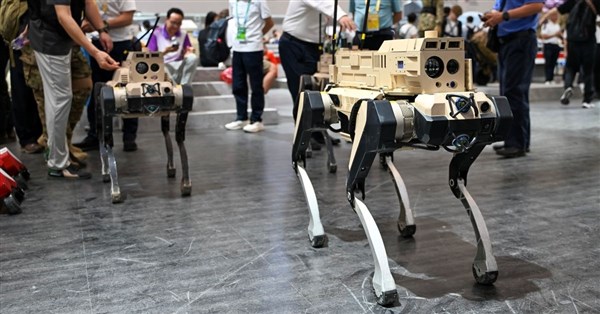
(CNA reporter Hou Tzu-Ying, Washington, 14th special report) Amid China's escalating military threats toward Taiwan, U.S. experts recently told CNA reporters that China is developing 'machine wolves'—quadruped ground robots that could be deployed in the early stages of a Taiwan Strait conflict instead of soldiers, for reconnaissance of landing zones and logistics transport. Beijing may thus perceive lower political costs for initial casualties; Taiwan should adopt a multi-layered defense.
Craig Singleton, Senior Director of the China Program at the Washington-based think tank 'Foundation for Defense of Democracies' (FDD), and Jack Burnham, Senior Research Analyst, recently released a report titled 'China’s War Wolves: From Commercial Tech to Combat Power'.
The report summary indicates that the Chinese People's Liberation Army's (PLA) embrace of 'intelligentized warfare' reflects its systematic integration of artificial intelligence (AI), robotics, and unmanned systems into frontline operations.
Singleton recently told reporters in an interview that China is developing quadruped ground robots resembling 'machine wolves', roughly the size of large dogs, equipped with cameras, sensors, LiDAR, and onboard computers. Some 'machine wolves' can also transport supplies, carry weapons, conduct terrain reconnaissance, and even operate in swarms. These have already appeared in PLA training footage and Chinese state media, 'indicating that the Chinese military is testing how to deploy them in actual operations, with a clear focus on Taiwan'.
He analyzed that Taiwan is the most likely real-world scenario where China would employ these systems. A cross-strait invasion would be extremely dangerous, with intense beachhead combat, urban warfare, communication disruptions, and heavy casualties in the first few hours. The use of robots would allow Beijing to send machines ahead instead of soldiers.
He pointed out that these robots could be used to scout landing zones, transport supplies, map terrain, and clear obstacles, helping China preserve manpower during the most dangerous phase of a conflict. 'This truly changes the trajectory of a potential war in its early stages'.
Singleton analyzed that robots do not eliminate risk but 'reallocate risk'. If machines absorb the initial danger, Beijing may perceive lower political costs for early casualties.
Regarding how Taiwan should respond, Singleton said Taiwan understands drones, 'but robotics is the next evolutionary stage'. Taiwan needs affordable, multi-layered defense mechanisms such as detection, jamming, electronic warfare, and urban anti-robot drills.
For countermeasures, he recommended that Taiwan prioritize efforts such as enhancing the ability to quickly detect and identify these unmanned ground systems, since robots heavily rely on sensors and communications. By jamming signals, navigation and communication links can be disrupted, disabling or degrading many robotic systems. He also urged building a multi-layered defense system so that if one method fails, another can immediately compensate.
As Taiwan faces growing Chinese threats, the National Chung-Shan Institute of Science and Technology (NCSIST) showcased three types of robotic dogs in early June—'reconnaissance', 'firepower', and 'LiDAR' models—developed based on the U.S. company Ghost Robotics' platform. These could be used in frontline reconnaissance, patrol, and high-risk missions in the future.
Singleton analyzed that robotics indeed affects risk assessment. If China believes machines can reduce casualties, its leadership may perceive lower political costs in the war's first phase. This does not guarantee conflict, but it does change how risks are weighed. 'That’s why anti-robot technology is so crucial for Taiwan’s deterrence and self-defense'.
Regarding U.S.-Taiwan cooperation, he suggested that the U.S. strengthen partnerships with trusted local Taiwanese robotics companies, streamline procurement processes, and support Taiwan’s capabilities to counter unmanned systems. He emphasized that most importantly, both sides must assume 'robotics will be part of the initial phase of (Taiwan Strait) conflict, and all preparations must be in place before a crisis occurs'.
Singleton also said Taiwan has access to the world’s best and most advanced chips. If Taiwan successfully integrates its local robotics firms with semiconductor manufacturers, it could develop more advanced robots than China. (Edited by Tang Sheng-Yang) 1150615
FACT BOX
- Source: CNA (Central News Agency)
- Category: Taiwan
- Organizations: Ghost Robotics