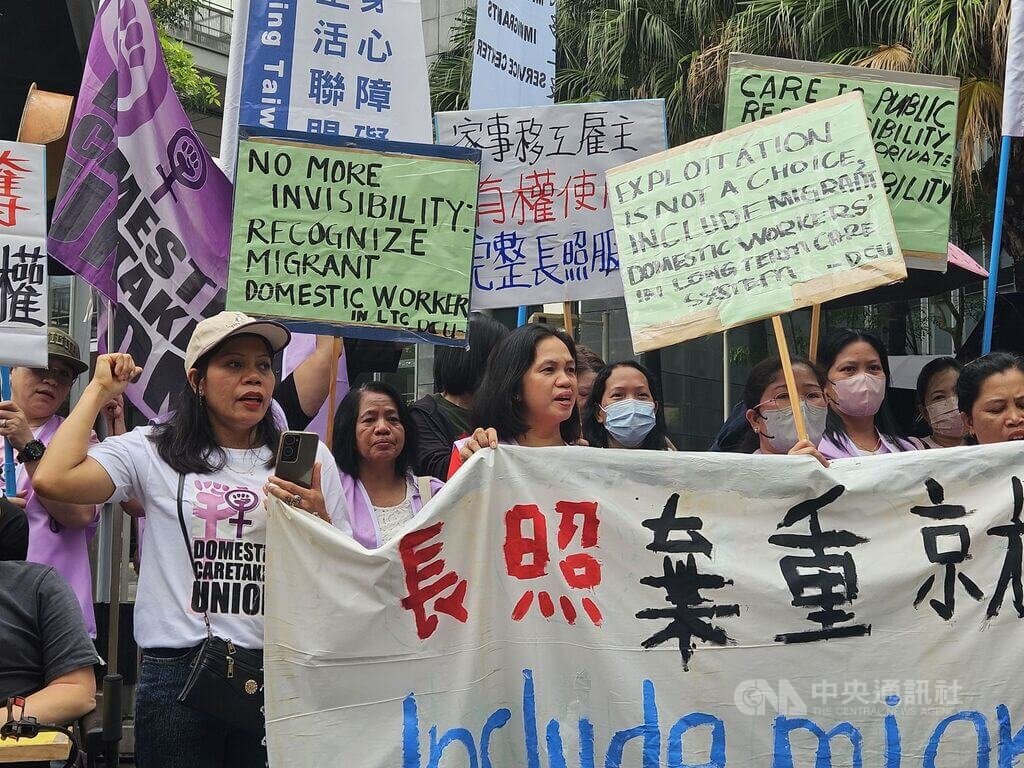
(CNA reporter Chen Chieh-ling, Taipei, June 14) Nearly 100 domestic migrant workers took to the streets in heavy rain today, protesting that due to 24-hour care demands for the elderly and people with disabilities, they have become scapegoats deprived of rest. They called for the inclusion of migrant workers in long-term care (LTC) human resources. The Ministry of Health and Welfare (MOHW) responded that the issue involves broad implications and requires careful evaluation.
Groups including the Migrant Workers’ Rights Network, Awakening Foundation, and Taiwan Self-Advocacy Alliance for People with Disabilities gathered in front of the Ministry of Health and Welfare to petition. They emphasized that rest days for domestic workers are a fundamental labor right, and care responsibilities should be collectively borne through public resources. They urged authorities to address the long-standing disconnect between the long-term care system and the foreign home care worker system, advocating for the integration of domestic migrant workers into the LTC workforce.
Napia, a representative from the Taiwan Care Workers’ Industrial Union, spoke in her native language on behalf of thousands of Indonesian home caregivers. She said that live-in caregivers provide 24-hour service daily, facing unclear working hours, difficulty obtaining rest days, interrupted rest periods, and lack of health protection. Many workers suffer from severe fatigue, mental stress, and chronic illnesses.
"Our right to medical care is often delayed," Napia said. With no one to replace them, the 24/7, seven-day work schedule is not only inhumane for workers but also affects the quality of care for the elderly and people with disabilities. Care work is a professional job that deserves professional protection. They demand equal legal safeguards, humane working hours, and reasonable rest rights.
Wu Ching-ju, researcher at the Taiwan International Workers’ Association, said that although LTC budgets have increased annually, most resources are allocated to day care centers and community stations serving mild to moderate disability cases. The proportion of severely disabled individuals using LTC subsidy services has not increased but decreased. Many still rely on family members and foreign caregivers for care. If a household depends entirely on one caregiver, any leave creates a critical gap.
Wu noted that as privately hired laborers, domestic migrant workers are pushed to the front line, bearing all care responsibilities, yet their working conditions remain unprotected by any labor laws. Nearly 40% have no fixed rest days. Even though the Ministry of Labor has introduced short-term substitute care services, local respite care services often face early budget exhaustion, manpower shortages, and matching difficulties, rendering the policy a visible but inaccessible resource.
Wu added that civil society has long advocated for integrating domestic migrant workers into the LTC workforce, with LTC institutions becoming the formal employers of these workers. Current private employers would then be relieved of employer responsibilities and revert to being service users. Institutions would dispatch migrant and care workers based on user needs, providing stable and professional home care services, while ensuring migrant workers are protected under labor laws.
Wu Hsi-wen, Deputy Director of the Long-Term Care Administration at MOHW, told the media that currently, home caregivers provide one-on-one, round-the-clock care. If the system shifts to institutional employment, the Labor Standards Act would apply. For those with 24-hour care needs, future services might require shift-based models, with different personnel providing continuous home care—resulting in a significantly different service model.
Wu Hsi-wen said that shifting from one-on-one continuous care to shift systems requires comprehensive planning of service design and manpower allocation. It also involves the Employment Services Act, as foreign workers must not undermine the employment rights and working conditions of local workers. Therefore, a holistic assessment of impacts on all stakeholders is necessary. MOHW will continue to gather opinions and work with the Ministry of Labor to seek solutions. (Editor: Wu Su-jou) 1150614
Stand with the truth. Your support safeguards press freedom.
Download the CNA "Breaking News" app to stay updated.
Text, images, and videos on this site may not be reproduced, broadcast, or transmitted without authorization.
FACT BOX
- Source: CNA (Central News Agency)
- Category: Taiwan