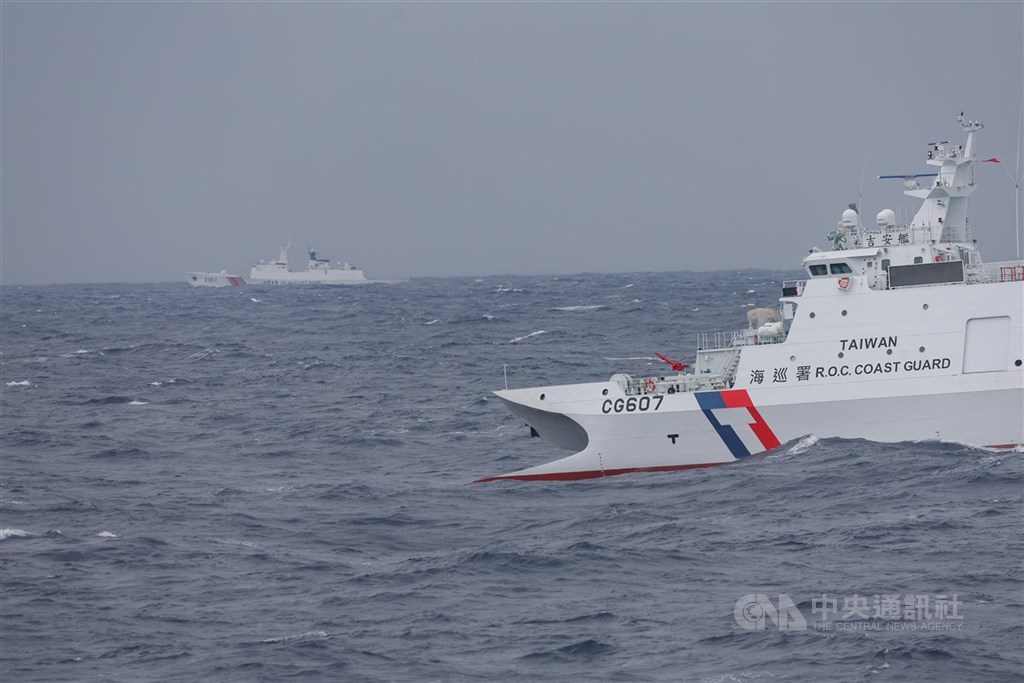
(Central News Agency reporter Wen Gui-xiang, Taipei, June 14) In recent years, China has continuously expanded its military activities in the Indo-Pacific region and strengthened information manipulation and institutional frameworks. National security experts indicate that Beijing is increasing regional pressure through gray-zone operations and military deployments, while simultaneously attempting to build a rules system distinct from the current international order, advancing its strategic goals across security, economic, and information domains.
Regarding China's recent downgrading of its participation in international security dialogue platforms—for example, not sending its defense minister to this year's Shangri-La Dialogue—national security experts note that although Taiwan or China are rarely directly mentioned at such meetings, the core discussions among nations revolve around Indo-Pacific security, island chain defense, and regional deterrence capabilities, which are essentially responses to current regional security challenges.
Experts point out that while China emphasizes peace, cooperation, and common development, it continues to advance military deployments and gray-zone operations in areas such as the Taiwan Strait, East China Sea, and South China Sea, exerting pressure on countries like Taiwan, Japan, and the Philippines. This inconsistency between words and actions has heightened neighboring countries' vigilance toward China's strategic intentions.
China's active hosting of the Beijing Xiangshan Forum has raised questions about whether it aims to rival the Shangri-La Dialogue. Security experts believe that the Shangri-La Dialogue, long organized by a UK-based think tank with international credibility, has become a key platform for security exchanges. In contrast, a forum dominated by a single country, lacking diverse viewpoints and open discussion, is unlikely to replace existing international security dialogue mechanisms.
Experts observe that China appears to be attempting to establish a new rules system under its leadership, aiming to create an operational model outside the current international order that serves its own interests. However, countries are more concerned about whether China is willing to abide by existing international norms and whether its actual actions align with its declared goal of peaceful development.
On regional developments, experts note that the Philippines' recent shift in stance toward China reflects not only disputes over South China Sea sovereignty but also the impact of China's ongoing militarization of islands and aggressive maritime actions on neighboring countries' security and public perception. As regional nations' awareness of security risks grows, security cooperation and information exchange among them are becoming increasingly important.
Moreover, experts state that China's influence on democratic nations' elections and public opinion has become a shared challenge. Beyond traditional political influence operations, recent years have seen increasing cases of overseas information manipulation and interference affecting democratic societies, with some instances showing coordinated efforts between Chinese and Russian information operations—warranting continued monitoring.
In response to China's multi-front advances in military, information, and institutional domains, democratic nations are gradually strengthening cooperation and coordination mechanisms to safeguard peace, stability, and the existing international order in the Indo-Pacific region. (Edited by Lin Ke-lun) 1150614
FACT BOX
- Source: CNA (Central News Agency)
- Category: Taiwan