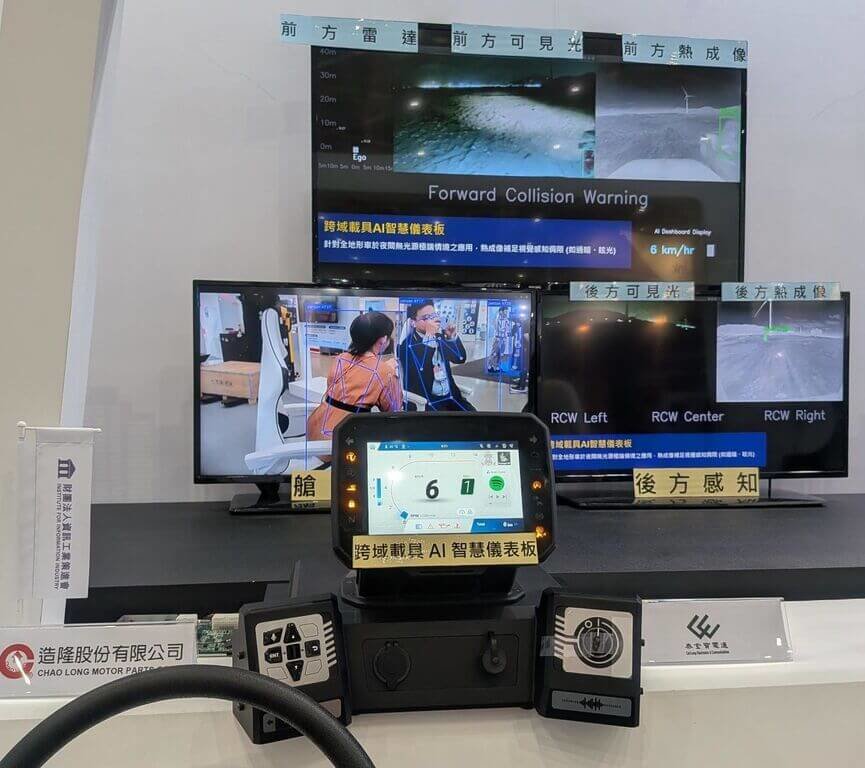
All-terrain vehicles (ATVs), often referred to as off-road or beach vehicles, operate in rugged environments such as beaches and forests, where safety is a critical concern. The III Software Institute has developed Taiwan’s first AI-powered 'Cross-Domain Vehicle Smart Safety Alert System' for ATVs, offering features such as forward collision warnings and rider fall detection. This innovation has enabled instrument manufacturer Zhaolong to secure overseas orders exceeding NT$100 million, demonstrating Taiwan’s advanced capabilities in intelligent safety technology for specialized vehicles.
ATVs, also known as beach vehicles, are designed to traverse challenging terrains including beaches, forests, and mountain trails. Beyond recreational and outdoor sports use, they are also employed in inspection and rescue operations. However, due to limited visibility and difficult terrain, demand for enhanced safety technologies continues to grow.
With support from the Ministry of Economic Affairs’ Industrial Technology Division, the III Software Institute has long been dedicated to intelligent vehicle technologies. It has established Formosa Dataset, Taiwan’s largest deep learning database for autonomous driving, and plays a key role in technology integration. This time, it partnered with Zhaolong and collaborated with AI and automotive electronics firms including Kneron, Zongying, Taijinbao, Wanlone, and Ruike. Together, they created a comprehensive solution integrating smart dashboards, AI chips, sensor modules, and system integration, using AI to enhance safety for specialized vehicles.
Discussing the development origin, Chu Bo-Jia, Director of the Mobility Safety and Trust Center at the III Software Institute, explained that at the end of last year, Zhaolong identified strong potential in overseas markets for specialized vehicles and requested enhanced smart dashboard functionality. Leveraging its existing AI database and industry ecosystem, the team developed the 'Cross-Domain Vehicle Smart Safety Alert System' within just over four months. Using AI-based multimodal sensor fusion and edge computing technology, the system delivers forward collision warnings, rear-end collision alerts, blind-spot detection, and rider fall detection.
Chu revealed that the team’s long-term accumulation of data and technical expertise significantly shortened development time. 'We spent only about one to two months on actual R&D to complete the proof of concept (PoC). Otherwise, setting up hardware, labeling data, and training models typically takes six months to a year,' he said, noting this accelerated timeline helped the company expand into international markets more quickly.
The term 'cross-domain vehicle' indicates that this AI perception and recognition technology can be applied in the future to various vehicles across land, sea, and air—including ATVs, jet skis, and drones. Currently, the system has been validated on ATVs.
Liu Wei-Chen, Group Leader of the Intelligent Driving Division at the III Software Institute’s Mobility Safety and Trust Center, analyzed that ATVs primarily operate in environments such as forests, off-road trails, and beaches, often lacking street lighting and facing challenges like low visibility and sand obstruction. In such conditions, standard cameras have limited recognition capabilities. To address this, the team integrated multiple sensing components—including visible light, radar, and thermal imaging—to enhance overall perception.
Liu further explained that when the system detects people, animals, or vehicles ahead or behind, the AI assesses risk by combining speed and distance data. If a collision is likely, a warning signal is immediately displayed on the dashboard. Blind-spot detection targets areas outside the driver’s line of sight, using multimodal sensing and AI recognition to identify approaching vehicles, people, or animals and trigger alerts.
Regarding the rider fall detection feature, Liu explained that riding specialized vehicles carries inherent risks, especially on jet skis. 'During turns, combined with wave impacts, rear passengers can easily be thrown off,' he said. To address this, a rear-facing camera is installed to detect whether a rider has left their seat using multimodal sensing, enabling real-time alerts.
Liu noted that this Taiwan-first 'Cross-Domain Vehicle Smart Safety Alert System' has already helped Zhaolong connect with international clients, securing over NT$100 million in overseas orders. The system is expected to be integrated with smart dashboards, enter pilot production next year, and achieve full-scale mass production by 2028.
The III Software Institute team stated that it will continue expanding intelligent safety systems to more vehicle applications, supporting industry players through technology development and supply chain collaboration, further strengthening Taiwan’s competitiveness in the global intelligent specialized vehicle supply chain.
FACT BOX
- Source: CNA (Central News Agency)
- Category: New Product