By reporter Shirley Shih, Taipei, June 13 (Special Report) — Osman Çubuk, an Islamic cultural scholar long settled in Taiwan, spoke with the Central News Agency, reflecting on the transition from the solemn Quranic recitations of the Middle East to the diverse religious landscape of Taipei’s streets. Crossing cultural and religious boundaries, he has witnessed the evolving understanding of Islam in Taiwanese society—evidenced by the growing number of halal restaurants and prayer spaces, making life easier for Muslims and increasing their visibility and acceptance.
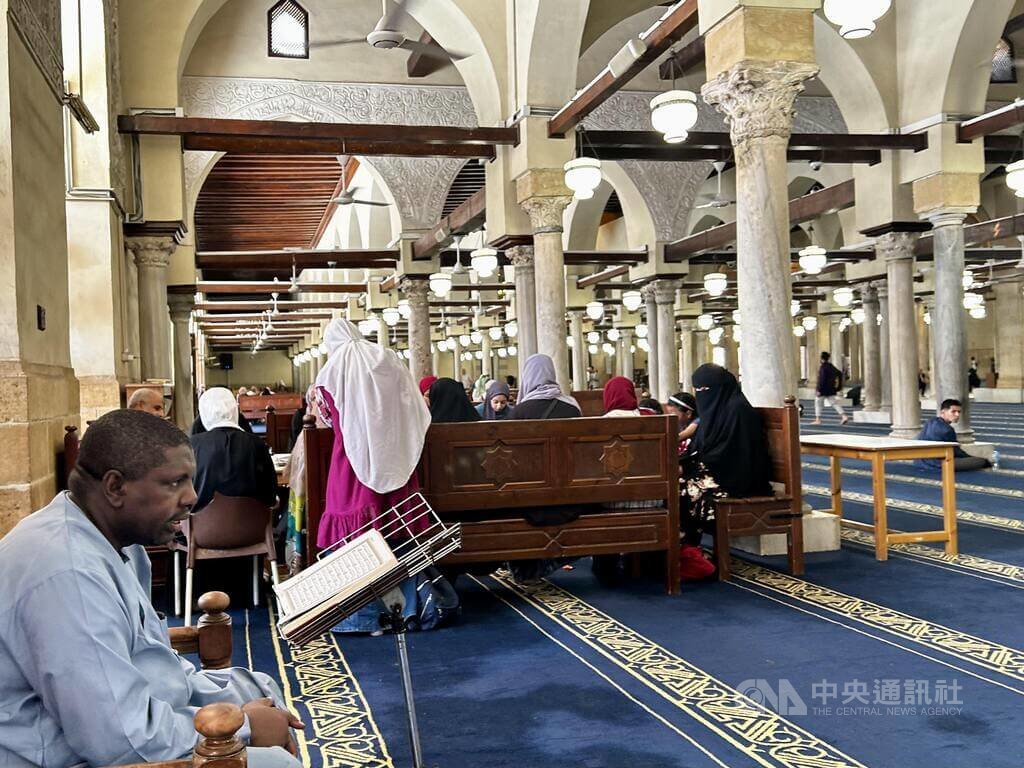
After completing high school in Turkey, Çubuk pursued higher education in Egypt, enrolling at Al-Azhar University (Azhar University), a revered institution in the Muslim world. Recalling his time there, Çubuk said: "Al-Azhar University is the oldest and most authoritative Islamic academic center in the Arab world. Many religious doctrines and publications must be approved by it."
However, studying at this prestigious institution was far from easy. Çubuk recalled that life in Cairo was stressful, with most students requiring six to seven years to graduate due to only one exam opportunity per academic year—leaving no room for failure.
Çubuk was among the rare few who completed the rigorous program in just four years. Reflecting on that period, he described it as difficult yet profound: "Life was simple—just classes and going home. But the entire city was immersed in a religious atmosphere."
He recalled that Quranic recitations played continuously in Cairo’s streets, shops, and buses. The call to prayer echoed through neighborhoods via loudspeakers from mosques. "It was an immersive faith environment," Çubuk reminisced.
After graduating from Egypt, Çubuk chose to come to Taiwan to study religious studies, aiming to better understand Eastern belief systems. "I wanted to learn how different religions perceive the world," he said.
He earned a Ph.D. from National Chengchi University’s Graduate Institute of Development Studies, specializing in religious studies. Today, he serves as an executive director of the Taiwan Islamic Studies Association and a part-time assistant professor in the Department of Foreign Languages at National Taiwan University, teaching Arabic, Turkish, and courses on Islamic history and culture.
When comparing Islam with commonly practiced religions in Taiwan—such as Buddhism, Taoism, and folk beliefs—Çubuk notes fundamental differences. Islam is a monotheistic religion emphasizing divine revelation and divine law, whereas Eastern religions tend to be polytheistic or philosophical systems.
He further explains that Islamic religious practice carries strong social dimensions—such as communal prayers, zakat (charitable giving), and the Hajj pilgrimage—all emphasizing community bonds and social responsibility. In contrast, Eastern religions emphasize personal cultivation and spiritual enlightenment, such as meditation and retreats.
In short, Çubuk says, "Islam is a complete way of life"—religion encompasses daily living, rather than being just a part of it. Thus, Islam governs not only acts of faith but also daily diet, economics, politics, and social relationships.
Meanwhile, Taiwan’s prevalent religious forms—Buddhism, Taoism, and folk beliefs—coexist in a pluralistic and flexible manner, with fewer rigid demands on personal life, contributing to a more adaptable and diverse lifestyle.
Having lived in Taiwan for over two decades, Çubuk has observed cultural gaps leading to misunderstandings. As Islam remains relatively unfamiliar in Taiwan, many people hold limited or stereotypical views—frequently asking why Muslims cannot eat pork, must fast for a month, or practice polygamy.
However, with increasing globalization, migration, and Taiwan’s New Southbound Policy, Çubuk has also witnessed a positive shift in societal awareness. "Compared to 20 years ago, there’s been significant improvement. Today, it’s common to see female migrant workers and international students wearing hijabs on Taipei streets. Halal restaurants and prayer spaces are increasingly available, making life more convenient for Muslims and enhancing their visibility and understanding in society."
Nonetheless, Çubuk identifies a growing concern: the Muslim community in Taiwan remains small, and there is a lack of Islamic educational resources. Without a comprehensive religious education system, the transmission of Islamic faith to the next generation may be at risk.
For Çubuk, the key to intercultural dialogue lies not in emphasizing differences, but in understanding the underlying value systems. "Every religion has its own complete worldview. What matters is whether people are willing to understand one another."
In Çubuk’s eyes, religion is not merely belief, but a way of understanding the world and others. From Turkey to Cairo, and from Cairo to Taipei—Çubuk’s journey across regions and faiths has made him a bridge connecting diverse cultures in Taiwan. (Editor: Tang Sheng-yang) 1150613
FACT BOX
- Source: CNA (Central News Agency)
- Category: Taiwan