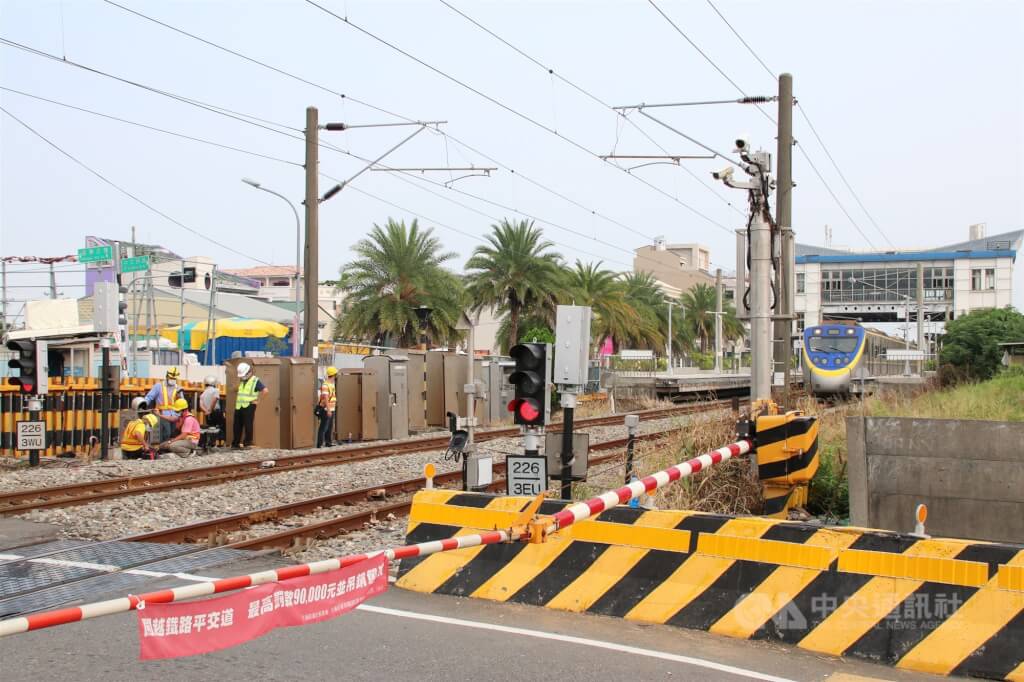
(Taipei, June 13, reporter Huang Chiao-wen) Taiwan Railways Administration (TRA) currently operates 415 level crossings across Taiwan. To improve safety and enhance protective measures, the Ministry of Transportation has announced a draft amendment stating that, in principle, no new level crossings will be added to existing railway lines. TRA has invested NT$400 million to install obstacle detection systems at 313 locations, with the remaining 84 expected to be completed by 2041 (Minguo Year 120).
This week, the Ministry of Transportation announced a draft amendment to the "Regulations on the Installation Standards and Cost-Sharing of Railway Grade Separations and Level Crossing Protection Facilities." The Railway Bureau explained via text message that, considering environmental changes and repeated level crossing accidents, the amendment aims to improve safety, enhance protective equipment, clarify classification and maintenance responsibilities for level crossings, and align the regulation's name with the authorizing provisions of the Railway Act. The revised regulation will be renamed the "Standards and Cost-Sharing Measures for the Installation of Railway Grade Separations and Level Crossing Protection Facilities."
Of TRA's 415 level crossings, approximately 350 are located on main lines. Statistics show 11, 9, and 7 accidents occurred at main line crossings in 2023, 2024, and 2025 (Minguo Years 112–114), respectively. The Railway Bureau aims to achieve a zero-accident goal through related improvement projects.
The Railway Bureau stated that, due to higher train speeds in electrified sections of the Western and Eastern Trunk Lines, level crossings will be gradually eliminated through grade separation projects. The underground railway projects in Tainan and Kaohsiung serve as examples, with one of their benefits being the elimination of level crossings. However, as grade separation involves extensive coordination, it will be progressively implemented alongside related plans.
The draft amendment states that, considering level crossing accidents as high-risk factors in railway operations and referencing Germany's Railway and Road Grade Crossing Act, no new level crossings will be built on existing railway lines as a general principle. However, recognizing that multiple railway construction projects are ongoing in Taiwan, the amendment retains the current level crossing installation standards through a proviso clause.
The amendment introduces two new subcategories for Type III level crossings: Type III-A and Type III-B. It also mandates that railway operators evaluate the barrier gate coverage area and develop obstacle detection equipment installation plans. Barrier gates should block both directions of traffic lanes, shoulders, and sidewalks. Where full coverage is unachievable, railway operators must submit justification and supporting measures or improvement plans.
The Railway Bureau noted that some level crossings in urban areas face land acquisition constraints, so a new proviso requires operators to develop protective measures or improvement plans with implementation timelines when full barrier coverage is unfeasible, subject to reporting and approval by the competent authority. According to TRA data, approximately 151 crossings currently allow full blockage, while over 260 do not.
Currently, level crossings are clearly classified: Type I requires full-time personnel; Type II requires personnel during specific or peak hours; Type III, though unmanned, must have automatic warning systems and active barrier gates.
Type III-A level crossings allow four-wheeled vehicles, while Type III-B crossings, typically in narrower roads, permit pedestrians and motorcycles to maintain local access. For the latter, posts are installed before the crossing to prohibit automobile entry.
The amendment further stipulates that railway operators must assess potential risks at Type III crossings and submit obstacle detection equipment installation plans for approval by the competent authority.
To enhance railway safety, TRA has already installed obstacle detection systems at 313 level crossings nationwide. The remaining 84 locations will be equipped, with full installation expected by 2041. The estimated total cost is approximately NT$400 million.
Additionally, the draft mandates safety measures or improvements when railway and road intersections face terrain constraints or cross three or more lanes. It also adds provisions for the use conditions and authorized users of manual emergency buttons.
The Railway Bureau stated that the draft regulation was announced on June 9 and will undergo a two-month public comment period. After collecting feedback, it will proceed through legal procedures. The official implementation timeline will depend on the progress of these procedures. (Edited by Chang Ming-kun) 1150613
FACT BOX
- Source: CNA (Central News Agency)
- Category: Taiwan