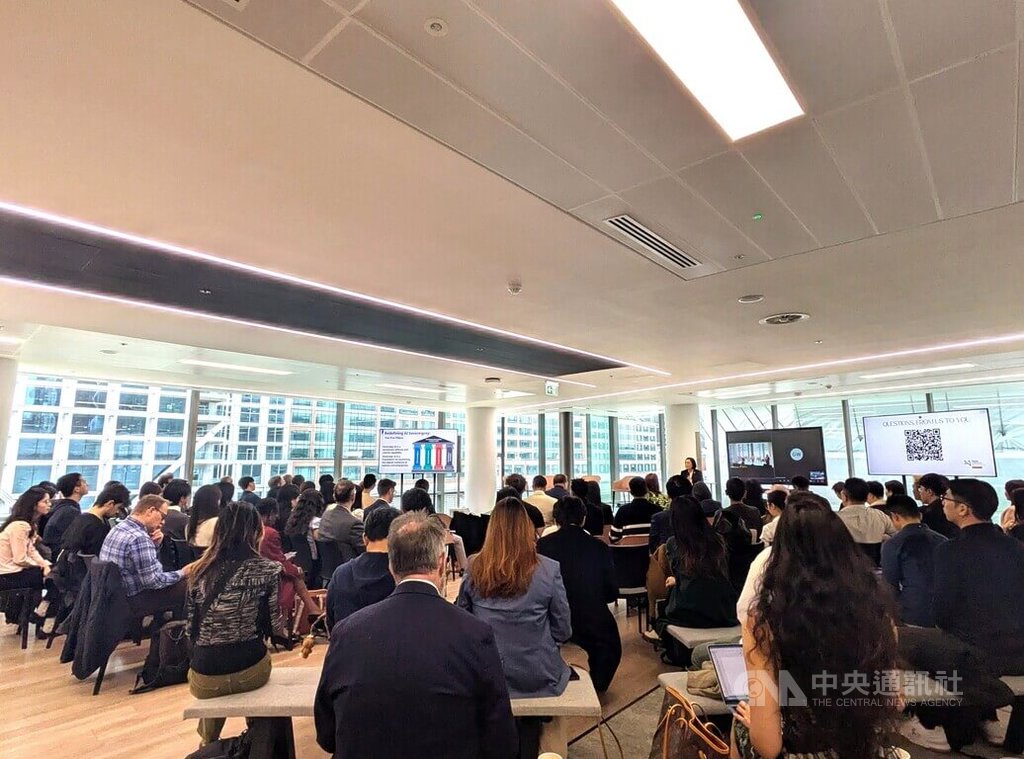
(CNA reporter Chen Yun-yu, London, June 11) Taiwan is expanding international cooperation in artificial intelligence (AI) during London Tech Week. At a recent event, Hsu Yung-chen, convener of Taiwan's AI Council of Excellence (AICoE), expressed Taiwan's ambition to transform into a 'hardware and software powerhouse.' However, she emphasized that challenges in institutional frameworks, talent development, and investment must still be overcome to achieve this goal.
The Science and Technology Division of Taiwan's Representative Office in the UK hosted the 'AI Without Borders 2.0' forum in London's financial district. The event explored the current state, trends, and potential for collaboration between Taiwan and the UK in AI, and included a startup exchange and presentation session.
Hsu Yung-chen delivered a keynote speech and joined AICoE Deputy Convener Liu Ching-i as a panelist. The forum attracted around 120 participants from both Taiwan and the UK, including representatives from industry, investment, research institutions, and policy circles. 'AI Without Borders 2.0' is an official side event of London Tech Week.
Taiwan's Representative to the UK, Yao Chia-hsiang, stated in his opening remarks that over 90% of the world's high-end chips and AI servers are produced in Taiwan, making Taiwan a key enabler of global AI development. Beyond its strong hardware capabilities, Taiwan is pursuing a broader AI strategy, including building AI sovereignty, strengthening data ecosystems, expanding national-level computing infrastructure, and ensuring AI governance meets the needs of safety, innovation, and public trust.
Yao also revealed that Taiwan is negotiating with the UK to sign a science and technology cooperation agreement, which he believes will facilitate more bilateral collaboration.
Hsu Yung-chen emphasized Taiwan's need and ambition to strengthen its software capabilities during the forum. In a subsequent interview with CNA, she stated that Taiwan should leverage its established hardware advantages to attract more international cooperation and foster a thriving software industry.
She pointed out that Taiwan's main challenge in software development is not a lack of talent, but being constrained by the 'burden of past success.' Taiwan's hardware achievements have created a mindset where the 'rules for success' no longer apply, and the conditions required for software development differ significantly from those for hardware.
Hsu candidly admitted that software companies in Taiwan are at a disadvantage. As a result, software talent either joins high-paying hardware-focused firms like TSMC or seeks opportunities in foreign companies or overseas to fulfill their creative aspirations—both trends hinder the growth of Taiwan's domestic software industry.
Moreover, Hsu observed that software professionals working in Taiwan's hardware companies often experience 'five years of work, and their knowledge and skills become outdated,' as their roles rarely require cutting-edge technologies.
Additionally, Taiwan's venture capital funds almost exclusively focus on hardware, partly because 'investors and bosses mostly only understand hardware.' Hsu stressed that Taiwan needs more venture capital funds with software expertise to enter the market, along with better policies, regulations, and implementation, to build a healthy and vibrant software innovation and startup ecosystem.
Hsu also suggested that Taiwan's international communication strategy should be adjusted to avoid overemphasizing hardware at the expense of software. In fact, some overseas investors mistakenly believe Taiwan lacks software talent. However, the root issue lies in the 'environment,' and professional foreign capital could help improve the situation.
Liu Ching-i shared Taiwan's AI governance framework and the 'Artificial Intelligence Basic Act,' passed by the legislature in December last year.
A legal expert, Liu is the only Taiwanese expert on the OECD's international platform, the Global Partnership on Artificial Intelligence (GPAI), having joined in late 2021 in a personal capacity to discuss AI policy with government-appointed delegates from other countries.
In an interview with CNA, Liu explained that the 'Artificial Intelligence Basic Act' primarily serves as a 'policy declaration,' outlining government direction and principles. However, individual agencies still need to assess whether they have sufficient regulatory tools, mechanisms to protect citizens' rights, and tools to promote industrial development. Without concrete behavioral guidelines and impact assessments, the law's 'practicality' and enforceability remain limited.
Liu pointed out several major issues with the act, including unclear definitions of rights and responsibilities, enforcement standards, oversight mechanisms, and avenues for redress; a lack of clear guidance and regulations for industry; and no clear direction on resolving or balancing conflicting interests or rights.
For example, the legal sourcing, acquisition, and use of AI training data is a core issue for developing sovereign AI. However, Liu noted that the Basic Act does not provide a clear regulatory foundation, and there are currently no signs that related laws—such as intellectual property rights, personal data protection, and government information disclosure—will be revised soon. This leaves AI developers vulnerable to legal liability and criminal prosecution risks.
Liu emphasized that Taiwan must adopt a more rigorous and long-term strategy in data governance to advance AI development.
Nonetheless, she highlighted that the 'Artificial Intelligence Basic Act' includes provisions requiring the government to actively use AI to protect workers' rights, bridge skill gaps caused by AI, and assist those displaced by AI in re-entering the workforce—features that reflect Taiwan's unique labor protections and have drawn positive international attention.
FACT BOX
- Source: CNA (Central News Agency)
- Category: Event