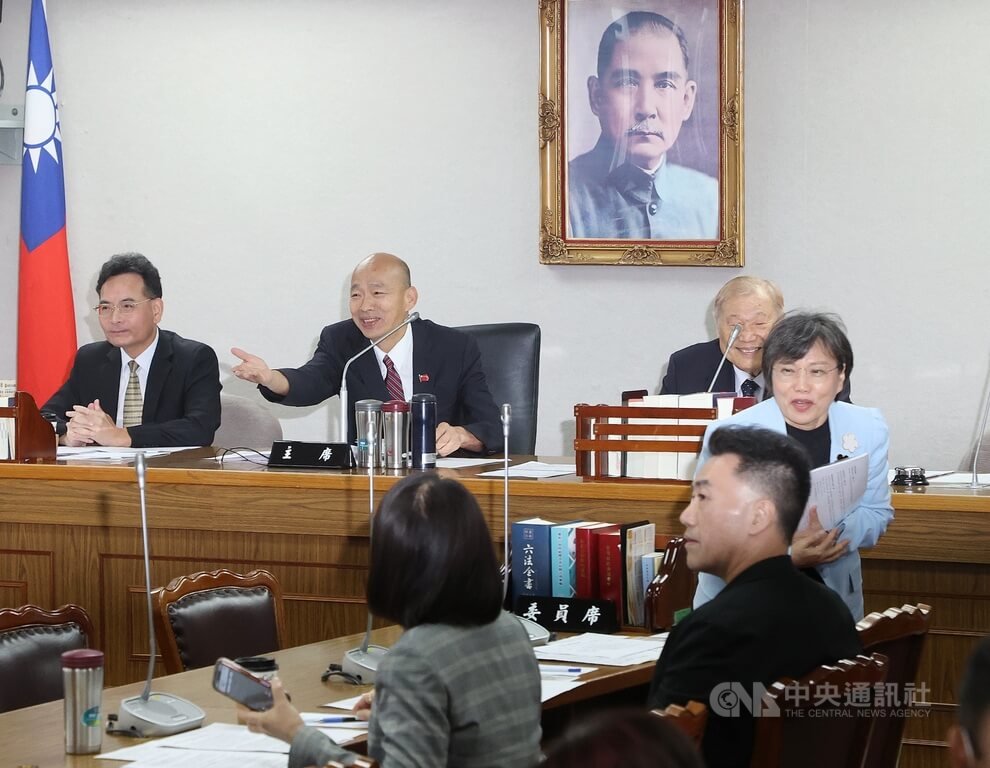
(Central News Agency, reporter Chen Chun-hua, Taipei, 11th) Legislative Yuan President Han Kuo-yu presided over cross-party negotiations on a draft amendment to the Civil Servants Election and Recall Law on the 11th, concerning matters that disqualify a person from registering as a candidate. The DPP caucus questioned whether the amendment was a case-specific revision tailored for Hsinchu Mayor Kao Hung-an. The TPP caucus stated it was about considering the people's right to participate in elections, not a revision for an individual. As no consensus was reached, Han announced that subsequent procedures would be handled according to regulations.
The Legislative Yuan's Internal Administration Committee passed the initial review of the draft amendment to Article 26 of the Civil Servants Election and Recall Law on April 23. This draft removes the negative qualification restriction on candidates who have received a suspended sentence and adds a provision that anyone convicted of an offense under the 'Fraud Crime Hazard Prevention Act' with a final judgment cannot register as a candidate.
Han convened the cross-party negotiations in the afternoon. TPP Legislator Hsu Chung-hsin proposed a revised motion, changing the text to 'except for those sentenced to imprisonment with a suspended sentence or a sentence that can be directly or indirectly commuted to community service.' He stated that using law to restrict people's right to run for office must comply with the principles of necessity and proportionality, and it is by no means a revision for a specific individual.
Hsu pointed out that the current Election and Recall Law's provision, which prohibits registration as a candidate for those convicted of lesser crimes (excluding treason, organized crime, drug trafficking, etc.) with a final sentence of imprisonment that has not yet been executed, clearly violates the principles of necessity and proportionality. Therefore, he proposed adding a proviso to restore the right to run for office for those who have committed lesser crimes.
Kao Hung-an was involved in a case of allegedly embezzling assistant subsidies. The second-instance trial changed the charge to document forgery and sentenced her to six months in prison. DPP Caucus Secretary-General Fan Yun stated that because Kao might be eligible for community service, politically, this would be seen as a case-specific revision tailored for Kao. The public would not accept a revision without cross-party consensus for an individual politician. The DPP caucus does not support the TPP caucus's proposal.
Kuomintang (KMT) Caucus Secretary-General Lin Pei-hsiang stated that the revision is because the times and environment are different from the past. Without presupposing a stance, public opinion polls show that the public's confidence in the judiciary is extremely poor. The revision must keep pace with the times and is an important cornerstone for the country's continued development. 'Laws that should be amended should be accepted and amended,' he said.
Minister of the Interior Liu Shih-fang, who attended the negotiations, said the Ministry of the Interior has repeatedly expressed its desire to maintain the current provisions without changes. Moreover, local elections are scheduled for November 28, less than half a year away. If the amendment is passed hastily, it might appear to be a case of making rules for a specific person. The executive branch holds a conservative stance, hoping to maintain the current regulations without any changes.
TPP Caucus Convener Chen Ching-lung stated that the DPP caucus's suspicion that the amendment is politically tailored is 'overblown.' He argued that the revision of the Election and Recall Law considers the people's right to participate in elections, not a revision for an individual.
DPP Caucus Secretary-General Chuang Jui-hsiung said that if the TPP caucus wants to overhaul the entire Election and Recall Law so that no political party has objections, they should do so. But if it's for Kao Hung-an, they should say so boldly and face public scrutiny. Fan Yun suggested that if the amendment explicitly states it will be promulgated and implemented on September 4 (the last day for registration for the year-end elections), the public would not think it is tailored for Kao Hung-an.
After nearly an hour of negotiations, Han stated that it was clear the party caucuses could not reach a consensus, and subsequent procedures would be handled according to regulations. (Editor: Wan Shu-chang) 1150611
FACT BOX
- Source: CNA (Central News Agency)
- Category: Taiwan