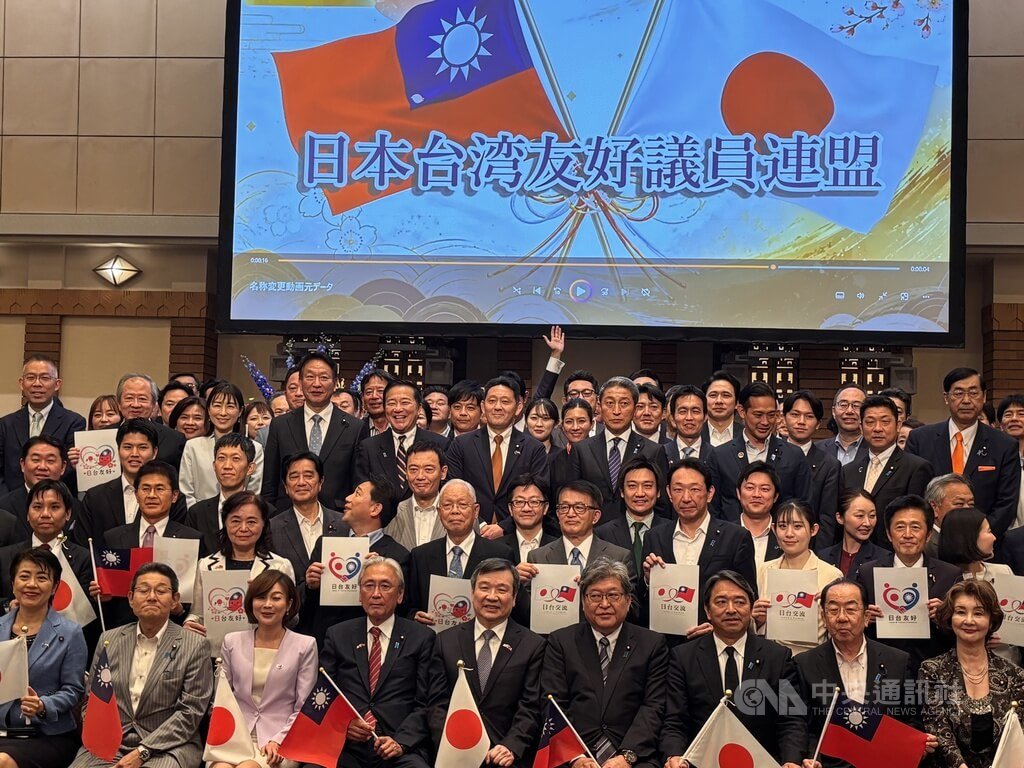
Japan's largest cross-party pro-Taiwan parliamentary group, the 'Japan-Taiwan Parliamentary Friendship League' (formerly known as the 'Japan-China Parliamentary Friendship Association' or 'Nichika-kun'), officially changed its name today. Taiwan's Representative to Japan, Lee I-chou (Li Yiyang), stated that this marks a historically significant moment. Presidential Office spokesperson Kuo Ya-hui expressed deep emotion at seeing 'Taiwan' formally included in the group's name, emphasizing that it symbolizes the recognition of Taiwan's democracy, people, and sovereignty.
Lee I-chou, speaking at the group's general meeting, described the renaming as a symbolic step that will deepen and further develop Taiwan-Japan relations on a long-standing foundation. He revealed that immediately upon learning of the name change outside the venue, he reported it to President Lai Ching-te, who expressed great joy and asked him to convey sincere gratitude and respect to all Japanese lawmakers supporting Taiwan.
Lee highlighted that under the leadership of Chairman Koike Keiji (Koike Keiji), the group has long united cross-party forces to advance Taiwan-Japan relations. This includes facilitating the Japanese Senate's unanimous 2021 resolution supporting Taiwan's observer participation in the World Health Assembly (WHA), consistently passing pro-Taiwan resolutions at annual meetings, and sending delegations to Taiwan during National Day, demonstrating steadfast support.
He also noted the group's long-standing efforts to allow 'Taiwan' to be marked in the nationality field of Taiwanese residents' household registration records in Japan, and its immediate public support for Taiwan in April when President Lai faced Chinese pressure during his visit to the friendly nation of Eswatini. Taiwan's society deeply appreciates these actions.
Lee further expressed Taiwan's gratitude to the United States, Japan, and other Indo-Pacific nations for jointly helping maintain regional security and peace and stability in the Taiwan Strait. As a member of the Indo-Pacific region, Taiwan plays a crucial role in non-red supply chains and security cooperation. Taiwan will act as a highly reliable partner, working hand-in-hand with Japan and the United States to fully promote a peaceful and stable Indo-Pacific.
Presidential Office spokesperson Kuo Ya-hui, speaking at the event, said she was deeply moved when she saw the word 'Taiwan' appear on the screen. She emphasized that this is not merely a name change but a significant moment where Taiwan's democracy, people, and sovereignty are clearly seen and affirmed.
Kuo specifically thanked Chairman Koike for his long-standing, unwavering support for Taiwan. She recalled that at President Lai's inauguration, Koike led a 31-member cross-party parliamentary delegation to Taiwan, setting a new record for the number of Japanese lawmakers attending a Taiwanese presidential inauguration, fully demonstrating the deep friendship between Taiwan and Japan.
She stated that the history of the former Nichika-kun is the history of Taiwan-Japan friendship. Whether it was Japan's donation of vaccines during the pandemic, Japanese citizens' enthusiastic support for Taiwanese pineapples when they were suppressed by China, or Japanese lawmakers' continuous vocal support for Taiwan's participation in the World Health Organization (WHO), the International Civil Aviation Organization (ICAO), and its bid to join the Comprehensive and Progressive Agreement for Trans-Pacific Partnership (CPTPP), all of these actions are deeply remembered by the Taiwanese people.
Kuo concluded by describing Taiwan-Japan relations as 'friends who share an umbrella on rainy days and partners who walk together on sunny days,' emphasizing that Taiwan will continue to cooperate with Japan and like-minded democratic nations to jointly safeguard freedom, democracy, and prosperity.
Regarding the significance of the renaming, attendees analyzed that this is not just a name adjustment but symbolizes Taiwan-Japan relations entering a new phase based on historical, institutional, and political consensus. First, changing from 'Japan-China' to 'Japan-Taiwan' represents Japan's pro-Taiwan parliamentary forces using clearer language to reflect the current state of Taiwan-Japan relations. Second, changing from 'Parliamentary Friendship Association' to 'Parliamentary Friendship League' reflects a move toward more institutionalized parliamentary exchanges between Taiwan and Japan.
Attendees noted that Japan's parliamentary friendship groups with other countries are mostly named 'Parliamentary Friendship Leagues.' With this renaming, Taiwan-Japan parliamentary exchanges now stand on equal footing with Japan's other international parliamentary organizations, aligning with diplomatic conventions. This change signifies that Taiwan-Japan exchanges are no longer just emotionally driven gatherings but a parliamentary cooperation platform with stronger institutional foundations and greater policy influence.
It was also pointed out that the group now has over 300 members, indicating that support for Taiwan is no longer limited to the long-held beliefs of a few senior pro-Taiwan politicians but is gradually forming a broader, cross-generational consensus within Japan's Diet. Especially as the situation in the Taiwan Strait has drawn heightened attention in recent years, 'we cannot let Taiwan face a crisis' has become a shared security concern among many Japanese politicians.
In response to potential reactions from China, relevant figures stated that there is a widespread belief within the league that 'what should be done must be done,' demonstrating an increasingly clear and firm stance from Japan's pro-Taiwan forces.
Additionally, the Japanese diaspora group 'United Association of Taiwanese in Japan' issued a statement, sincerely welcoming the official establishment of the 'Japan-Taiwan Parliamentary Friendship League.'
The statement expressed hope that the newly established 'Japan-Taiwan Parliamentary Friendship League' will serve as an important foundation for further deepening Taiwan-Japan exchanges and cooperation, continuously promoting a future-oriented partnership and opening a new chapter in Taiwan-Japan friendship. It emphasized continued collaboration with all sectors of Japanese society to promote the development of Taiwan-Japan friendship and support a free and open Indo-Pacific order and democratic values. (Editor: Chen Hui-ping)
FACT BOX
- Source: CNA (Central News Agency)
- Category: Taiwan