Central News Agency Report
(CNA reporter Lu Chia-jung, Taipei, 11th) — Following the Trump-Xi meeting, US-China-Taiwan relations have drawn international attention. Vice Chairperson Shen You-Zhong of Taiwan's Mainland Affairs Council stated today that China continues to pressure Taiwan through military threats, official vessel incursions, and the 'One China' narrative. It is China, not Taiwan, that is truly changing the status quo. Taiwan has consistently maintained the status quo.
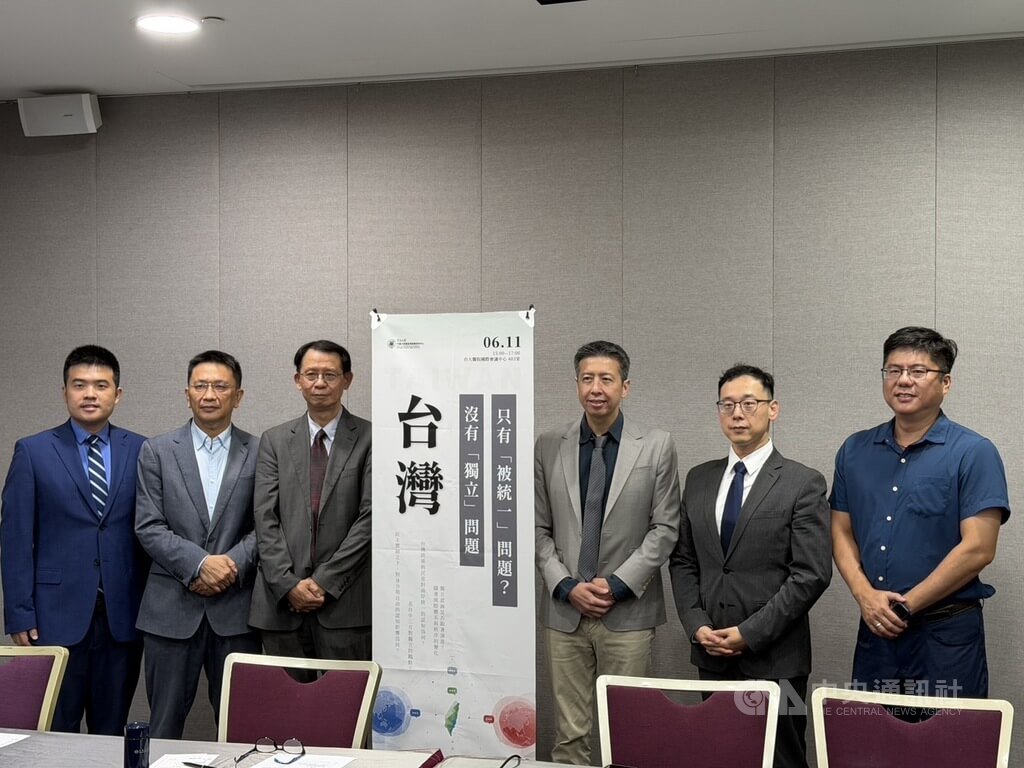
The China and Regional Development Research Center at Tunghai University hosted a panel discussion this afternoon in Taipei titled 'Taiwan does not have an independence issue, but rather a forced unification issue,' focusing on how China's unilateral imposition of a unification agenda impacts Taiwan's future.
Shen stated that China has recently attempted to expand gray-zone incursions and alter the status quo through so-called 'special law enforcement' operations in the East China Sea and related propaganda. These actions lack basis in international law and undermine regional peace and stability.
Shen emphasized that China continues to pressure Taiwan through military threats, official vessel harassment, and the 'One China' narrative. The party altering the status quo is not Taiwan, but China. Taiwan has consistently maintained the status quo, with no policy of pursuing de jure independence—only a commitment to safeguarding sovereignty and preserving its free, democratic way of life.
He stressed that China has no right to represent Taiwan or unilaterally alter the cross-strait status quo. In the face of authoritarian unification and gray-zone coercion, Taiwan must continue to strengthen its self-defense capabilities, unite to defend national sovereignty and democratic institutions, and maintain peace and stability through strength.
Lin Tzu-li, Director of the China and Regional Development Research Center at Tunghai University, noted that China has long used domestic propaganda and international narratives to portray Taiwan as the party seeking to change the status quo, accusing Taiwan of 'relying on the U.S. to pursue independence.' However, in reality, Taiwan has long maintained the status quo. Neither the Democratic Progressive Party (DPP) government's cross-strait policy nor the fundamental framework of U.S. policy toward Taiwan has undergone any fundamental change.
Lin emphasized that as China once again attributes tensions in the Taiwan Strait to Taiwan following the Trump-Xi meeting, it is essential to return to the facts and examine the true nature of the status quo and who is attempting to change it.
Tsai Jung-hsiang, Professor of Political Science at Chung Cheng University, stated that the root cause of recent cross-strait tensions lies in China's unilateral alteration of the status quo through military exercises, gray-zone operations, and various forms of pressure on Taiwan, without abandoning the use of force to achieve unification. U.S. policy consistently emphasizes that any resolution to cross-strait differences must have the consent of the people of Taiwan, and that Taiwan's future should be determined by the people of Taiwan.
Yeh Yao-yuan, Distinguished Professor of Political Science at the University of St. Thomas in the United States, pointed out that 'Taiwan independence' is not currently the most pressing political issue. The U.S. is concerned about whether the status quo in the Taiwan Strait is being changed and does not believe Taiwan has taken any fundamental actions to alter the cross-strait status quo in recent years. On the contrary, it is China that is changing the status quo through military expansion, cognitive warfare, and pressure on Taiwan. Under this framework, Taiwan is not facing an independence issue, but rather the challenge posed by China's persistent push for unification and alteration of the status quo.
Hung Pu-chao, Deputy Executive Director of the Mainland Research Center at Tunghai University, stated that discussions on cross-strait relations must reject the framing imposed by China. Taiwan has never had an independence issue; the real issue is China's aggression toward Taiwan. 'Anti-Taiwan independence' is merely the political language China uses to justify its aggression.
Chen Shih-min, Professor of Political Science at National Taiwan University, noted that the idea that 'Taiwan has no independence issue' was already articulated during the Lee Teng-hui era, with the core argument being that the Republic of China already exists as a sovereign state. He stated that Taiwan faces a 'forced unification' issue—China's persistent efforts through political, military, and united front tactics to incorporate Taiwan into the People's Republic of China system.
Wu Kuan-sheng, Assistant Professor of Criminology and Political Science at the University of South Alabama, stated that in the face of China's ongoing pressure, Taiwan should further strengthen democratic resilience, deepen cooperation with democratic nations, and jointly safeguard liberal democratic values. (Edited by Yang Sheng-ju) 1150611
FACT BOX
- Source: CNA (Central News Agency)
- Category: Taiwan