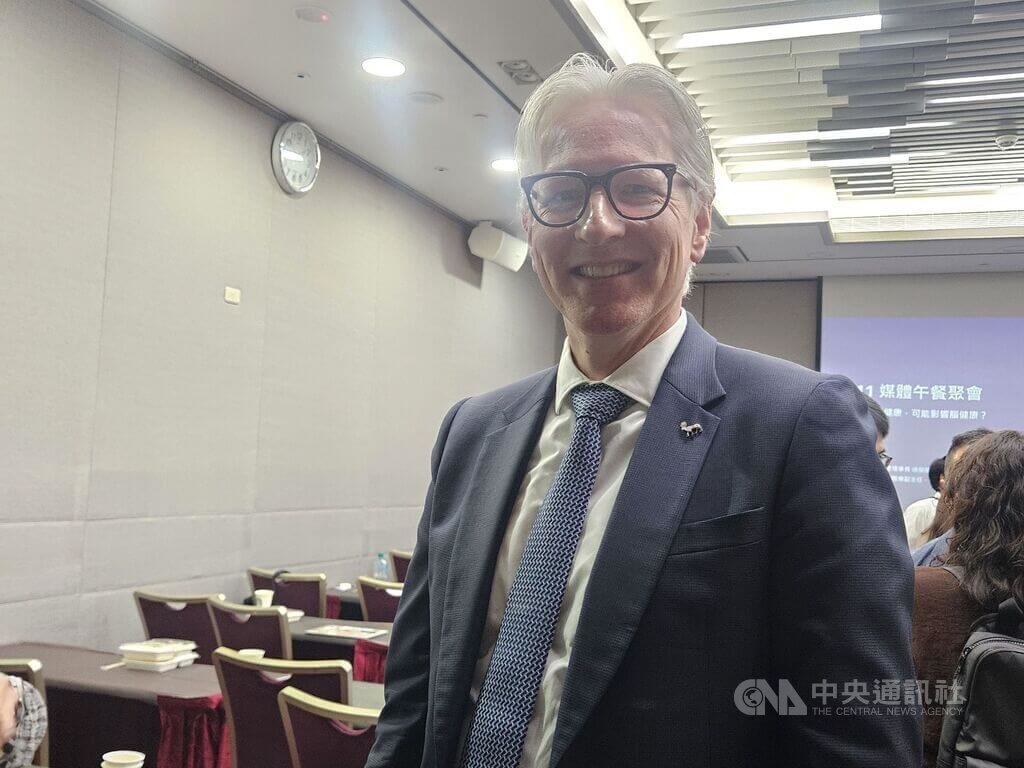
(Central News Agency, reporter Chen Jieling, Taipei, 11th) Hans Du, General Manager of Novo Nordisk Taiwan, recently participated in a Taiwanese soap opera. Despite being a foreigner, he delivered his lines in Taiwanese Hokkien, creating a striking contrast. Today, he shared his filming experience, praising Taiwan's creativity and stating that using avant-garde methods to convey medical knowledge can change more people's lives.
Du attended a media luncheon today, discussing how the advent of GLP-1 drugs has brought about a significant transformation for global human health. After the event, he gave a joint media interview, reenacting a classic scene from the drama and noting that he still remembers the Taiwanese Hokkien lines.
Asked why he accepted the challenge of appearing in a local Taiwanese soap opera, he laughed and said it was an invitation from his pharmaceutical team. "I think they were a bit afraid to ask at first," he said. He believes that the crazier the idea, the more worthwhile it is to try if it can raise public awareness of diseases.
Du described the filming experience as very interesting, admitting he was nervous before filming began and practiced his Taiwanese Hokkien lines many times privately. He was pleased with the final result, saying, "Of course, I only played a small role."
Noting that the primary audience for Taiwanese soap operas is often the elderly, a CNA reporter asked if he would be willing to participate in idol dramas or children's programs to convey correct concepts about metabolic diseases to younger generations. He replied, "I don't have any specific ideas at the moment, but I'm very much looking forward to hearing everyone's suggestions and creativity. As long as there's a good idea, I'm willing to try it."
Du said this was his screen debut. He found the Taiwanese team very creative and collaborating with them and his own pharmaceutical team was a lot of fun. This demonstrates that when medical knowledge can be delivered through innovative methods, it can have a huge impact on many people's lives.
Dr. Liu Peng-chih, Deputy Director of the Health Management Department at Shin Kong Wu Ho-Su Memorial Hospital, stated that for long-term management of chronic diseases and organ protection, GLP-1 drugs have become a new weapon in treating metabolic comorbidities. He emphasized that obesity and metabolic diseases are chronic and relapsing conditions requiring long-term care and co-management of multiple conditions, not just short-term weight loss. The focus should be on long-term outcomes for risks to the heart, kidneys, liver, and blood vessels.
Dr. Liu reiterated that metabolic diseases threaten not only the heart, liver, and kidneys but also brain health. Waist circumference and visceral fat are measurable and the most direct warning signs. Controlling blood sugar, weight, and blood pressure are just the basics of metabolic disease management; the real goal is to reduce long-term organ risk. Weight is not equivalent to health improvement; quality is the key. (Editor: Lung Po-an) 1150611
FACT BOX
- Source: CNA (Central News Agency)
- Category: Event