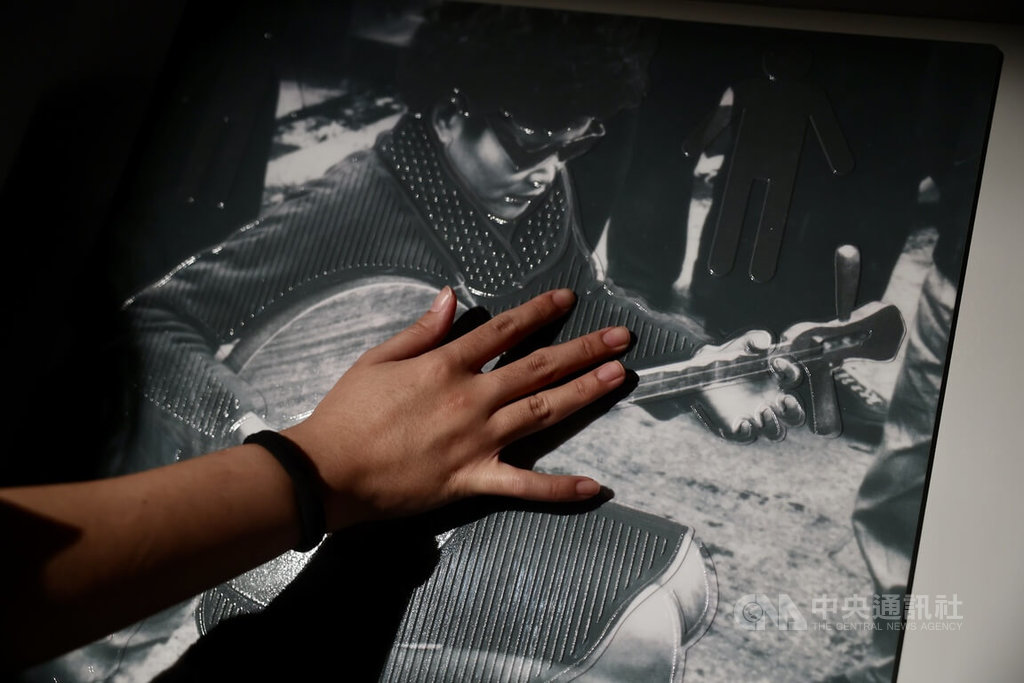
(Central News Agency, reporter Wang Bao'er, Taipei, 11th) Dark restaurants and dark exhibitions have become popular in various places in recent years, allowing participants to awaken senses other than sight. The National Photography and Culture Center is holding the 'Dark Image: Seeing the Unseen' exhibition, which also plans a completely dark 'Black Box Operation' experience, allowing people to appreciate photographic works through touch.
The National Photography and Culture Center held the opening ceremony for 'Dark Image: Seeing the Unseen' today, with singer Li Binghui performing the opening act.
The 'Dark Image: Seeing the Unseen' exhibition features 76 works, divided into two sub-theme areas: 'Realm of Gaze' and 'Vision of the Unseen.' The 'Realm of Gaze' area focuses on visual archives related to blind and visually impaired people in the history of photography, and introduces works by visually impaired creators. The 'Vision of the Unseen' area displays multiple works of Taiwanese photography about blind people, using photography to witness changes in the social environment.
Curator Zhao Xinyi, an associate professor at National Chung Hsing University who has long focused on non-visual art and tactile cognition, said she originally studied photography and even won a photography newcomer award. Later, she went into teaching and re-encountered photography 18 years ago when she was invited to curate an art course for the visually impaired, which included photographic art.
Zhao said that at the time, she thought about what kind of photos visually impaired people would take. After getting in touch and understanding more, she saw many image results different from those of people learning photography, very different from the general public's understanding of 'photography.' The reason she continues to focus on and research this field is precisely these 'differences.'
For example, Japanese scholar Hirose Kojiro, who lost his sight at age 13, brought the series 'Invisible Landscapes.' With team design, UV stereoscopic printing technology is used to highlight key points in the exhibited photos. General audiences can see protruding transparent dots on the photos through reflected light. By reaching out and touching, they can feel how the dots converge into the points, lines, and planes of the photo's subject. For example, radial dotted circles correspond to a fountain pool, and squares represent buildings.
Hirose said that photography is a way for him to prove his existence even when he cannot see, allowing him to recall the sounds, smells, and feelings he experienced at the time. He remembers 30 years ago, when he applied for a reporter job at a newspaper, the interviewing supervisor asked him, 'Then how will you take photos?' Thirty years later, he never imagined he could take photos and even exhibit them in Taiwan, hoping that people will increasingly value the works created by those who cannot see.
The exhibition features various experiences, such as 'Black Box Operation,' where audiences move along handrails in a completely dark environment to appreciate nine photographic works through touch. There is also artist Jiang Yucheng's experiential work 'Where the Gaze Cannot Reach,' which uses the common Taiwanese scene of 'blind massage,' allowing audiences to lie on a massage table and listen to the stories of blind masseurs.
'Dark Image: Seeing the Unseen' opens today. The 'Vision of the Unseen' exhibition area runs until October 11, and the 'Realm of Gaze' exhibition area runs until October 26. Both are located at the National Photography and Culture Center Taipei Branch. (Editor: Wu Surou) 1150611
FACT BOX
- Source: CNA (Central News Agency)
- Category: Event