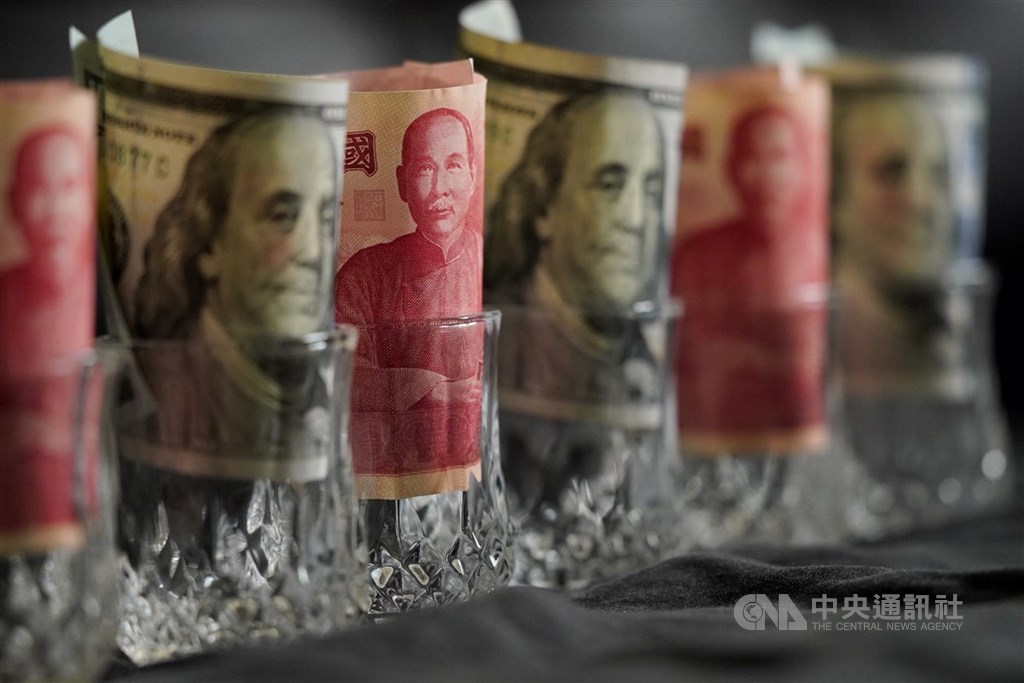
(Central News Agency reporter Chao Min-ya, Taipei, June 11) Tensions in the Middle East have escalated again, driving up international oil prices and triggering market concerns, leading to a decline in U.S. stocks. Taiwan's stock market plunged over 1,200 points at one point today, and the New Taiwan Dollar (TWD) briefly fell below the 31.7 level in early trading. However, in the afternoon, foreign fund outflows paused, and exporters flooded the market with forex sales, causing the TWD to reverse from depreciation to appreciation. It rose as high as 31.617, with intraday volatility exceeding 1.5 cents, and closed at 31.631, gaining 3.7 cents, ending a five-day losing streak in exchange rates.
The U.S. May Consumer Price Index (CPI) rose 4.2% year-on-year, the highest in three years, but in line with market expectations, temporarily narrowing the U.S. market's losses. However, U.S. airstrikes against Iran on the 10th reignited Middle East tensions, increasing investor uncertainty, and major U.S. indices closed lower.
Taiwan's stock market opened lower and at one point plunged over 1,200 points, narrowly holding the 42,000-point level. The weighted index eventually closed at 43,149.46 points, down 76.08 points. Institutional investors collectively sold short NT$35.391 billion, with foreign investors withdrawing NT$35.779 billion, marking their sixth consecutive day of net selling.
The TWD/USD rate opened at 31.68. Affected by a rising U.S. Dollar Index and foreign investors selling, the TWD quickly broke below 31.7, hitting a low of 31.768. In the afternoon, the exchange rate reversed, turning from depreciation to appreciation, and closed firmly above the 31.6 level. Total trading volume in the Taipei and Yuanta foreign exchange markets reached $2.837 billion.
Foreign exchange traders noted that foreign funds continued to repatriate capital in the morning, pushing the TWD toward 31.77. However, in the afternoon, foreign inflows resumed, and exporters entered the market with large-scale forex sales, driving the TWD into positive territory. "Today, supported by exporters, the TWD strengthened uniquely while most major Asian currencies weakened," they said.
Traders added that the U.S. May CPI at 4.2% year-on-year met market expectations, and the market is now awaiting the outcome of next week's U.S. Federal Reserve (Fed) meeting. Recently, the TWD's movement has been driven not only by foreign capital flows but also by the strength of exporter forex sales, with expectations of short-term trading between 31.5 and 31.8.
According to central bank data, the U.S. Dollar Index rose 0.08% today. Most major Asian currencies declined: the Korean won fell 0.31%, the Japanese yen dropped 0.07%, and the Singapore dollar depreciated 0.02%. The Chinese yuan closed flat, while the TWD appreciated 0.12%. (Edited by Yang Lan-hsuan) 1150611
FACT BOX
- Source: CNA (Central News Agency)
- Category: Taiwan