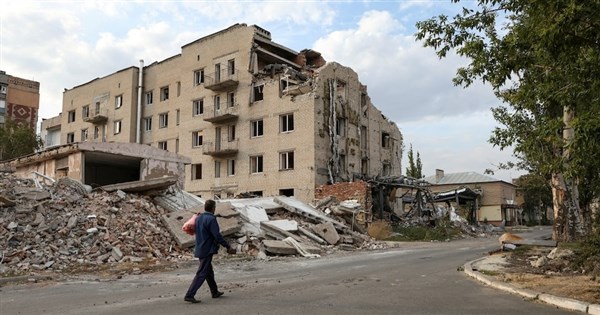
The war between Russia and Ukraine, which began with Russia's invasion in 2022, has surpassed the duration of World War I. Experts describe this war as a World War with the addition of drones.
According to The New York Times, the Russia-Ukraine war has entered its 1,569th day today, surpassing the record of 4 years and 3 months set by World War I.
When Russian President Vladimir Putin ordered the military to invade Ukraine in February 2022, he initially believed that Ukraine could be captured within a few days. However, Ukraine repelled the Russian military, turning the war into a war of attrition. Many of those involved in the war did not expect it to last this long.
A Ukrainian soldier revealed that he initially thought the war would last no more than 2 or 3 years, "and then political figures would reach some kind of consensus." However, both Russia and Ukraine continue to engage in fierce fighting, and peace talks are at a standstill, with no signs of an end to the war in the short term.
Surveys show that about half of Ukrainians believe the war will last at least until 2027, which would make the war's duration approach the 6-year duration of World War II. Many Ukrainians also believe that the current war actually began as early as 2014 when Russian forces occupied Crimea.
Historians point out that the scale of World War I and World War II far exceeds that of the Russia-Ukraine war, involving multiple battlefields and armies, making it difficult to compare the two in terms of casualties and firepower.
Nevertheless, Ukrainian historian Yaroslav Hrytsak believes that the Russia-Ukraine conflict, like World War I, is highly likely to become one of the most influential conflicts in modern European history. These two wars reshaped military alliances and prompted strengthened defense measures not seen in decades, altering the geopolitical landscape of Europe.
Military analysts also point out that both wars fundamentally rewrote the nature of warfare by introducing new technologies. A century ago, it was airplanes and tanks; now it is drones. In these two wars, technological progress has only made warfare more brutal.
French retired colonel and military historian Michel Goya believes that "in many respects, the Ukrainian war is the modern war closest to World War I."
The two wars had similar beginnings. In 1914, the German military quickly launched an offensive against Paris, aiming for a quick victory. In 2022, the Russian military also quickly advanced towards the Ukrainian capital, Kyiv. However, the attacking side, which had approached the original target, was eventually repelled and turned into a stalemate of attrition.
At the end of 2022, the Ukrainian military began to hide in trenches and shelters. Historians described this as a return to the trench warfare of World War I. Goya pointed out that when the front line is stalemated and artillery is concentrated, "to survive, you have to bury yourself in the ground."
However, after Ukraine introduced drones into the battlefield, the existing strategy began to change. With drones capable of all-weather monitoring of the battlefield and more precise strike accuracy than traditional shells, the previously open trench network is no longer safe and reliable.
Ukrainian soldiers said they must rely on smaller, deeper underground shelters to survive. The Ukrainian military has changed to use small anti-aircraft shelters that can accommodate only a few people as their base. These shelters are small enough to be difficult to detect from the air and deep enough to withstand external attacks. For example, soldiers on solo missions usually only dig shelters slightly larger than foxholes.
The scale of casualties in the Russia-Ukraine war is difficult to compare with that of World War I. World War I resulted in the deaths of approximately 9 to 11 million soldiers, while the Russia-Ukraine war has so far resulted in the deaths of approximately 500,000 soldiers.
However, military analysts and officials, including Admiral Pierre Vandier, the highest commander of NATO's Allied Command Transformation, believe that drones have made the lethality of the Ukrainian battlefield comparable to World War I levels.
The Russia-Ukraine conflict is highly consumptive, even making the Russian military's advance slower than the most stalemated battlefields of World War I.
The current question is whether both sides can break the stalemate. In World War I, the Allies imposed a strict naval blockade on Germany, applying economic pressure and continuous attacks, ultimately achieving victory.
Ukraine's end-of-war strategy also has similarities. For example, it deploys drones to attack Russia's economic lifeline, oil facilities, to weaken Moscow's war finances. Although Kyiv cannot replicate the manpower of World War I offensives, it has deployed a large number of small attack drones on the battlefield, hoping to inflict unbearable losses on the Russian military.
Hrytsak summarized, "This is World War I with the addition of drones."
FACT BOX
- Source: CNA (Central News Agency)
- Category: 其他