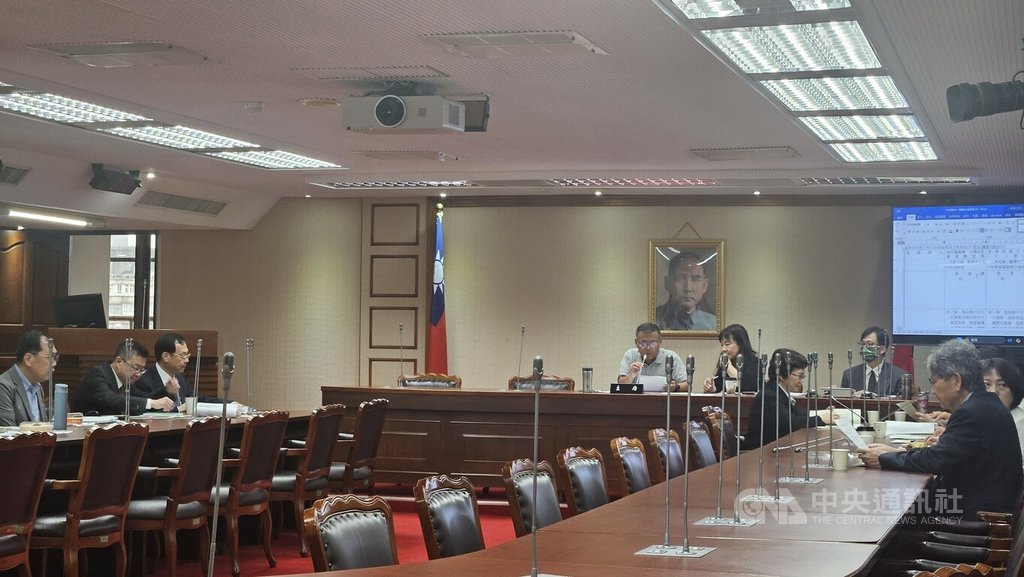
(Central News Agency, Reporter Zeng Yining, Taipei, 10th) The Legislative Yuan's Social Welfare and Health Committee today held a consultation on the draft 'Future Account Special Act' and other proposals. DPP Legislator Lin Yueh-chin questioned that the design of self-deposits and guaranteed returns would widen the generational wealth gap. KMT Legislator Chen Ching-hui, TPP Legislator Chiu Hui-ju, and DPP Legislator Fan Yun debated whether the Executive Yuan's non-legislative version of the growth allowance violates the principle of legal reservation.
The Legislative Yuan's Social Welfare and Health Committee today held a cross-party consultation on the 'Taiwan Future Account Special Act Draft' proposed by the Kuomintang (KMT) caucus and the Taiwan People's Party (TPP) caucus, and the 'Taiwan Children and Youth Investment Savings Account Act Draft' proposed by 18 legislators including DPP Legislator Kuo Kuo-wen. Minister of Health and Welfare Shih Chung-liang attended the meeting.
KMT Legislators Wang Yu-min and Chen Ching-hui, TPP Legislators Chiu Hui-ju and Liu Shu-bin, and DPP Legislators Lin Yueh-chin and Wang Cheng-hsu participated in the discussion; however, Legislator Kuo Kuo-wen was absent. After an hour of discussion, the ruling and opposition parties failed to reach a consensus. The meeting chair, KMT Legislator Lu Hsien-yi, announced that the matter would be handled in accordance with the relevant provisions of the Legislative Yuan's Organic Act.
According to the draft proposed by the KMT and TPP, in addition to an annual fixed deposit of NT$10,000 by the central competent authority into the children and youth future account, individuals could also deposit up to NT$100,000 per year as self-deposits before the child turns 12. The employer of the child's legal guardian could also deposit NT$50,000 per year as a corporate sponsorship. The drafts also require the competent authority to provide incentives such as tax exemptions for self-deposits and corporate sponsorships.
Furthermore, both drafts require that the account's returns must not be lower than the returns on a 2-year bank fixed deposit; any shortfall would be covered by the national treasury.
In response, Minister Shih stated that the difference between the Executive Yuan's proposed '0 to 18 Growth Allowance' and the existing drafts is, first, it does not include a parental self-deposit design to avoid widening the wealth gap; second, it saves the administrative and backend management costs of individual accounts; and third, the guaranteed return design in the drafts involves government subsidies and raises issues of tax fairness. Therefore, he hopes to maintain the Executive Yuan's proposed growth allowance to avoid widening the generational wealth gap.
However, Chiu Hui-ju questioned why the government's promotion of the growth allowance is acceptable, while a legislator's proposal is seen as increasing the wealth gap.
Wang Cheng-hsu argued that the design allowing parents to self-deposit NT$100,000 is 'a pie in the sky' for disadvantaged families and could even result in the government using tax revenue to subsidize wealthy families.
Lin Yueh-chin expressed concern that if the funds for the future account are raised through debt, it raises the question of whether it is an investment in the future or borrowing from the future. She also noted that scholars have previously pointed out that the draft plan could maintain or even widen the wealth gap.
Additionally, Chen Ching-hui and Chiu Hui-ju, citing Judicial Yuan Interpretation No. 443, questioned whether the Executive Yuan's promotion of the growth allowance without legislation violates the principle of legal reservation. Fan Yun argued that in Interpretation No. 614, the Grand Justices declared that if there is no restriction on people's freedom and it is merely a matter of benefit administration, there is no violation of the principle of legal reservation even without legislation.
In response, Minister Shih said that the portion of the growth allowance that deposits NT$2,500 per month into a dedicated children and youth growth allowance account for ages 6 to 18 is an administrative benefit and does not restrict people's rights. (Editor: Su Lung-chi) 1150610
FACT BOX
- Source: CNA (Central News Agency)
- Category: Taiwan