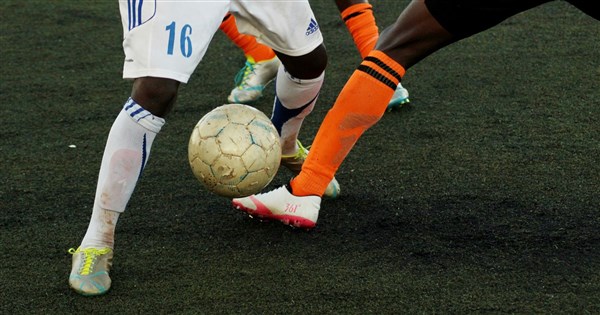
(CNA Web, 9th) The 2026 FIFA World Cup, co-hosted by the United States, Canada, and Mexico, is set to ignite a global football frenzy. For the first time, the tournament has expanded to 48 teams, with a total of 104 matches. Modern football emphasizes speed, space, and tactical shifts, making the coach's formations, on-field transitions, player records, and team honors key viewing points. During broadcasts, terms like 'hat-trick,' 'long-range shot,' and tactical discussions mentioning 'high press' and 'false 9' are common. What do they mean? CNA provides a guide to these World Cup keywords to help you deeply appreciate the changes and rhythm of contemporary football. In the past, football emphasized fixed roles, such as forwards attacking and defenders defending, with relatively clear player positions. However, modern football prioritizes speed and spatial utilization. Players frequently switch positions during matches, making their roles more diverse. Forwards may drop back to help organize play, and defenders may join the attack. Pressing at the opponent's doorstep! Teams actively press and try to win the ball as soon as the opponent begins to organize an attack, even before they cross the halfway line. This aims to force errors and launch quick counter-attacks closer to the opponent's goal. This tactic requires coordinated team movement and high-intensity running, speeding up the game but demanding immense physical fitness. The seemingly 'unorthodox' center-forward who actually confuses the defense is the 'false 9.' Unlike the traditional '9' (center-forward) who stays in the box waiting to shoot, the false 9 drops back to the midfield to participate in build-up play before attacking. This style disrupts the opponent's defensive rhythm, making it hard for defenders to decide whether to follow, and has changed the role of the modern forward. Lionel Messi is a prime example of a false 9. The 'half-space' is modern football's most fascinating attacking corridor, located between the center and the wing. It is less congested than the center and less restricted by the touchline. Many attacking combinations and shooting opportunities originate from here, making it a frequently mentioned concept in modern tactical analysis. 'Parking the bus' refers to an extremely defensive strategy where a team abandons attack to strengthen defense, essentially a '9-0-1 formation.' Except for one forward, almost the entire team defends in their own penalty area, like parking a large bus in front of the goal. It is common when a weaker team faces a stronger opponent. The 'bicycle kick' is a high-difficulty move where a player, in the air with their back to the goal, leans back and kicks the ball over their head with one foot. It requires excellent explosive power and core strength, used for saving or shooting. The 'Marseille turn' (or 'roulette') is a skill move where a player, when challenged by a defender, drags the ball with one foot and spins around 360 degrees, using their body to shield the ball and shake off the defender. It is quick and fluid, often seen in midfield and wing breakthroughs. French legend Zinedine Zidane and the late Argentine star Diego Maradona are famous for using this technique. A 'one-on-one' situation occurs when an attacking player breaks through the opponent's last line of defense and faces the goalkeeper directly. The attacker must stay calm and engage in a psychological and feinting duel with the goalkeeper, which is often decisive. The 'Panenka' is a penalty kick technique where the player feigns a shot to the corner but lightly chips the ball underneath, sending it in a parabolic arc down the center of the goal, deceiving the goalkeeper. Czechoslovakian player Antonín Panenka famously used this kick to win the 1976 European Championship final against West Germany. A player scoring two goals in a single match is a 'brace,' while three goals is the fan-favorite 'hat-trick.' Four or more goals is a 'haul' or 'poker.' Such performances usually indicate a player in top form. A 'wonder goal' refers to a difficult and spectacular goal, such as a long-range strike, a shot from a tight angle, or a technically challenging finish like a bicycle kick. An 'own goal' occurs when a player inadvertently kicks the ball into their own net. If a goalkeeper deflects the ball into their own goal, the referee judges whether it's an own goal. For example, if the attacker's shot was clearly heading into the goal, and the goalkeeper's touch doesn't change its path, it counts as a goal for the attacker, not an own goal. Furthermore, throwing a throw-in directly into one's own goal or scoring an indirect free kick into one's own goal are invalid goals and not own goals. A 'treble' refers to a team winning its domestic top league, its primary domestic cup, and its continent's premier continental club competition in the same season. Paris Saint-Germain achieved a treble in the 2024-2025 season by winning Ligue 1, the Coupe de France, and the UEFA Champions League. However, in the 2025-2026 season, despite retaining Ligue 1 and the Champions League, they failed to defend the treble due to an early upset exit in the Coupe de France. (Editor: Guo Yuru) 1150609
FACT BOX
- Source: CNA (Central News Agency)
- Category: Taiwan