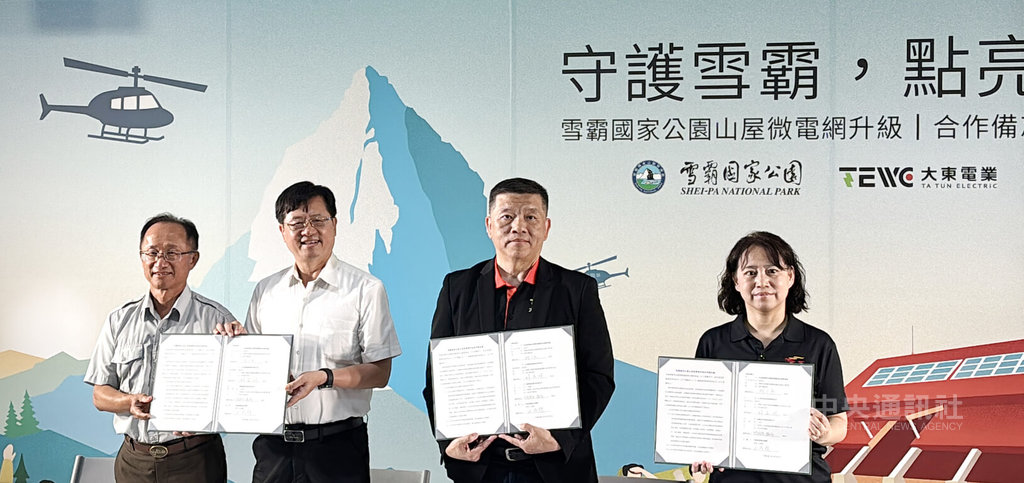
(Central News Agency, reporter Gao Huaqian, Taipei, June 9) Shei-Pa National Park is collaborating with enterprises to update the solar panels and energy storage facilities at four mountain huts. The priority is to upgrade the 'Taoshan Hut' from June 22 to 25, 2025. The overall power generation capacity will be increased by 3.7 times, and energy storage capacity by more than 6 times. The plan also includes installing a personal mobile phone USB charging socket at each bed, aiming to improve the resilience of high-mountain huts and climbing safety.
The Shei-Pa National Park Administration, under the National Park Service of the Ministry of the Interior, signed a Memorandum of Understanding (MOU) today with Ta Tung Electric Wire & Cable Co., Ltd. and Jin Jie Aviation Co., Ltd. for the 'Shei-Pa National Park Mountain Hut Microgrid Upgrade.' National Park Service Director Wang Cheng-Ji served as the witness.
In his speech, Director Wang stated that in this collaboration, Ta Tung Electric is donating solar panels, energy storage equipment, and related technical manpower support, while Jin Jie Aviation is donating high-mountain helicopter sling-load material transportation services. This will transport 680 kilograms of updated equipment to the high mountains, promoting the public-private partnership to update the solar panels and energy storage facilities at high-mountain huts.
Director Wang emphasized that this project will prioritize the system upgrade of the 'Taoshan Hut.' In addition to improving energy efficiency and power supply stability, it will also feature a personal mobile phone USB charging socket at each bed. He noted that mobile phone battery power is a precious resource for viewing maps and making emergency calls. Assisting climbers in charging their phones is beneficial for enhancing the resilience of high-mountain huts and climbing safety. The National Park will continue to gradually build a more resilient high-mountain service system through facility updates, making the national park an important demonstration site for promoting net-zero emissions and environmental education.
Yang Guo-Hua, Section Chief of the Environmental Maintenance Section of the Shei-Pa National Park Administration, pointed out that the high-mountain environment is long-term affected by low temperatures, strong winds, humidity, and large temperature differences between day and night. This has led to the gradual aging of existing solar panels and energy storage equipment in mountain huts, with some huts facing challenges such as unstable power supply and difficult maintenance. The MOU signed this time covers the improvement of microgrids in four mountain huts. The first phase will prioritize the improvement of the Taoshan Hut and Cuichi Hut in 2026 (the 115th year of the Republic of China). The second phase will improve the Xuebei Hut and Sumida Hut in 2027 (the 116th year of the Republic of China).
Section Chief Yang said that the Taoshan Hut will be equipped with a 3.735 kilowatt (kW) solar power generation system and a 10 kilowatt-hour energy storage system. The overall power generation capacity will be increased by 3.7 times, and the energy storage capacity by more than 6 times, significantly improving power supply stability and energy self-sufficiency. Furthermore, during consecutive cloudy or rainy weather, the energy storage system can still provide backup power for more than 3 days, ensuring the stable operation of lighting, communication, and mobile phone charging equipment. (Editor: Lin Shu-Yuan) 1150609
FACT BOX
- Source: CNA (Central News Agency)
- Category: Partnership