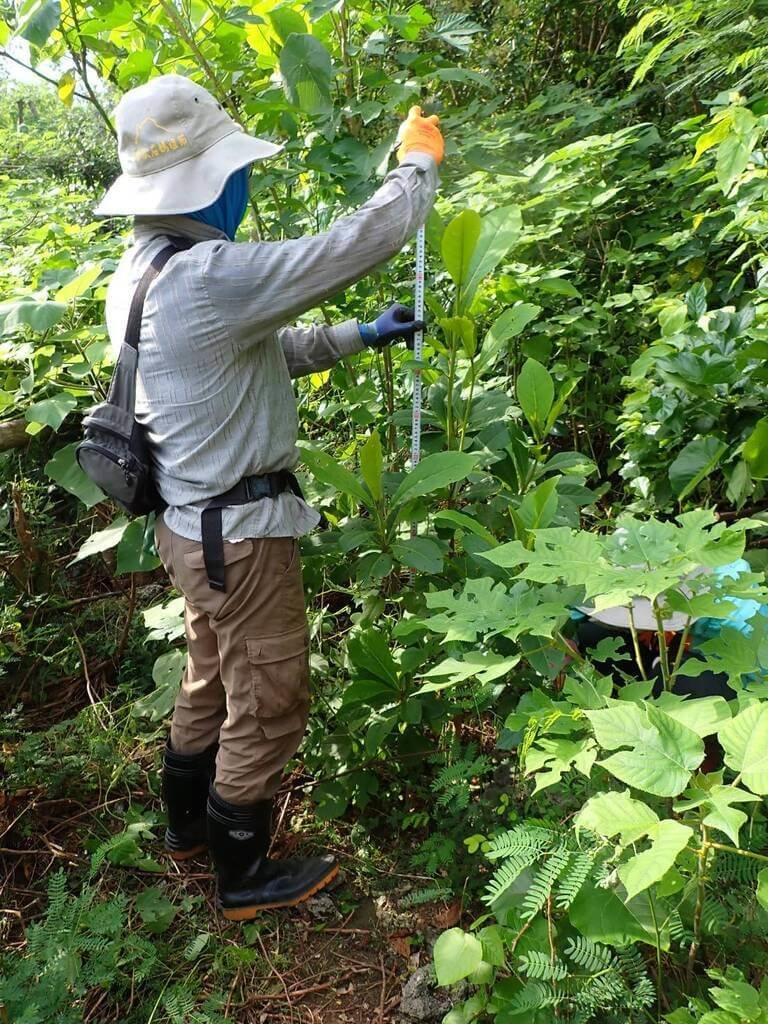
Central News Agency, Taipei, June 9th (Reported by Wang Shufen) Leucaena is an invasive alien plant species that has long threatened the coastal ecology of southern Taiwan. The Forestry Research Institute (TFRI) of the Ministry of Agriculture previously restored woodlands after removing Leucaena by transporting seedlings to the site for planting. Now, it has found that direct seeding on-site is more labor-saving.
The Ministry of Agriculture issued a press release today stating that the invasive alien species Leucaena has long threatened the coastal ecology of southern Taiwan. If the land is not promptly reforested after Leucaena removal, the plant will quickly return. The latest research by the TFRI has found that, in addition to planting container seedlings, directly sowing seeds of native plants can also successfully establish forests, offering another low-carbon, labor-saving option for coastal restoration.
The TFRI pointed out that in the past, woodland restoration often involved the traditional method of transporting seedlings to the site for planting, which was not only labor-intensive but also costly in terms of cultivation and transportation. In recent years, the TFRI team has experimented with direct seeding for restoration, allowing seeds to germinate and grow directly on-site. They found this helps plants gradually adapt to environmental stresses such as high temperatures, drought, and strong winds on the coast. This not only enhances the seedlings' adaptability to the coastal environment but also represents an ecological restoration method that is both labor-saving and low-carbon.
The TFRI team conducted experiments in the Hengchun Peninsula using the native tree species "Aglaia formosana" (Red Cedar). The results showed that directly scattering fresh, mature seeds from the current season yielded excellent germination and seedling survival rates. Additionally, in the local environment of strong winds and high salinity, the team simultaneously deciphered key seeding techniques for important native species like the Sea Almond (Terminalia catappa) and the Alexandrian Laurel (Calophyllum inophyllum). Notably, the Sea Almond, which has larger seeds, performed exceptionally well after direct seeding.
The TFRI stated that a more indicative finding was that after 1.5 years of growth on-site, seedlings grown directly from seeds had gradually caught up in height and stem diameter to container seedlings that were initially raised in a greenhouse and then transplanted. There was no significant difference in size between the two groups.
The research results show that direct seeding afforestation is highly feasible under appropriate conditions. In the future, it may reduce labor needs for seedling cultivation, transportation, and planting in some areas.
The TFRI indicated that in the future, by combining Aglaia formosana with wind-resistant and salt-tolerant native species, placing wind-wave tolerant species in the front line and canopy species behind, they can quickly construct a multi-layered forest with depth using direct seeding.
However, the TFRI noted that coastal restoration still faces multiple challenges such as harsh environments and weed competition. The direct seeding technique is not applicable to all tree species. The key to successful restoration lies in precisely selecting suitable species, mastering the timing of seed collection, conducting operations on-site during the rainy season, and utilizing natural rainfall as irrigation to improve seedling survival rates. (Editor: Guan Zhongwei) 1150609
FACT BOX
- Source: CNA (Central News Agency)
- Category: Survey
- Dates in source: 1150609