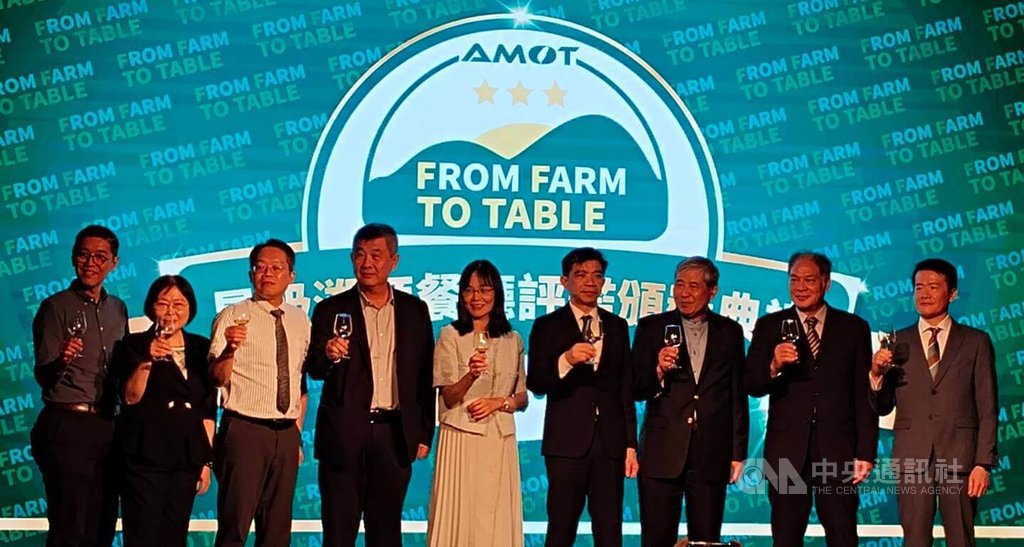
(Central News Agency, reporter Wang Shufen, Taipei, 9th) The Taiwan Agricultural Interdisciplinary Development Association, in collaboration with the Ministry of Agriculture, launched the traceable restaurant initiative in 2013, aiming to ensure consumers can dine with peace of mind. Initially, businesses adopted a wait-and-see approach, but as food safety issues gained increasing attention, approximately 1,600 restaurants now offer traceable ingredients, including popular local 'hot stir-fry' eateries.
The Taiwan Agricultural Interdisciplinary Development Association (AMOT) held the 11th 'Star-rated Traceable Restaurant Evaluation' awards ceremony today, showcasing the achievements of Taiwan's food and beverage industry in recent years in promoting food traceability, low-carbon supply chains, and sustainable dining. Representatives from the Ministry of Agriculture, Ministry of Environment, Ministry of Foreign Affairs, and the NGO International Affairs Council also attended.
Association Secretary-General Zhang Huanyun said in a media interview that the association pioneered a traceability platform in 2013, linking it to production and sales履歴 (traceability) and organic databases. This makes the sources of ingredients used by restaurants more immediate and transparent. By scanning the QR code of a traceable restaurant before ordering, consumers can see the time and source of ingredient deliveries, allowing the public to easily grasp the origin of safety-certified ingredients and confirm their freshness.
Zhang stated that becoming a traceable restaurant inevitably increases operating costs. Initially, businesses were hesitant; only 4 restaurants applied in the first year, and 3 withdrew in the second year. Subsequently, several food safety incidents in Taiwan prompted more food and beverage businesses to join the traceability system. The participation of well-known brands like Wowprime and McDonald's was a strong endorsement of the system. There are now approximately 1,600 restaurants, and consumer recognition has been a crucial factor in the rapid growth of traceable restaurants.
Zhang explained that the association has been conducting the 'Star-rated Traceable Restaurant Evaluation' for 11 years, with three levels. One star is based on using a single traceable ingredient; two stars require a broader scope of use; three stars require at least 5 traceable dishes with diverse ingredient items, not allowing repetition of a single item. This has gradually formed a recognizable market standard.
According to association statistics, restaurants with three stars currently account for over 30%, with the majority being two-star. Last year, the total amount of traceable ingredients used reached 5.82 million kilograms, demonstrating that the system has substantially boosted agricultural product sales.
Zhang noted that restaurants can use the association's platform to match with suppliers and farmers. Some brands even purchase directly from farmers, gradually breaking away from the traditional multi-tiered auction supply method. Suppliers who cooperate with shipments and fully log data can receive recommendations, making it easier for restaurants to find suitable sources. Because long-term contract farming and stable purchase prices are better than the auction market, farmers also gain higher security.
Zhang said that although some businesses have seen costs rise due to implementing traceability, they have not raised prices and remain committed. The main reasons are brand image and risk management. For example, a chain of hot stir-fry restaurants originally in New Taipei City first applied to become a one-star traceable restaurant, then applied for an upgrade to two stars without raising prices, and recently opened a branch in Taipei City.
Zhang mentioned that according to the association's survey, most consumers feel more at ease with restaurants that have joined the traceability system and show greater tolerance for occasional incidents involving the business.
Zhang concluded that Taiwan's practice of introducing production traceability and real-time verification mechanisms at the restaurant level has attracted attention from businesses in Singapore and Japan. Japan has even sent delegations to Taiwan for observation. (Editor: Guan Zhongwei) 1150609
FACT BOX
- Source: CNA (Central News Agency)
- Category: Event