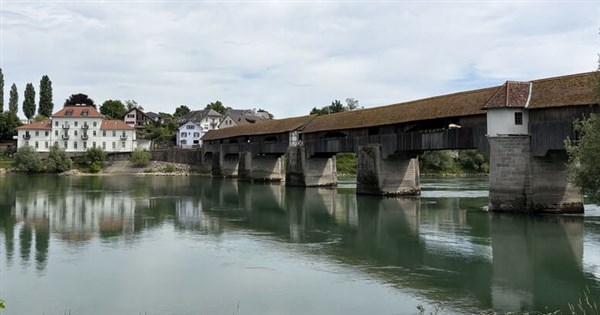
Spanning the Rhine River, the historic Holzbrücke Säckingen has been a channel connecting Switzerland and Germany since the Middle Ages. After multiple instances of damage and repair, the current structure is over 450 years old. With no border checks, one can walk from Switzerland to Germany in just a few minutes. The ancient bridge carries history, and residents on both banks have co-created a comfortable living circle.
The mighty Rhine flows with the small Swiss town of Stein on the left bank of the old bridge and the medieval German town of Bad Säckingen on the right. This historically significant bridge is named after Bad Säckingen and, at 203.7 meters long, is the longest covered wooden bridge in Europe. Because there are no border defenses, entry and exit are easy, creating a common living area for residents on both sides.
When our reporter visited the old bridge during lunchtime, many Swiss people were seen crossing to Germany to dine. One interviewee, a Swiss resident named Akim, said that although he lives in Switzerland, he heads to the German right bank every day. There are more shops and restaurants, the lifestyle is more relaxed, and the people are friendlier. Compared to the seriousness of Switzerland, the right bank is a place to enjoy freedom and relax.
A German resident, Natalie, said in an interview that she originally lived on the German right bank and now lives on the Swiss left bank because her husband is Swiss from the left bank. She believes that Swiss housing design and living-related regulations are more rigorous, and the living conditions in Switzerland are more comfortable and superior.
Furthermore, she mentioned that wages on the German right bank are only half of those in Switzerland. Although prices are lower, the overall prices on the right bank have also risen in recent years due to the increased volume of consumption by Swiss people, showing a mutual influence between the two banks.
Swiss-accented German can be heard everywhere on the streets of Bad Säckingen. George, an employee at a local coffee shop, also said, "We have customers from Switzerland every day. We live a harmonious and mutually beneficial life."
The old bridge, which carries the memories of the people, has also witnessed much history. During World War I, German and Swiss soldiers would sometimes even stop on the bridge to chat for a few moments, and old photographs have recorded these heartwarming moments of wartime.
During the Cold War in the 1970s, the Swiss government designated this bridge as one of the "permanent demolition facilities" on the border. If an invasion occurred here, the bridge had to be quickly blown up to prevent enemy tanks from entering Switzerland. During renovations in 2014, workers removed several hundred kilograms of explosives from two of the bridge piers.
When the pandemic broke out in 2020, the wooden bridge was completely sealed off with metal fences, and many families and lovers on opposite banks were forced to separate. They could only gaze at the other side or leave messages of longing on the bridge.
The Holzbrücke Säckingen was originally open to cars, but after a new nearby bridge was opened in 1979, the wooden bridge was converted for pedestrian and bicycle use only. People walk or cycle across the border, and the old bridge continues its centuries-old important function of economic, cultural, and interpersonal connection.
FACT BOX
- Source: CNA (Central News Agency)
- Category: 社會