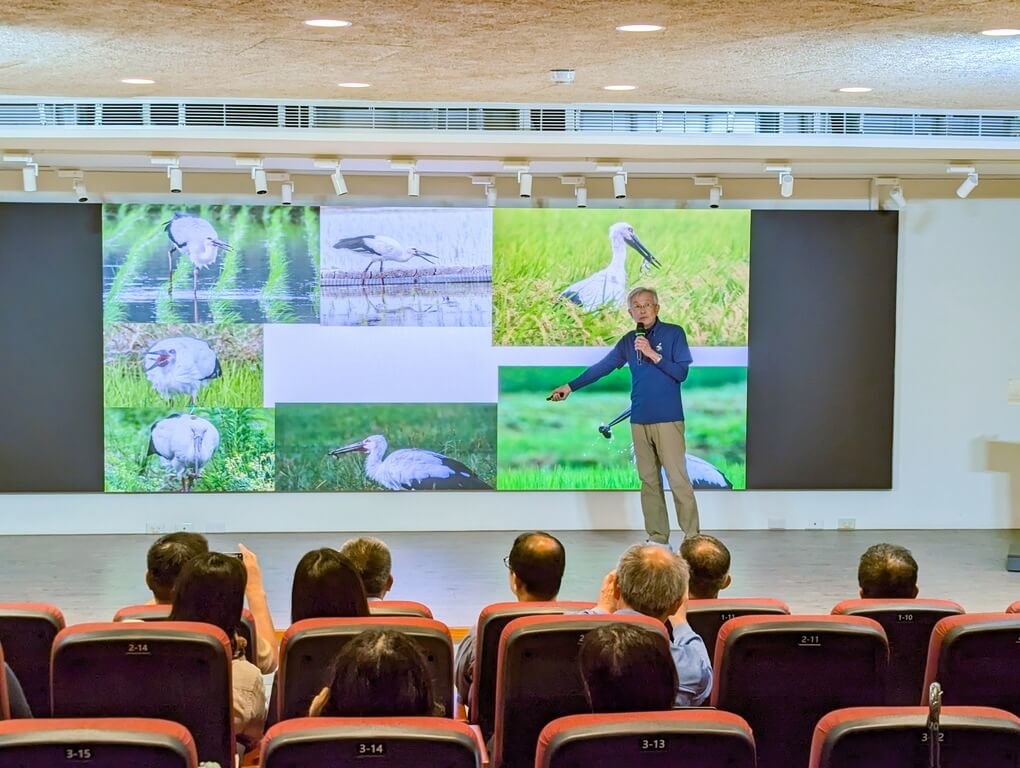
(Central News Agency, reporter Jiang Yijing, Yunlin County, 9th) Following the successful nesting and breeding of the protected Oriental White Stork in Yunlin County this spring, the Nantou Branch of the Forestry and Nature Conservation Agency invited the Oriental White Stork Society of Japan and other organizations on the 9th, aiming to use international experience sharing and local issue dialogue as a reference for future conservation efforts.
The Nantou Branch of the Forestry and Nature Conservation Agency, Ministry of Agriculture, held the "2026 Taiwan-Japan Conservation Symbiosis Area and White Stork Conservation Exchange Event" in Mailiao, Yunlin, inviting the Oriental White Stork Society of Japan, Kanazawa University, and Mailiao Cogeneration Company to participate.
The Nantou Branch stated that this spring, Oriental White Storks nested and bred on a power transmission tower at the border of Erlun and Lunbei townships in Yunlin County. The process, from egg incubation and chick rearing to fledging, attracted significant public attention. During this period, Mailiao Cogeneration made "ecological concessions" by adjusting operations to ensure power supply safety and grid stability, allowing the storks to successfully complete their breeding cycle, demonstrating a crucial corporate contribution to wildlife conservation.
The Nantou Branch noted that Japanese experts and relevant organizations first visited the Zhuoshui River estuary ecological site in the morning to discuss the stork's nesting tower, local habitat environment, and related management issues. In the afternoon, Setsuo Satake, Chairman of the Oriental White Stork Society of Japan, shared experiences from Toyooka City, Hyogo Prefecture, Japan, regarding the reintroduction of storks to the wild, artificial nesting towers, wetland creation, eco-friendly agriculture, and local participation.
Professor Naoki Kikuchi from Kanazawa University presented on how human society can coexist with nature from the perspectives of environmental sociology and regional resource management. Professor Sun Yuan-Hsun from the Institute of Wildlife Conservation at National Pingtung University of Science and Technology shared findings on the stork's home range, habitat use, and prospects for future conservation research from a Taiwanese research perspective. Additionally, a representative from the Forestry and Nature Conservation Agency reported on the current status of promoting conservation symbiosis areas in Taiwan.
The Nantou Branch hopes that through dialogue involving Japanese experience, Taiwanese research observations, and conservation policy practice, Taiwan can broaden its practical vision for large waterbird conservation, habitat management, and cross-sector collaboration in the future.
The Nantou Branch indicated that the exchange resulted in a preliminary consensus to continue monitoring the activities of Oriental White Storks in the Zhuoshui River basin and surrounding open landscapes such as farmland, wetlands, and fish farms. It also agreed to study the feasibility of establishing artificial nesting towers, monitoring habitat use, and conducting related conservation research in Taiwan, drawing on Japan's experience with stork restoration and artificial tower installation.
The Nantou Branch stated that it will continue to maintain exchanges with Japanese experts, domestic research teams, relevant agencies, and facility management units, hoping this event serves as an important starting point for Taiwan-Japan cooperation on Oriental White Stork conservation, gradually accumulating conservation practices suitable for Taiwan's environmental conditions. (Editor: Guan Zhongwei)
FACT BOX
- Source: CNA (Central News Agency)
- Category: Event