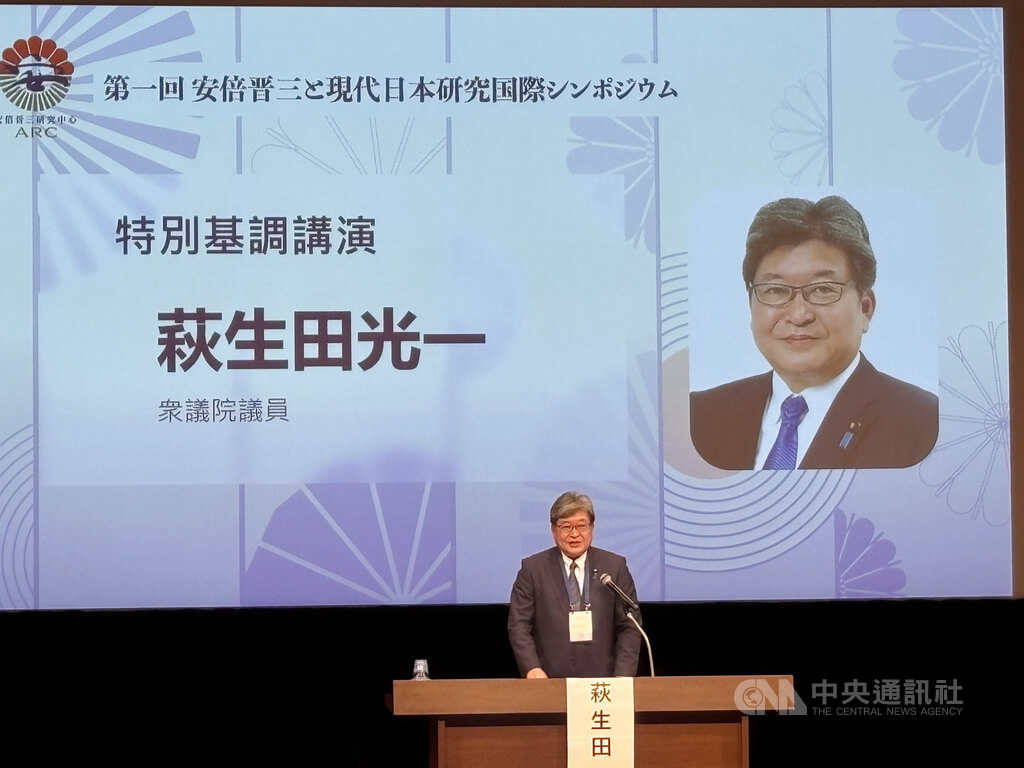
(Central News Agency reporter Dai Yazhen, Tokyo, 9th) Japanese House of Representatives member and Acting Secretary-General of the Liberal Democratic Party, Koichi Hagiuda, today used the term 'Free Pineapple' to describe Japan-Taiwan joint resistance against Chinese economic coercion. When China banned the import of Taiwanese pineapples, the late former Japanese Prime Minister Shinzo Abe publicly expressed support for Taiwan, sparking a buying boom in Japan. Today, Japan has become a crucial export market for Taiwanese pineapples, a concrete manifestation of the 'Free Pineapple' spirit.
The 'International Forum on Shinzo Abe and Modern Japanese Studies,' hosted by the Shinzo Abe Research Center at National Chengchi University in Taiwan, was held today in Tokyo. Hagiuda, Kenneth Weinstein, Director of the Japan Chair at the Hudson Institute in the US, Yoshiko Sakurai, Chairperson of the Japan Institute for National Fundamentals, and Presidential Advisor Chi-yi邱義仁 delivered keynote speeches discussing Abe's political legacy from various perspectives.
Hagiuda expressed deep emotion that National Chengchi University established the world's first research center named after Shinzo Abe last year, stating that as someone who has long followed Abe in political activities, he was deeply moved. Thinking of Prime Minister Abe's unwavering friendship with Taiwan over the years fills him with deep emotion.
He recalled that when China imposed an import ban on Taiwanese pineapples, Abe posted a photo of himself smiling while holding a Taiwanese pineapple on social media. This was shared by then-President Tsai Ing-wen, sparking a buying frenzy in Japanese society. He recently saw news that Japan now accounts for 99% of Taiwan's pineapple export market, which he said embodies the spirit of the 'Free Pineapple.'
He believes the 'Free Pineapple' is not only a symbol of Japan-Taiwan friendship but also demonstrates the power of democratic nations cooperating to counter economic coercion. He added that the legacy left by Abe continues to elevate the friendship and trust between Japan and Taiwan to higher levels.
Kenneth Weinstein, Director of the Japan Chair at the Hudson Institute, noted that many people summarize Abe's achievements as Abenomics, the National Security Strategy, the CPTPP, the Quad, or the Free and Open Indo-Pacific (FOIP) policy. However, he believes Abe's most important legacy is 'restoring Japan's national confidence.'
Weinstein pointed out that Abe made Japan believe again that it has the ability to shape the world, rather than being shaped by it. He described Abe as a rare political leader with long-term strategic thinking, capable of foreseeing trends decades ahead before others noticed.
He specifically mentioned Abe's 2007 speech titled 'Confluence of the Two Seas' at the Indian Parliament, which became a crucial source for the later Free and Open Indo-Pacific concept. Before most countries understood the importance of the Indo-Pacific strategy, Abe recognized that the Indian and Pacific Oceans form a single strategic space where the future international order would be reshaped.
Weinstein believes the most important value of FOIP is providing a strategic framework integrating security, economy, infrastructure, technology, and diplomatic cooperation. It successfully influenced US policy thinking and became a foundational Indo-Pacific strategy adopted by successive US administrations.
Presidential Advisor Chi-yi邱義仁 stated in his speech that the Free and Open Indo-Pacific strategy, now on everyone's lips, is actually the result of Abe's years of advocacy and efforts within the international community. Without Abe's foresight and efforts back then, the world might not have been able to establish a new Indo-Pacific strategic framework so quickly.
邱義仁 said that besides FOIP, the CPTPP is another important case demonstrating Abe's strategic thinking and execution ability.
He noted that after the US withdrew from the TPP in 2017, many believed the TPP was dead. However, Abe, deeply understanding the inseparable link between economy and security, continued to lobby member states and the Japanese Diet, ultimately realizing the CPTPP.
邱義仁 stated that the current international economic environment has undergone significant changes, with economic security gradually becoming a core global concern. He pointed out that China has long distorted the international economic order through subsidies, dumping, intellectual property infringement, and market monopolies, even weaponizing trade and economic tools to exert political pressure on other countries.
He emphasized that only through institutional cooperation among democratic, free, and like-minded nations can risks be effectively reduced. Therefore, the CPTPP must further incorporate the concept of economic security in the future, promoting institutional upgrades and restructuring towards a CPTPP 2.0.
He concluded that a person with only foresight but no action can only be a thinker; a person with only action but lacking a macro perspective can be dangerous. Abe became a great strategist precisely because he possessed both a macro perspective, profound thinking, and strong execution ability. (Editor: Chen Huiping) 1150609
FACT BOX
- Source: CNA (Central News Agency)
- Category: Event