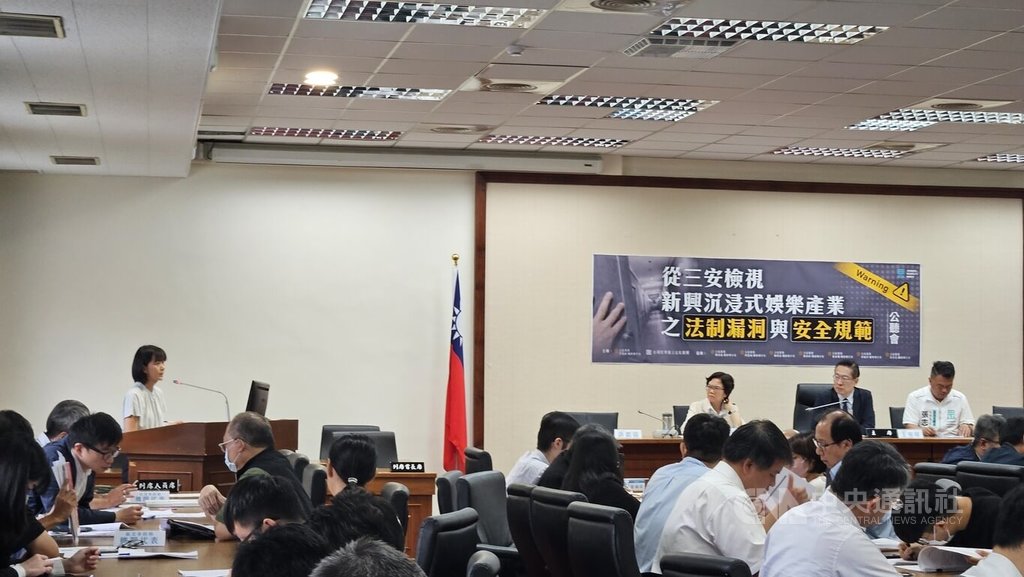
(Central News Agency, Taipei, June 9) The death of an escape room employee who suffocated while playing the role of a hanged ghost has sparked discussions on occupational safety. The Taiwan Immersive Experience Association announced today that it has introduced professional resources to draft exclusive occupational safety guidelines for the industry. Legislators from the Taiwan People's Party (TPP) suggested that the Ministry of Labor study the development of an occupational safety checklist more suited to the industry's characteristics.
The TPP legislative caucus held a public hearing today titled "Examining Legal Loopholes and Safety Regulations in the Emerging Immersive Entertainment Industry from the Perspective of Three Types of Safety."
Hsieh Sheng-yen, Executive Secretary of the Taiwan Immersive Experience Association, stated at the meeting that this incident is a painful lesson for the industry. The association deeply understands that if it cannot provide a reassuring environment, the industry has no reason to exist, and firmly believes that "without a safe space, there is no creative tomorrow." Therefore, regarding occupational safety, public safety, and civil safety, the association has no room for compromise and will adopt a pragmatic approach to enhance safety.
Hsieh said that after the incident, the association quickly introduced external professional resources, including labor-management consulting firms and the Occupational Accident Prevention Center, to aid in accident prevention. Furthermore, during the drafting of industry-specific occupational safety guidelines for actors and NPCs, professional institutions were brought in to assist, adding checklists to formulate clearer and more implementable operational procedures within the industry's unique spaces. The guidelines are currently undergoing field testing.
However, regarding current regulations, Hsieh noted that many structural bottlenecks remain. Taiwan's immersive experience industry currently comprises over 80 businesses and more than 1,000 employees, with an annual output value reaching NT$1 billion. Yet, in practice, businesses still face regulations formulated over a decade ago, leading to numerous conflicts. Therefore, better regulations are desired.
Huang Pao-shun, Chairman of the Taiwan Provincial Industrial and Mining Safety and Health Technicians Association, pointed out that immersive entertainment venues create spaces different from everyday environments. Therefore, when a disaster occurs, the reflexive muscle memory of participants and workers may make it impossible to avoid harm.
Huang stated that immersive experiences come in diverse forms, and their venues include elements such as escape routes, height differences, falls, and the release of gases or dry ice, all of which have caused safety hazards in other industries in the past. He suggested that the Ministry of Labor, after communicating and investigating potential occupational safety hazards, formulate occupational safety and health guidelines for the industry, providing a framework for businesses to follow and preventing the recurrence of such disasters.
TPP Legislator Wang An-hsiang also noted that the Occupational Safety and Health Administration had previously issued the "Occupational Accident Prevention Guidelines for the Film and Television Industry." Therefore, he suggested studying the development of an occupational safety checklist more suited to the specific equipment and venues of the immersive experience industry.
Chang Shu-ming, Senior Technical Specialist of the Occupational Safety and Health Administration, Ministry of Labor, responded on-site that the immersive industry includes escape rooms and interactive theaters, with potential risks such as working at heights, operating electrical equipment, and planning venue access routes. Regarding the establishment of relevant guidelines, he stated that if the competent authority for the industry deems it necessary in the future, the administration will fully cooperate. (Editor: Su Lung-chi) 1150609
FACT BOX
- Source: CNA (Central News Agency)
- Category: Taiwan