(Central News Agency, Reporter Shen Peiyao, Taipei, June 9) The Ministry of Health and Welfare's Centers for Disease Control (CDC) announced today the first confirmed domestic paratyphoid case of the year in Taiwan. The patient is a man in his 50s from northern Taiwan who developed symptoms including fever, headache, and body aches in late May. He sought medical attention and was hospitalized for 8 days before being discharged after recovery. The source of infection is still under investigation.
According to CDC statistics, there has been only 1 confirmed domestic paratyphoid case this year. The cumulative number of domestic cases from 2022 to this year is 6, 26, 3, 0, and 1, respectively. The cumulative number of imported cases for the same period is 0, 2, 1, 1, and 0, respectively. The countries of infection for imported cases from 2023 to 2025 were India (2 cases), Indonesia (1 case), and Cambodia (1 case).
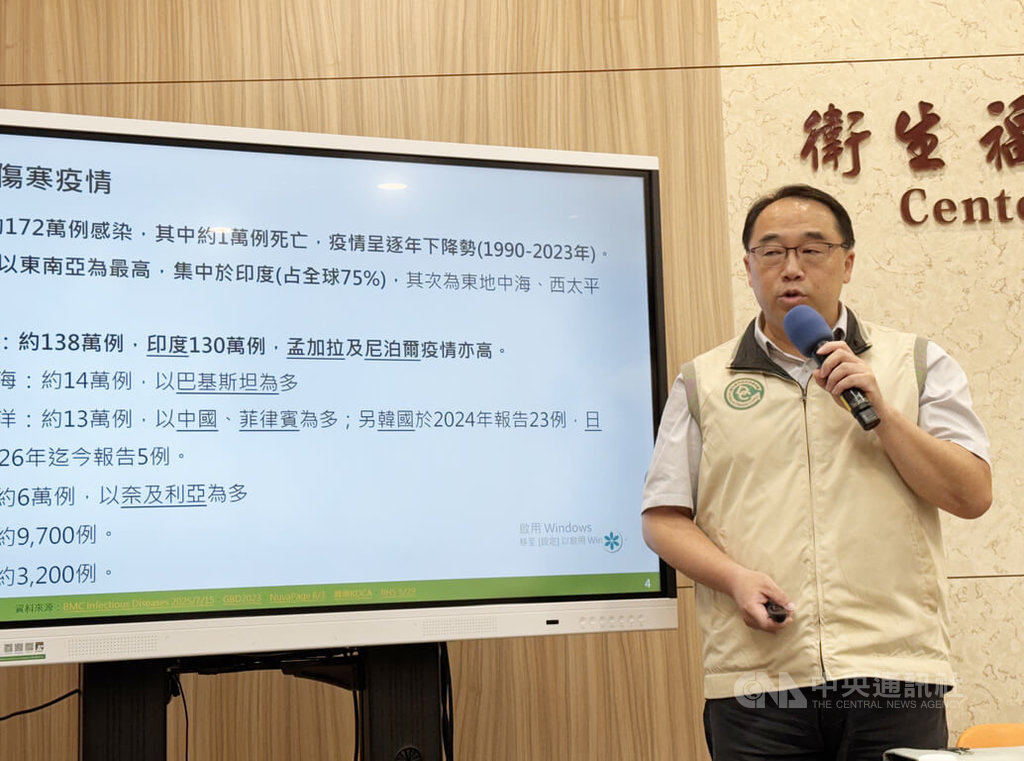
Regarding this new domestic case, Dr. Huang Po-Han, a CDC physician, explained during the routine epidemic report today. The man, a Taiwanese national in his 50s, had no underlying medical conditions and no recent travel history. He visited a clinic one day after developing symptoms of fever, headache, and body aches. After taking medication for 3 days without improvement, he went to a hospital outpatient clinic. Blood tests isolated Salmonella Paratyphi, confirming the diagnosis as a domestic case.
Dr. Huang stated that fortunately, the man was hospitalized and received antibiotic treatment for 8 days before being discharged after recovery. As the man reported no consumption of raw food, the cause of infection remains unknown. One household contact and seven workplace contacts showed no symptoms, and their stool samples all tested negative.
CDC spokesperson Tseng Shu-Hui stated that paratyphoid is mainly concentrated in areas with weaker health infrastructure, with the highest incidence in Southeast Asia. Taiwan only sees sporadic cases and faces the risk of imported cases. Like South Korea and Japan, which are frequent travel destinations for Taiwanese, sporadic cases still occur occasionally each year.
The CDC noted that paratyphoid is a Category 2 notifiable infectious disease. It is an intestinal infection caused by Salmonella Paratyphi, primarily transmitted through consuming food or water contaminated by the feces or urine of patients or carriers. The incubation period is typically 1 to 10 days, and the infectious period is 1 to 2 weeks. Common symptoms include sustained fever, headache, malaise, anorexia, abdominal pain, diarrhea, relative bradycardia, or a rash on the trunk.
The CDC urges the public to always pay attention to food and hand hygiene. Drinking water should be boiled or bottled, and food must be thoroughly cooked before consumption. During cooking and preparation, cross-contamination between raw and cooked food should be avoided. Furthermore, practicing good personal hygiene, such as washing hands thoroughly with soap and water before meals, after using the toilet, before handling food, or after changing diapers, is essential for effective prevention. (Editor: Li Hengshan) 1150609
FACT BOX
- Source: CNA (Central News Agency)
- Category: Survey