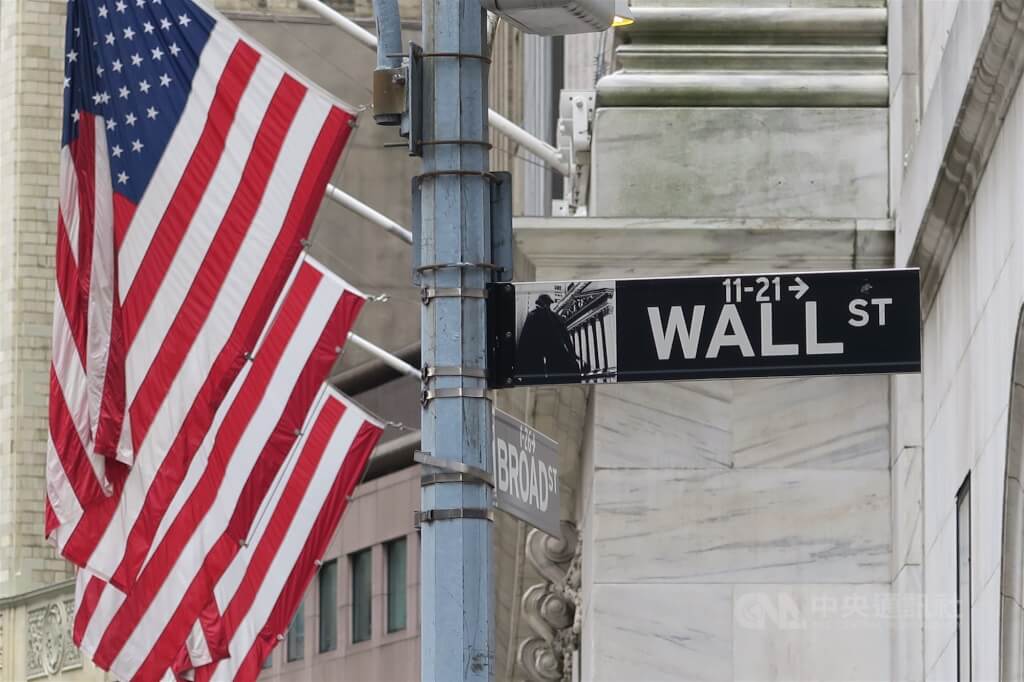
(Central News Agency, New York, 7th, Combined Foreign Reports) A stronger-than-expected U.S. jobs report triggered a sell-off, pushing bond yields higher. The market faces several challenges in the near term, including a key inflation report, SpaceX's initial public offering, and Alphabet's $85 billion equity financing deal.
When employment data beats expectations, the market logic is that the economy might be too strong, making it difficult to lower inflation and keeping interest rates high. Expectations of a hawkish Federal Reserve policy shift triggered the market sell-off.
According to the Wall Street Journal, the current downturn originated from a better-than-expected jobs report released on June 5, which sent the Nasdaq Composite Index down 4.2%, leading investors to anticipate a rate hike by the Fed before the end of the year.
Meanwhile, a sell-off in the bond market pushed yields on some U.S. Treasury bonds to their highest levels since early 2025, putting pressure on the stock prices of multinational corporations and small-cap companies focused on the domestic U.S. market. Gold prices fell to near their lowest levels of the year.
This crash has prompted warnings from Wall Street that more turbulence may lie ahead. Ray Dalio, founder of global hedge fund giant Bridgewater Associates, said the June 5 crash is a significant indicator, highlighting the central role that the global investor frenzy for artificial intelligence and related stocks has played in driving the stock market to record highs.
He noted that with valuations in related sectors already high and bond yields rising, bonds are now far more attractive than stocks. After the sharp decline on June 5, the market is in a fairly fragile state.
Dalio said, "The market and the economy's capital is concentrated in a brand new industry sector, which is highly volatile, extremely risky, yet feverishly pursued by inexperienced investors. This is a classic bubble phenomenon."
The report states that investors will face major tests in the coming days. One is a key inflation report, which will provide more data to influence the outlook on interest rates. The recent energy shock from the Iran war has also drawn more attention to this data.
Another test is the groundbreaking public listing of Elon Musk's SpaceX, which is just one of a series of large IPOs, borrowings, and stock issuances. These transactions could test investors' appetite for AI and other hot investment themes.
The June 5 sell-off in U.S. stocks was concentrated in chip companies. Dow Jones Market Data shows that the Philadelphia Semiconductor Index lost over $1 trillion in market value, although the index is still up 73% year-to-date.
A major trigger for the selling pressure was on June 3, when Broadcom told investors it expected quarterly revenue to triple year-over-year to $16 billion, but did not raise its 2027 financial outlook. As Broadcom is a key supplier of networking chips for AI data centers, the forecast raised doubts in the market about the future growth rate of the AI industry.
Investors had been betting that demand for chips from AI data centers would continue to drive massive profit growth across the industry. However, chip stocks fell for two consecutive days, and this decline dragged down South Korea's KOSPI index, which is heavily influenced by Samsung and SK Hynix, by more than 5% on the 5th.
Many investors had already anticipated a market correction and are comparing the AI rally to the dot-com bubble around 2000.
Ben Emons, a prominent strategist at Medley Advisors, even dubbed seven memory and chip stocks the "Parabolic Seven": AMD, Broadcom, Dell, Intel, Marvell Technology, Micron, and Sandisk.
Katie Stockton, founder of risk assessment consultancy Fairlead Strategies, said, "When the market's leadership is concentrated in a few names, the entire market becomes very fragile." (Editor: Chen Yiwei) 1150608
FACT BOX
- Source: CNA (Central News Agency)
- Category: Taiwan
- Organizations: Bridgewater Associates / Alphabet / SpaceX