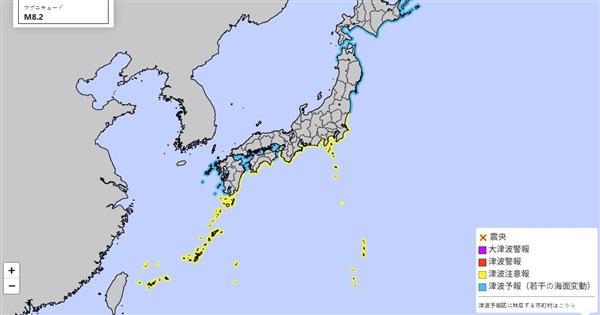
(Central News Agency, Tokyo, 8th - Special Report) A strong earthquake with a magnitude of 7.8 struck off the coast of Mindanao in the southern Philippines on the morning of the 8th. In response, the Japan Meteorological Agency issued tsunami advisories for multiple regions along the Pacific coast and held a press conference at 10:30 AM, urging people to stay away from the coast and maritime activity areas until the advisories are lifted.
According to the Pacific Tsunami Warning Center, an earthquake with a magnitude of 8.2 occurred off Mindanao, Philippines, at 7:38 AM Taiwan time, which was later revised down to 7.8. It is assessed that this earthquake could pose a tsunami threat in the Pacific region.
NHK reported that Shinji Kiyomoto, the Earthquake and Tsunami Countermeasures Planning Officer at the Japan Meteorological Agency, stated that due to the potential for a tsunami, residents should immediately leave the coast. He noted that even if the tsunami height is small, the currents will remain turbulent, so people should not enter the sea or approach the shore until the advisory is lifted.
According to the Japan Meteorological Agency's warning classification, a "Tsunami Warning" is for wave heights between 1 and 3 meters, while a "Tsunami Advisory" is for heights between 0.2 and 1 meter. Areas currently under a Tsunami Advisory include the Kanto region, Izu and Ogasawara Islands, Tokai region, Wakayama Prefecture, Kochi Prefecture, Miyazaki Prefecture, and eastern Kagoshima Prefecture.
Kiyomoto pointed out that near the epicenter of this earthquake, a magnitude 7.6 earthquake occurred in December 2023, which also generated a tsunami observed in Japan. Furthermore, in August 1976, a magnitude 8.0 earthquake occurred nearby, also generating a tsunami. Earthquakes that cause tsunamis frequently occur near the Philippines.
He mentioned that, for reference, in a similar earthquake in the same region in 2023, it took approximately 9 hours from the issuance of the tsunami advisory to its cancellation. At that time, a 40-centimeter tsunami was observed on Hachijo Island.
He stated that tsunamis can create complex wave movements in coastal areas and may overlap to form higher waves, so he hopes residents will refrain from approaching the coast for the time being.
Regarding the development of the tsunami, Kiyomoto explained that tsunamis caused by large overseas earthquakes are often not largest in the first wave; subsequent waves can be higher. The Meteorological Agency will continue to assess whether adjustments to tsunami information or warning levels are necessary based on actual observations.
Additionally, based on local tidal observation data, a tsunami of approximately 0.5 meters has been observed in the Davao region of the southern Philippines.
Kiyomoto noted that this is a very large earthquake, so subsequent seismic activity may become more active. However, he stated that generally, if only earthquakes of around magnitude 6 occur subsequently, they are not expected to cause a tsunami impact on Japan.
FACT BOX
- Source: CNA (Central News Agency)
- Category: Taiwan
- Organizations: NHK