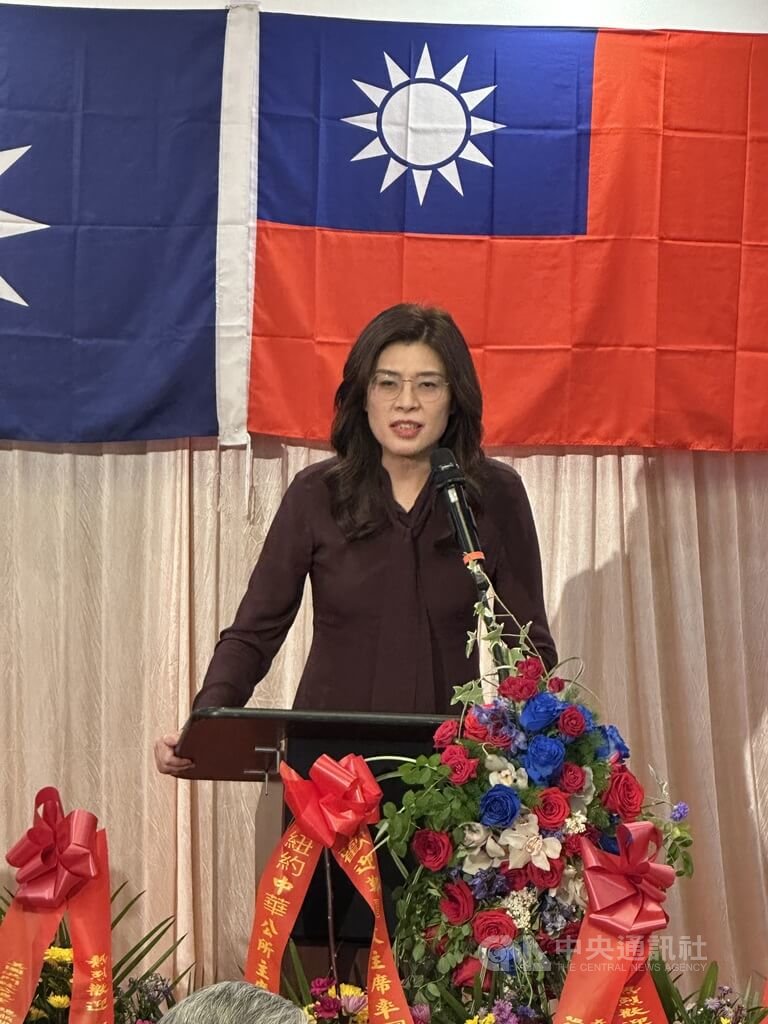
(CNA reporters Yeh Su-ping, Lin Ching-yin, and Liu Kuan-ting, Taipei, June 8) The Democratic Progressive Party (DPP) stated today that during KMT Chairperson Cheng Li-chun's visit to the United States, she reportedly met with an official from China's United Front Work Department. Additionally, Fu Kun-chi, convener of the KMT's Legislative Yuan caucus, proposed an amendment to the Nationality Act that would exempt Chinese nationals from renouncing their citizenship to participate in politics in Taiwan. The DPP criticized the KMT for repeatedly enabling pro-China statements by Cheng and attempting to create special exceptions for Chinese nationals, which would leave Taiwan's doors wide open—an outcome the Taiwanese people would not accept.
Regarding reports that Yu Guo-liang, an official from the Chinese Communist Party's United Front Work Department, attended Cheng Li-chun's overseas Chinese banquet in Boston, the KMT responded that Yu was a guest invited by a Taiwanese overseas compatriot attending the event. Chang Yun-lan, the standing committee member of the KMT's Overseas Affairs Department in Boston and organizer of the banquet, did not know Yu, and his name and affiliation were not listed on the banquet's guest list. Yu took a group photo with Cheng Li-chun when she was toasting guests table by table, but he did not dine at the same table as Cheng.
DPP spokesperson Wu Cheng made a statement this morning, criticizing Cheng Li-chun's trip to the U.S. He pointed out that her delegation included Chin Peng-chen, a KMT Central Standing Committee member married to a Chinese national, who has publicly advocated for 'early reunification across the Taiwan Strait.' Cheng also heavily promoted the idea of a 'Xi-Cheng meeting,' stating that 'without a Xi-Cheng meeting, I am insignificant,' causing widespread shock in Taiwanese society.
Wu said that the latest reports of Cheng dining with an official affiliated with the CCP's United Front Department show that every word and action during her trip served as propaganda for the Chinese Communist Party, with her rhetoric perfectly synchronized with that of China's Taiwan Affairs Office. He accused Cheng, as chair of Taiwan's largest opposition party, of willingly becoming a special envoy for Xi Jinping.
Wu added that during Cheng's U.S. visit, which coincided with the 37th anniversary of the June 4 Tiananmen Square incident, the KMT headquarters made the unprecedented move of remaining completely silent on the issue. This, he said, clearly shows that Cheng has become a subordinate and agent of the CCP, explaining why even U.S. media have referred to her as 'Beijing's person.' He asserted that Cheng's hidden pro-China, pro-unification agenda cannot deceive the Taiwanese people or the international democratic community.
Wu further criticized that while Cheng acted as a mouthpiece for the CCP in the U.S., the KMT is simultaneously undermining Taiwan's democracy domestically. Fu Kun-chi's proposal to amend the Nationality Act to allow Chinese nationals to participate in politics in Taiwan without renouncing their Chinese citizenship violates the principle that public officials of the Republic of China must have sole loyalty and cannot hold dual citizenship—a rule not targeted solely at Chinese nationals. The KMT's attempt to create a special exception for Chinese nationals would leave Taiwan's gates wide open.
Chuang Jui-hsiung, chief whip of the DPP's Legislative Yuan caucus, also said at a press conference this morning that 'if both sides of the strait belong to one China, where does sovereignty lie?' He emphasized that the two sides cannot belong to one China, and as chair of the largest opposition party, Cheng has no right to declare this to the outside world. To claim that both sides belong to one China would be the greatest disruption to the current status quo. (Edited by Hsieh Chia-chen) 1150608
FACT BOX
- Source: CNA (Central News Agency)
- Category: Taiwan