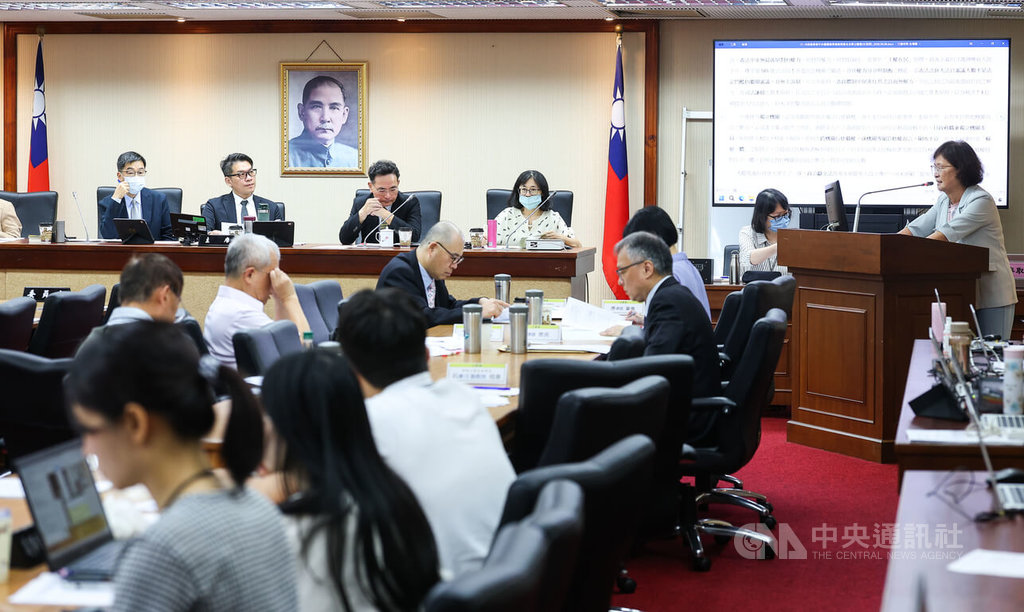
(Central News Agency, reporter Chen Chun-hua, Taipei, 8th) The Executive Yuan has made a supplementary nomination of Deputy Minister of Justice Huang Mou-hsin as a member of the Central Election Commission (CEC). Some scholars believe that it is absolutely inappropriate for a politically appointed head of the prosecution system to concurrently serve as a member of an independent commission. Other scholars argue that the Ministry of Justice is responsible for investigating election offenses, and there is a need for business coordination, which is unrelated to party politics and is purely a functional consideration.
The Legislative Yuan voted on March 13 to approve the nominations of CEC Chairperson nominee You Ying-long and three other commissioners, but rejected the nominations of Vice Chairperson nominee Hu Bo-yan and two others. On April 21, the Executive Yuan appointed You Ying-long and three other commissioners and made supplementary nominations of former Executive Yuan Counselor Shen Shu-fei as Commissioner and Vice Chairperson, and lawyers Tsai Wei-che and Huang Mou-hsin as commissioners, sending them to the Legislative Yuan for review.
The Legislative Yuan's Internal Administration, Justice, and Legal System Committees held a public hearing today on the "Executive Yuan's submission of the list of nominations for members of the Central Election Commission, with Shen Shu-fei as Commissioner and Deputy Chairperson, and Tsai Wei-che and Huang Mou-hsin as Commissioners, for consent."
Kainan University Department of Law Adjunct Associate Professor Chang Kuei-mei stated that the CEC is an independent agency, and the unity of the prosecution is well-known. If a high-ranking official of the prosecution agency, especially a politically appointed one, concurrently serves as a member of an independent commission, the independence of that commission would be challenged institutionally. She questioned how such cross-agency authority could be exercised.
Chang Kuei-mei said that it is "absolutely inappropriate" for a politically appointed head of the prosecution system to concurrently serve as a member of an independent commission, as it would undermine the system. Although the personnel authorities pointed to past precedents, she clarified that those precedents did not involve politically appointed prosecution heads.
Aletheia University Department of Law Professor Wu Chin-chin commented on Huang Mou-hsin's nomination, saying, "Was this a mistake? Shouldn't he have been nominated as Prosecutor-General?" Regarding whether a Deputy Minister is suitable to concurrently serve as a CEC commissioner, he said that while it is legally permissible to nominate him, there is an issue of independence. The requirement for independence while serving as a Deputy Minister creates a conflict.
Former CEC Commissioner and lawyer Chen En-min stated that before the legalization of CEC commissioners, the President would nominate the Deputy Minister of the Interior and the Deputy Minister of Justice as ex-officio CEC commissioners. This was necessary because the Ministry of Interior oversees police and household registration, and the Ministry of Justice oversees election offense investigations. After legalization, the practice of including the Deputy Minister of the Interior continued without interruption, but the inclusion of the Deputy Minister of Justice was discontinued.
Chen En-min pointed out that the nomination of Huang Mou-hsin as a CEC commissioner this term reflects a need for business coordination. Whether to revive this practice is a matter for institutional discussion. "This is unrelated to party politics; it is a purely functional consideration," he said. He suggested amending the CEC Organizational Act to change the status of relevant ministry heads from "concurrent" commissioners to "attendees" of CEC meetings, which is a worthwhile approach.
Fu Jen Catholic University College of Law Assistant Professor Yao Meng-chang called on the Legislative Yuan to exercise its power of consent as soon as possible, allowing the CEC to operate according to its original legal design with 9 to 11 commissioners. This would prevent the executive branch from acting unilaterally and ensure the fairness and objectivity of election affairs. He warned that if the Legislative Yuan delays exercising its power of consent, it would infringe on the CEC's spirit of collegiality, and he expressed hope that the Legislative Yuan would fulfill its constitutional duty of loyalty. (Editor: Su Zhi-zong) 1150608
FACT BOX
- Source: CNA (Central News Agency)
- Category: Taiwan