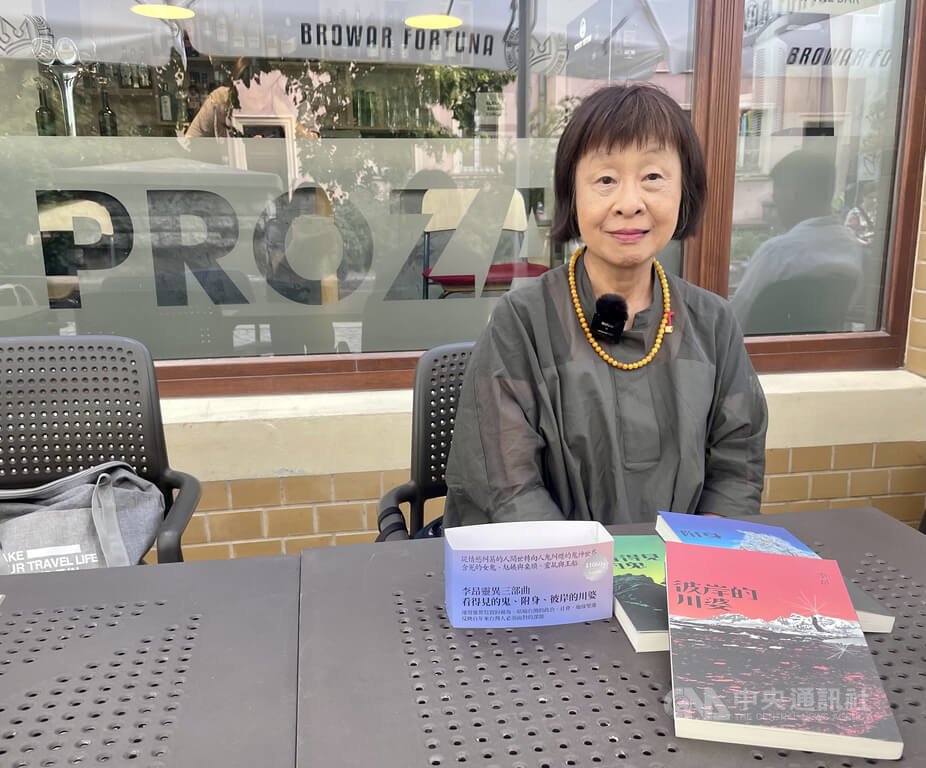
(Central News Agency correspondent Zheng Jingyu, Warsaw, 8th) The Central European literary event 'Writers' Reading Month' opened in Poland on the 6th, with Taiwan serving as the honorary guest of honor, led by writer Li Ang. Li Ang gave an exclusive interview to the Central News Agency, discussing her connection with Polish readers and how Taiwanese literature is gaining international attention.
●The Shock of the Warsaw Book Fair: Resonance of Women in a Catholic Society
Li Ang's representative work 'The Butcher's Wife' caused a sensation when its Polish edition was published in 2023. Local television stations gave it extensive coverage, and hundreds of people filled the lecture hall. Li Ang said that in the 40 to 50 years of her works' international publication, this was the first time she had received such a grand welcome abroad.
She analyzed the 'Taiwan fever' at the time as having two main reasons: first, the outbreak of the Ukraine war led to public discourse that 'after Ukraine comes Taiwan,' drawing attention to Taiwan's geopolitical status; second, Poland's deep-rooted Catholic cultural background.
'Compared to Western Europe, Poland is relatively conservative on women's issues, abortion, and sex,' Li Ang pointed out. 'The Butcher's Wife''s intense plot brought a great shock to local readers.
Many female readers privately asked after book signings how to become more independent in their sex lives and personal lives. These exchanges made her see that behind the seemingly open European society, women still face many invisible taboos and restrictions.
●Chips and Geopolitics: An Opportunity for Taiwanese Literature to Be Seen by the World
Regarding the international visibility of Taiwanese literature, Li Ang believes this is first attributable to the key position of Taiwanese chips in the global industrial chain, and secondly to the tense cross-strait relations.
'Because Taiwan has been seen politically, Taiwanese literature has been seen. I'm sorry to say this, but it seems unavoidable.'
She emphasized that for a work to attract international readers, it must possess both 'Taiwanese characteristics' and a 'global perspective.'
Using 'The Butcher's Wife' as an example, it has seen a wave of retranslations in Italy, Spain, and South Korea in recent years, with the focus shifting from women's rights to the more universal issue of domestic violence. The uniquely Taiwanese culture of 'gossiping aunties' (三姑六婆), wrapped around the globally shared dilemma of domestic violence, has become a key element for the work to transcend borders.
●Unique 'Supernatural Realism': Using 'Burning the King Boat' as a Metaphor for Cross-Strait Tensions
Li Ang read an excerpt from her book 'The River Woman on the Other Shore' at the event. She specifically proposed the literary concept of 'supernatural realism' to distinguish it from Latin American 'magical realism.'
She stated that the supernatural elements in her works originate from the major transformations in Taiwanese society. 'The River Woman on the Other Shore' depicts the traditional Taiwanese religious ritual of 'burning the king boat' (燒王船), using it as a metaphor for the profound geopolitical differences between the two sides of the strait.
In the novel, king boats symbolizing plague gods from coastal China repeatedly drift to Taiwan. The residents continuously send them back but eventually have to build a temple to enshrine them.
'This is absolutely not just about religion; it involves complex social and human nature behind it.' She also looks forward to observing how Polish readers understand Taiwan's unique religious culture and social experiences.
●Times Change, But the Novel Will Not Die; Worries About Extreme Polarization in Taiwanese Society
Facing the digital age and the wave of artificial intelligence (AI), Li Ang admitted that it is increasingly difficult to get young people to read novels of 80,000 to 100,000 words. However, she is not pessimistic about the future of literature.
In recent years, Li Ang has experimented with adapting works like 'The Lustful Goddess of the North Harbor' and 'The Mandarin Duck and Spring Feast' into adult comics, which have been well-received. 'Times will change, but content and text will always need literary writers to provide them. The novel will not die.'
Li Ang also observed the extreme polarization of Taiwanese society. Taiwan has open attitudes towards sex and has legalized same-sex marriage for years, but the younger generation is polarized: on one side are those with rich sexual experience and bold exploration, and on the other are the 'pure-hearted ones' who live online and lack real emotional connections. Social changes such as not marrying and not having children, coupled with cross-strait relations, are tearing Taiwanese society apart. She called on the public to avoid online abuse and confrontation and to promote rational dialogue in society. (Editor: Chen Yanjun) 1150608
FACT BOX
- Source: CNA (Central News Agency)
- Category: 事件
- Dates in source: 1150608