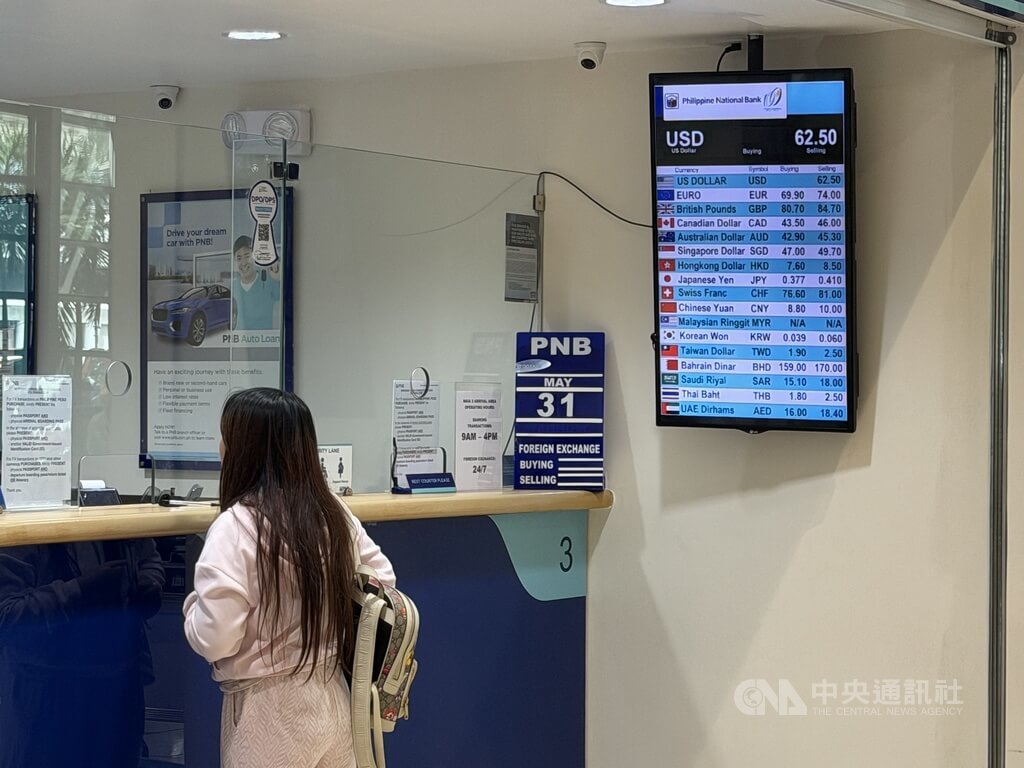
(Central News Agency, correspondent Lin Xingjian, Manila, 7th) The Philippines is currently facing the dual pressures of high inflation and a depreciating peso. Although export-oriented Taiwanese businesses may benefit from the weak peso, the rising cost of living for employees could lead to greater wage adjustment pressures in the future.
According to data from the Philippine Statistics Authority (PSA), the inflation rate rose to 7.2% in April and fell to 6.8% in May, still far exceeding the central bank's target of 2% to 4%. Meanwhile, the peso-dollar exchange rate fell to a historic low of over 61.72 pesos per US dollar in mid-May, drawing market attention.
Hsieh Chia-chen, President of the Federation of Taiwanese Chambers of Commerce in the Philippines, told CNA that in terms of purchasing power, "1,000 pesos in 2018 is roughly equivalent to only about 750 pesos now." She noted that oil prices are also twice as high as before, and costs for transportation, food, and daily expenses continue to rise, impacting low-income families most significantly.
Hsieh said that to help employees cope with rising living costs, many Taiwanese companies have recently started providing monthly transportation or living allowances to ease their burden and help them through this difficult period.
Malacañang Palace explained that the strong US dollar, surging global oil prices, and the Philippines' dependence on imported energy have led to a surge in dollar demand, widening trade and current account deficits, and causing the peso to depreciate. Rising oil prices are also reflected in transportation, logistics, and food costs, fueling inflation.
For the general public, the most direct impact is the increase in spending on transportation, electricity, and food. Businesses are also under pressure, facing the dilemma of losing customers if they raise prices or incurring losses if they do not.
Despite this, the weak peso offers some short-term benefits for export-oriented industries.
Chang Che-chia, President of the Subic Bay Taiwanese Business Association, told CNA that most Taiwanese companies in the Subic Bay Freeport Zone are in manufacturing and exports. With income in US dollars and salaries paid in pesos, a weak peso is beneficial for reducing labor costs in the short term.
However, Chang warned that the exchange rate advantage may not last long, as continued increases in oil and commodity prices will raise workers' living costs, inevitably increasing pressure for wage hikes in the future.
Beyond economic factors, recent political turmoil has also become a market focus. Two to three months ago, transport groups frequently went on strike and protested due to rising oil prices. More recently, the impeachment complaint against Vice President Sara Duterte was submitted to the Senate, plunging the political arena into more intense infighting. Gunshots were even heard within the Senate compound, and a leadership dispute emerged, undermining investor confidence.
In the first quarter of this year, the Philippine economy grew by 2.8%, below market expectations. On the 2nd, the ASEAN+3 Macroeconomic Research Office (AMRO) revised down its 2026 economic growth forecast for the Philippines to 4.1% in its regional economic outlook update, down from a previous estimate of 5.3%.
Facing economic difficulties, the Marcos administration launched the "UPLIFT" (Unified Package for Livelihood, Industry, Food, and Transport) assistance program, integrating transport subsidies, fuel aid, food supply stabilization, and support for vulnerable families. The Bangko Sentral ng Pilipinas (BSP) also raised interest rates in late April to try to curb inflation and support the peso.
However, some observers worry that UPLIFT is more of a "short-term painkiller" than a "long-term prescription." They suggest enhancing energy self-sufficiency, improving infrastructure, and attracting more investment to create jobs and boost productivity, thereby strengthening resilience against external economic shocks. (Editor: Tang Shengyang) 1150607
FACT BOX
- Source: CNA (Central News Agency)
- Category: Taiwan