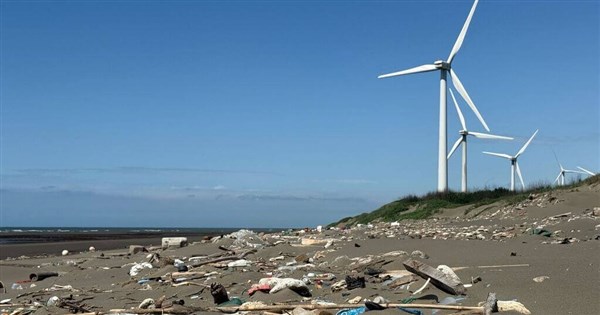
This beach needs cleaning 1 (Central News Agency reporter Zhang Xiongfeng, Taipei, 7th) Every year before National Ocean Day on June 8th, beach clean-up events take place one after another, totaling tens of thousands annually. However, statistics show that the top 10 most popular clean-up locations are concentrated in just 4 counties and cities across Taiwan. Environmental groups have surveyed and built a 'Dirty Beach Map', hoping that even less popular beaches will get cleaned.
According to statistics from the Ministry of Environment, there are over 10,000 beach clean-up events each year, with about 170,000 participants annually. 'The locations where people apply to clean up are too concentrated, leading to an uneven distribution of resources,' Tsai Sheng-yen, Project Manager for the clean-up initiative at Taiwan's environmental education group RE-THINK, told CNA reporter helplessly.
The Ministry of Environment's '2021 Coastal Rapid Survey' found that the amount of waste on the west coast of Changhua, Yunlin, Chiayi, and Tainan accounted for 37% of the national total, the highest, marking these coastlines as needing enhanced and more frequent cleaning. This was followed by the Kaohsiung and Pingtung coast, which accounted for 11% of the national waste. The proportion of coastal waste from outlying islands was 11% for Penghu, 12% for Kinmen, and 9% for Matsu.
Since the 'Salute to the Ocean' coastal clean-up and maintenance plan was launched in 2020, according to the Ministry of Environment's Coastal Clean-up Information Platform, among the top 10 hotspots for clean-up applications last year, Taoyuan City had the most with 4 locations, followed by New Taipei City, Kaohsiung City, and Taichung City with 2 each. However, the Changhua, Yunlin, Chiayi, and Tainan areas, which were originally assessed as needing enhanced cleaning, did not make it into the top 10.
Analyzing the reasons behind this, Tsai shared his experience from years of organizing clean-ups. He noted that when the public and companies choose a clean-up location, they are often limited by 'space' constraints, including whether the terrain is gentle, if there is sufficient parking, restrooms, and a large enough area to accommodate the number of participants.
To break the dilemma of popular spots being cleaned repeatedly while remote beaches are neglected, RE-THINK partnered with the General Association of Scouts of the Republic of China to survey 146 beaches nationwide. From these, they selected 50 key dirty coastlines and built an online 'National Dirty Coastline Map', or 'Dirty Beach Map', in an attempt to guide private resources.
Tsai said the original intention of building the dirty coastline map was the realization that resources were somewhat unevenly distributed. The map classifies beaches into three levels: 'clean', 'fair', and 'dirty'. It selects 50 'dirty' beaches and aims to monitor whether they can gradually become cleaner through clean-up efforts. It also serves as a reference for companies or individuals interested in organizing clean-ups.
Similarly, Chen Ren-ping, CEO of Haiyong Studio, which has long organized beach clean-ups, told CNA that when assisting corporate clean-ups, they design the event based on the age and number of participants. If the group is small and consists of adults, they recommend cleaning dirtier beaches that are more difficult to access.
Furthermore, to allow participants to collect more trash, Chen has put some thought into the routes. For example, by changing the entry point and walking a bit further before descending onto the beach, participants can find a greater amount of trash.
However, there are still limitations. Chen pointed out that rocky beaches like Waimushan in Keelung, which resemble cliffs, are not the first choice for clean-ups. Also, while the coastline in Linkou is sandy, it is near many industrial parks and construction sites with complex routes, so those locations are not specifically chosen either.
RE-THINK hopes to overcome the challenge of hard-to-reach corners through local collaboration. Speaking about local empowerment, Tsai mentioned that last year RE-THINK trained 9 clean-up squad leaders and established partnerships with 6 local organizations to serve as stationed clean-up activity personnel.
For example, a beach at Fengchuisha in Pingtung, due to its remote location, has accumulated a large amount of marine debris over the years. RE-THINK partnered with a local dive shop, as the sea is closely related to their life and work, and they were willing to help. After training, corporate resources were directed to key coastlines with local empowerment mechanisms. Statistics later showed that the amount of trash removed from these heavily affected beaches increased from 6,842 kg in 2024 to 10,410 kg in 2025. (Editor: Chen Qingfang) 1150607
Choose to stand with the facts. Your support is the power to protect press freedom.
Download the Central News Agency 'Yi Shou Xin Wen' app to get the latest news instantly.
The text, images, and audio/video on this website may not be reproduced, publicly broadcast, publicly transmitted, or used without authorization.
FACT BOX
- Source: CNA (Central News Agency)
- Category: キャンペーン