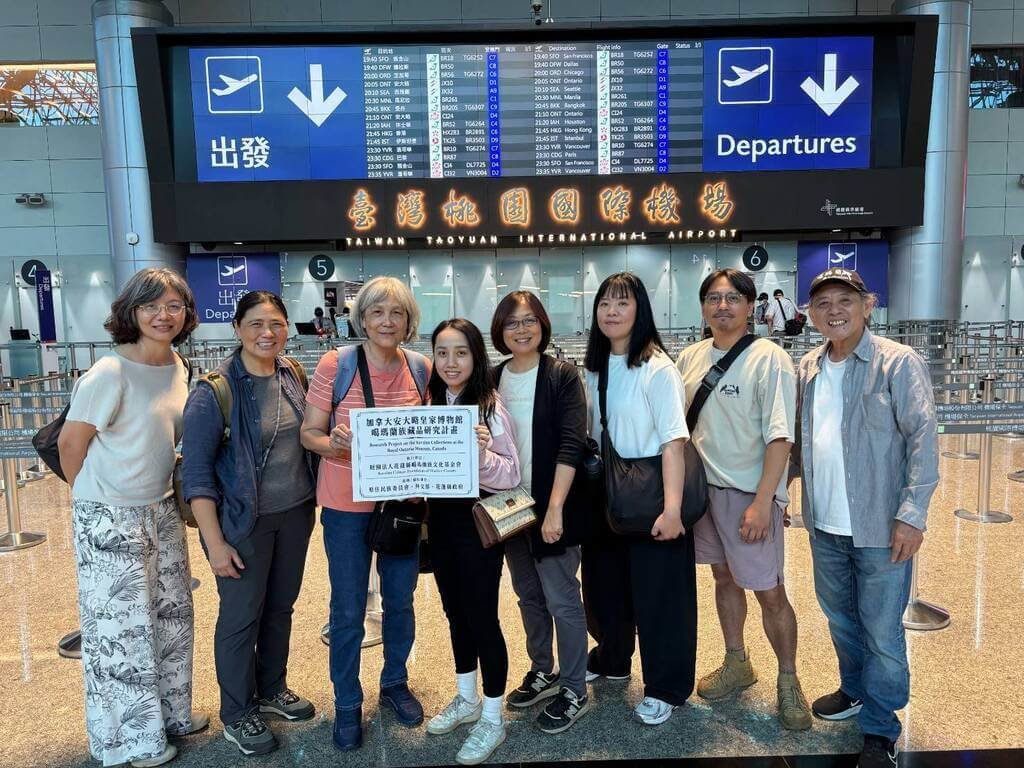
(Central News Agency, Hualien County, 7th) A team from the Hualien County Kavalan Cultural Foundation departed for Canada on the 5th to conduct the "Royal Ontario Museum Kavalan Collection Research Project." They will closely study over 40 Kavalan artifacts collected by Reverend Mackay from the Lanyang Plain and film a documentary.
The research team, organized by the Hualien County Kavalan Cultural Foundation, will reconstruct the weaving memories of their ancestors. This is the Kavalan people's first trip to the Royal Ontario Museum in Toronto, Canada, after a decade of planning.
Presbyterian missionary George Leslie Mackay visited the Lanyang Plain multiple times for missionary work in the 1880s, when it was still the homeland of the Kavalan people. His travels covered villages including Dama Yan, Qiliban, Jialiwan, and Qiwulan. Mackay collected many indigenous artifacts during that time, which he brought back to Canada in his later years and donated to the Royal Ontario Museum.
The late Professor Hu Jiayu from National Taiwan University's Department of Anthropology studied the collection at the Royal Ontario Museum in 2000 and confirmed they were Kavalan artifacts. She provided photos and research data of the collection to the "Xinshe Banana Fiber Workshop," operated by the Hualien County Kavalan Development Association. This became a crucial clue for the Kavalan people to reconnect with their ancestral crafts and culture, laying the foundation for reviving Kavalan weaving patterns and banana fiber craftsmanship.
The Hualien County Kavalan Cultural Foundation stated that this research project focuses on precious artifacts in the museum's collection, including Kavalan banana fiber textiles, women's ceremonial skirts, headdresses, belts, wrist ornaments, and weaving tools. These artifacts are not only important testimonies to the craftsmanship and lifestyle of the Kavalan people on the Lanyang Plain in the 19th century but also carry the ethnic group's historical memory and cultural context.
This trip marks the first time Kavalan people, in collaboration with scholars and experts, have closely studied their ancestral artifacts. Through material analysis, pattern observation, weaving aesthetics, and technique documentation, it will serve as a vital foundation for future craft revival and cultural education.
The seven-member research team includes craftswoman Lin Shuli from Shibi Dyeing and Weaving, craftswoman Xie Shuyue from Xinshe Banana Fiber Workshop, banana fiber craft apprentice Pan Nianxin, documentary director Pan Yufan, photographer Li Yuanlong, Professor Wang Yuxin from National Dong Hwa University, and Deng Xuezhen, head of Islanders International. The team will simultaneously film a documentary.
Pan Chaocheng, Chairman of the Hualien County Kavalan Cultural Foundation, stated that traveling all the way to Canada to closely observe, study, and measure these long-dispersed artifacts is a historic first for contemporary Kavalan descendants. It is also a way to mend the broken link between the past and the present, making it profoundly significant.
This project aims not only to deepen Kavalan culture but also to enable future reproduction, promotion, and education for Kavalan descendants. It also hopes to establish a long-term cultural exchange and research platform between Taiwan's indigenous peoples and international museums through cooperation with the Royal Ontario Museum, reconnecting ancestral artifacts scattered overseas with the indigenous people and their land. (Editor: Wu Surou) 1150607
FACT BOX
- Source: CNA (Central News Agency)
- Category: Event