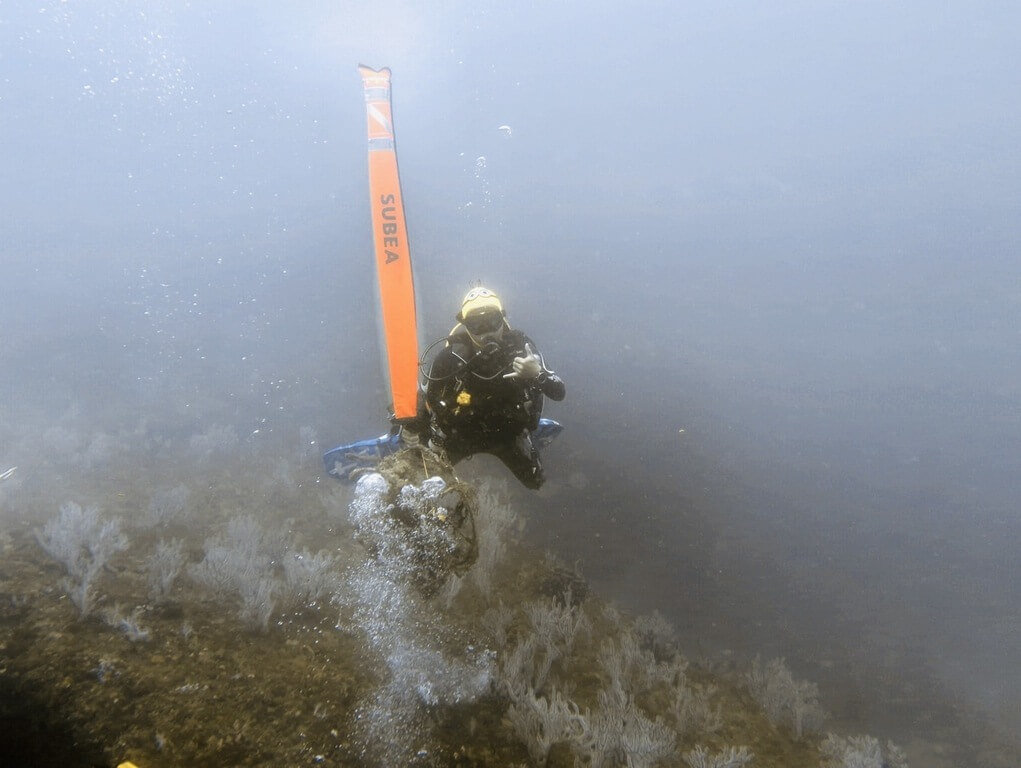
Chen Cheng-wei, an associate professor and the head of the Department of Applied Foreign Languages at Chien Hsing University of Science and Technology, began diving in 2017, subsequently earned his diving instructor certification, and has dedicated himself to ocean cleanup activities. Initially a collaborator, he later founded his own group, hoping to protect 'God's aquarium.'
'Diving at depths of up to 40 meters, when sunlight penetrates well and visibility is high, feels like being in God's aquarium,' Chen recalls of his first diving experience in 2017. He told a CNA reporter that he initially learned to dive as a way to change his mood but truly fell in love with the activity, eventually becoming a certified diving instructor.
After learning to dive, he joined ocean cleanup efforts. Chen says he first participated in cleanups organized by others. After becoming an instructor himself and gaining the capacity, he began organizing friends, students, and even divers he didn't know to get involved in cleaning the sea.
What should have been God's beautiful aquarium had been marred by what he saw as an 'underwater great wall of death.' As Chen participated in more cleanups, he discovered that discarded fishing gear and nets constituted a significant portion of underwater trash, followed by plastic bottles and bags. Frighteningly, the fishing nets create a chain-reaction trap.
For example, Chen said, many fishing nets can be seen on the seafloor in Gongliao's Longdong, likely abandoned because they couldn't be pulled up. 'These things cause great harm to the ecosystem,' he explained. Small fish get caught in the nets, and then medium and large fish come to feed, only to get entangled themselves, with more and more getting trapped.
In the more than five years since the 'Salute to the Sea' project was launched, the Ocean Affairs Council has gradually established a systematic monitoring mechanism, intercepting pollution at the source from the estuaries of major rivers across Taiwan to marine organisms, and recruiting private-sector forces for trash cleanup.
According to OAC statistics, from 2020 to the end of last year, a cumulative total of 6,665 environmental fleet vessels were recruited to collect marine debris, and 6,089 'ocean cleanup warriors' (divers) were enlisted to remove underwater waste.
In 2023, Chen organized eight cleanup events and brought the collected trash to elementary and junior high school students to sort together, helping them understand its origins. Last year, he also held a cleanup for a Rotary Club, again emphasizing parent-child interaction, encouraging parents and children to join in sorting the garbage.
Besides his hands-on participation, Chen hopes to inspire more people to get close to the sea, so he established the Deep Blue Diving Club at the university. Chen explained that incoming freshmen may not know how to dive, so the club provides training and assists them in obtaining diving certifications, allowing them to gradually improve their skills and eventually join the work of ocean cleanup and environmental protection.
Chen also hopes that after students learn to dive, in addition to contributing to ocean cleaning, they can undergo training as ecological divers within the club to conduct underwater ecological surveys and coral reef inspections.
To protect the beautiful scenery 40 meters deep, Chen not only personally engages in ocean cleanup but also focuses on long-term education and even international exchange. From parent-child interactions to school clubs, he aims to build a consensus of affinity for the sea, hoping to slowly ameliorate the problem of marine debris.
FACT BOX
- Source: CNA (Central News Agency)
- Category: 社會