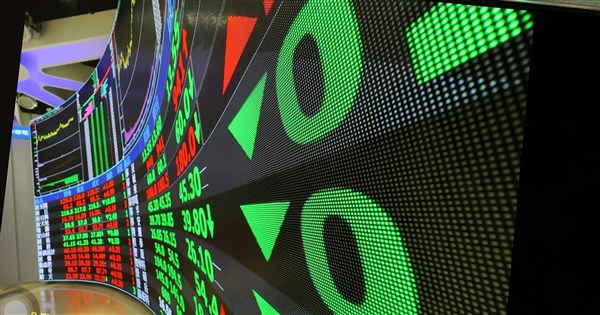
(Central News Agency, reporters Tseng Jen-kai and Chang Liang-chih, Taipei, 7th) US stocks plunged sharply last Friday, with the Philadelphia Semiconductor Index, most closely linked to the Taiwan stock market, plummeting 10.26%. This triggered a massive 3,006-point (6.65%) drop in Taiwan stock index futures during after-hours trading on the 5th, closing at 42,220 points, the largest point drop in history. Chen Yi-kuang, Chairman of Fubon Investment Consulting, believes that the Taiwan stock market at Monday's opening will face multiple selling pressures, including stop-losses, margin calls, program trading, and foreign capital, forming a 'sum of all fears' in the market.
Stronger-than-expected US non-farm payroll data for May dampened expectations for a Federal Reserve rate cut. This, combined with Broadcom's disappointing earnings forecast and concerns over a new wave of capital crowding out effects from SpaceX's IPO, dragged US stocks lower on the 5th.
Last Friday, the Dow Jones Industrial Average fell 1.35%, the S&P 500 fell 2.64%, the tech-heavy Nasdaq Composite fell 4.18%, and the Philadelphia Semiconductor Index plunged 10.26%.
Memory and advanced chip giants Micron, Intel, and AMD plunged 13.25%, 11.28%, and 10.86%, respectively. Marvell Technology fell 16.74%, while Broadcom and Nvidia fell 7.92% and 6.19%, respectively.
TSMC ADRs, closely tied to the Taiwan market, fell 6.69%, UMC ADRs fell 5.24%, and ASE ADRs fell 11.38%. Taiwan stock index futures in overnight trading once hit the daily limit down, falling 4,522 points, before closing down 3,006 points (6.65%) at 42,220 points, setting a record for the largest intraday and closing point drop in history.
Analysts point to factors including a correction in high AI valuations, fading rate cut expectations, foreign capital hedging, and program trading cascades for the market decline. Key observations for Monday's market include whether TSMC can provide support, whether foreign capital short positions continue to expand, and whether panic selling emerges in AI stocks.
Chen Yi-kuang believes there are three main reasons for this decline. First, the US May non-farm payroll data significantly exceeded expectations, raising concerns about interest rate hikes. Second, Broadcom's earnings forecast fell short of extremely high market expectations, triggering selling pressure in semiconductor stocks. Third, and most importantly, he believes it is a correction after a significant rally.
Chen pointed out that the Taiwan stock market surged 7,203 points in April and another 5,806 points in May, skyrocketing over 13,000 points in just two months. It even rose to 46,552 points in June. The rally was rapid and fierce, making a pullback expected. He believes the market is now finding reasons to decline.
Chen predicts that Monday's opening will face a 'sum of all fears,' with multiple selling pressures including stop-loss selling, panic selling, forced margin calls, program trading, ETF liquidation, and foreign capital trend-following operations all pouring out. He reasonably estimates a minimum drop of 2,000 points at Monday's opening, potentially breaking below the monthly moving average of around 43,030 points.
However, Chen simulates that many investors in this bull market have developed a habit of buying on dips. He speculates that Monday's low point will occur within the first 15 minutes of trading, characterized by crowded trades and irrational selling. After the plunge, bargain-hunting buying may emerge, leading to a potential instant rebound. However, he warns that a rebound does not mean stabilization and advises retail investors not to rashly 'catch a falling knife.'
Chen believes there are four key indicators for the market to bottom out. First, the US 10-year Treasury yield is currently around 4.55%; the high of 4.66% on May 19 must not be breached. If it falls back to around 4.2%, it would signal a temporary removal of negative factors.
Second, Chen states that the current margin balance in the Taiwan stock market has surged to a record high of NT$566.6 billion. This correction needs to reduce it by at least 10% to 15%, meaning a decrease of about NT$50 billion to NT$80 billion. Third, foreign capital's net short position in Taiwan stock index futures is nearly 70,000 contracts, also a record high. Ideally, this should drop below 50,000 contracts. Fourth, the stability of the New Taiwan Dollar exchange rate needs to be observed.
Wang Wei-che, fund manager at E.Sun Investment Trust, believes that with the margin balance at NT$566.6 billion and foreign capital's futures short positions remaining at a high level of over 69,000 contracts, short-term market volatility is expected to be剧烈. He advises investors to maintain appropriate cash flexibility, buy on dips, and avoid chasing highs.
Wang noted that the recently concluded 2026 Taipei International Computer Show (COMPUTEX) demonstrated that the focus of AI development is shifting from 'Generative AI' to 'Agentic AI,' indicating the AI trend is still ongoing. Leveraging its advantages in advanced semiconductor manufacturing and a complete supply chain, Taiwan plays a key role in the current explosion of AI and high-performance computing demand, which should help support the Taiwan stock market.
Chen Guo-ching, Head of Research at Horizon Securities Investment Consulting, expects the broader market index and individual stock prices to fall first and then rebound this week. He suggests focusing on Taiwan's AI supply chain stocks with good earnings, strong fundamentals, that have already corrected during the computer show, and span the three major GPU/CPU giants and the top five US CSPs. However, he warns against stocks with poor fundamental earnings, that have already surged in price, and have high margin balances, as they are susceptible to margin selling pressure from price declines. (Editor: Chang Liang-chih) 1150607
FACT BOX
- Source: CNA (Central News Agency)
- Category: Taiwan
- Dates in source: 1150607