(Central News Agency, Reporter Zeng Renkai, Taipei, 7th) Artificial intelligence (AI) is driving rapid economic growth in Taiwan, with related tech companies performing exceptionally well. Traditional industries are also striving to transform. Legacy manufacturers such as Formosa Chemicals & Fibre Corporation (FCFC), Formosa Plastics Corporation (FPC), and Shinkong Synthetic Fibers Corp. (SSFC) have recently announced expansion or transformation plans, each entering the semiconductor supply chain from different angles to connect with new AI technologies.
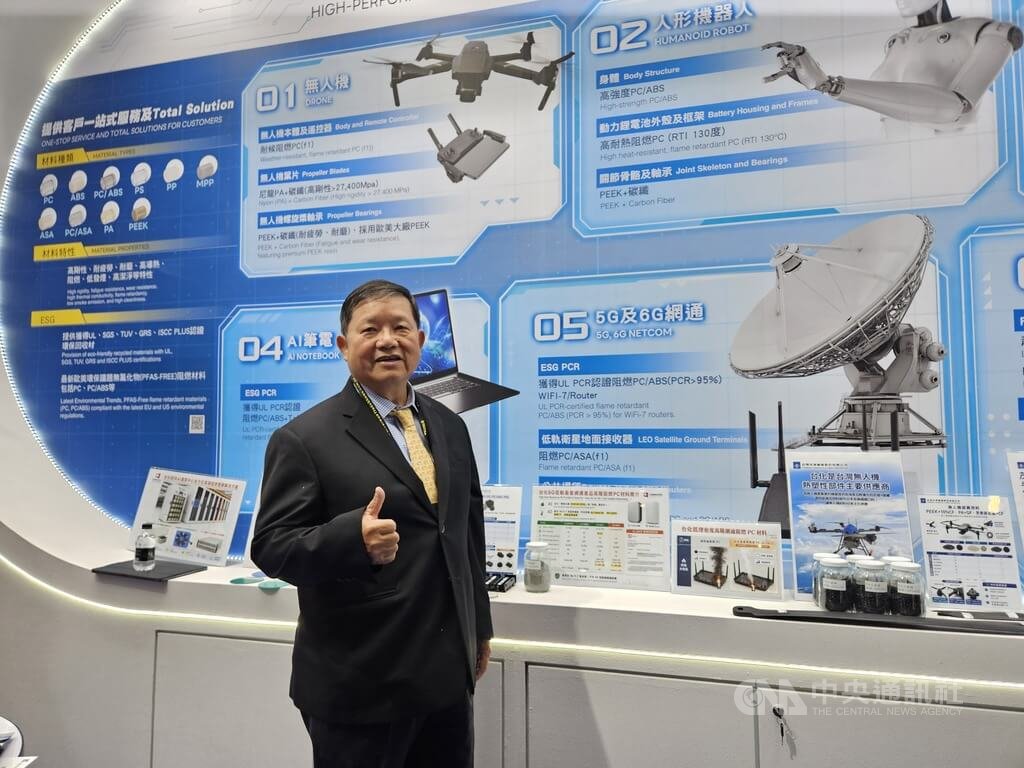
At the 2026 Taipei International Computer Show (COMPUTEX) that concluded last week, FCFC appeared on the exhibitor list. Because its main business does not align with technology, the organizer even had to confirm this multiple times before the event. FCFC, a subsidiary of the Formosa Plastics Group, participated in COMPUTEX for the first time this year, setting a precedent for the 'Four Treasures of Formosa Plastics' to exhibit.
FCFC President Lu Wen-chin stated that facing headwinds such as overcapacity in the Asian petrochemical industry and the US-Iraq war, FCFC has been working very hard on transformation in recent years. It initiated a slimming plan, abandoning the red ocean market. Revenue dropped from a peak of approximately NT$380 billion to NT$287 billion in 2025, a decrease of nearly NT$100 billion. Concurrently, FCFC is actively pursuing a high-value transformation.
FCFC is collaborating with Japan's JPP Company to develop metallocene PP (polypropylene) ultra-clean materials. These materials can meet the strict cleanliness requirements of the semiconductor industry and have been adopted for wafer boxes and carrier boxes used in semiconductor processes. FCFC has become the world's third supplier of PP wafer carrier materials, with mass production expected to begin by the end of this year.
Lu Wen-chin revealed that FCFC has been investing in the R&D of third-generation semiconductor material silicon carbide (SiC) for over three years. A team of 26 professional R&D personnel is continuously optimizing the technology, with a public announcement expected by the end of 2027. Currently, electronic-related applications, including high-performance composite materials, account for about 4% of FCFC's total revenue. The goal is to increase this share to 30% by 2030. The gross profit margin for products like high-end composite materials can reach over 30%, far exceeding FCFC's current single-digit gross profit margin, which is expected to boost overall profitability.
At the end of May, Formosa Plastics also held a press conference for material information, announcing a proportional capital increase of NT$500 million in its investee company, Formosa Tokuyama Co., Ltd. The plan is to expand a second-phase plant for electronic-grade isopropyl alcohol (IPA) at its Linyuan plant in Kaohsiung.
IPA is mainly used for cleaning in semiconductor processes. Capitalizing on Taiwan's semiconductor manufacturing strength, Formosa Plastics and Japan's Tokuyama Corporation established a joint venture, Formosa Tokuyama, in 2020 to jointly produce and sell electronic-grade IPA.
The first-phase plant of Formosa Tokuyama, with an annual capacity of 30,000 tons, is already operating at full capacity. Considering the rapid growth and increasing demand from semiconductor customers, Formosa Tokuyama has decided to launch a second-phase expansion plan, scheduled for completion and operation in 2028. At that time, Formosa Tokuyama's IPA capacity will double.
Formosa Plastics Chairman Kuo Wen-pi declared at the company's shareholders' meeting that semiconductor-related chemicals and key materials are the focus of Formosa Plastics' next transformation and layout. Formosa Plastics has already targeted semiconductor chemical items such as electronic-grade hydrogen, ammonia water, hydrochloric acid, and sulfuric acid, and has begun developing key materials like atomic layer deposition ruthenium metal precursors and photoresist diluents.
Another company that recently started a second-phase plant plan is Shinkong Synthetic Fibers (SSFC). SSFC is a major chemical fiber manufacturer under the Shinkong Group. In 2023, it established a joint venture, Shinshuo Advanced Chemical Co., Ltd., with Belgium's Solvay Group to produce high-purity electronic-grade hydrogen peroxide, entering the semiconductor specialty chemicals market.
SSFC pointed out that high-purity electronic-grade hydrogen peroxide is used for cleaning wafer surfaces, removing particles and metal impurities, as well as etching and photoresist removal. It is an indispensable specialty chemical for semiconductor processes. The first-phase plant of Shinshuo has a capacity of 40,000 tons, and its current utilization rate has reached 100%. The expansion of the second-phase plant began at the end of 2025 and is expected to start production in the second quarter of 2027, at which point capacity will double.
Shinkong Synthetic Fibers Chairman Douglas Tong said that in addition to Shinshuo, with the rapid development of AI applications, demand for high-performance engineering plastics that are heat-resistant, have low dielectric loss, and dimensional stability has surged. SSFC will extend from its existing technology base to prioritize the development and mass production of high-temperature materials for high-value-added markets such as AI server connectors, automotive electronics, and high-speed communications. (Editor: Chang Liang-chih) 1150607
FACT BOX
- Source: CNA (Central News Agency)
- Category: Taiwan