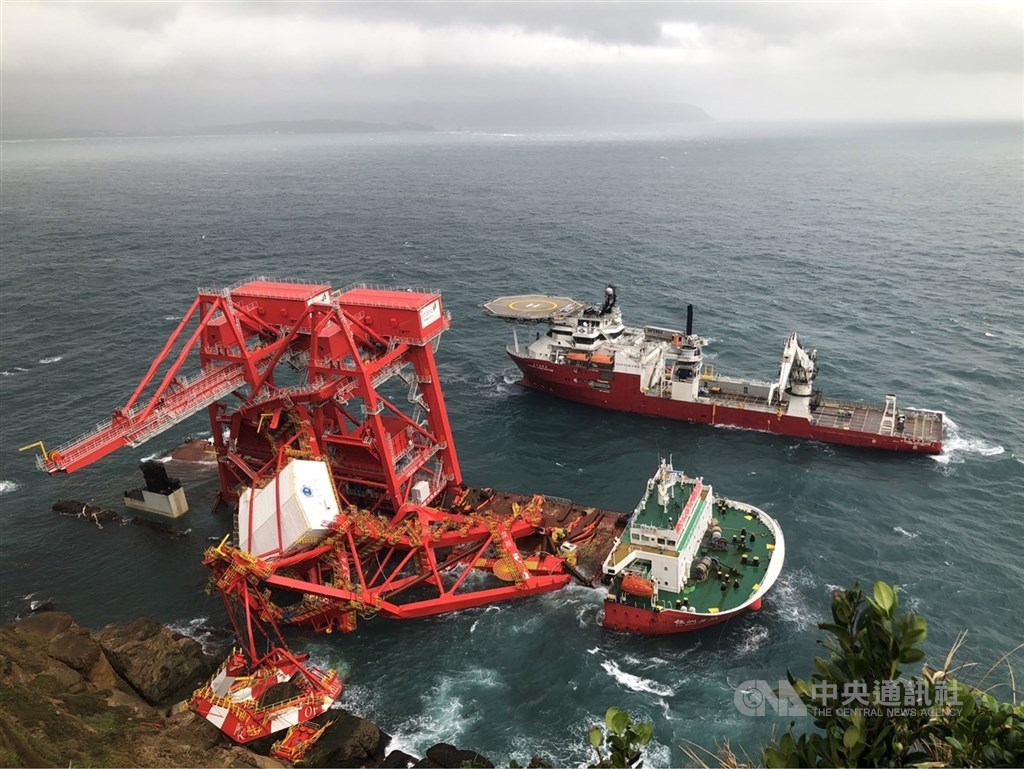
(Central News Agency, reporter Gao Huaqian, Taipei, 7th) The Chinese cargo ship 'Yu Zhou Qi Hang' ran aground at Yehliu during a typhoon in 2024. In March 2025, the Ocean Affairs Council discovered an oil leak and imposed a fine of NT$600,000 according to the law. The company owning the 'Yu Zhou Qi Hang' disagreed, arguing that it could not be proven that the oil on the sea surface was caused by the ship, and therefore filed an administrative appeal, which was recently rejected by the Executive Yuan.
The 'Yu Zhou Qi Hang', which was carrying large machinery, accidentally collided with and caused the collapse of a shore-side gantry crane worth approximately NT$300 million while berthing at Keelung Port on October 14, 2024. Later, the ship set sail on October 29 of the same year, but due to恶劣 sea conditions caused by Typhoon Kong-rey, the captain abandoned ship that same day. The vessel ran aground at Yehliu on October 31, initially raising concerns about a heavy oil leak. Subsequently, under the supervision of the Maritime and Port Bureau, the operator removed over 280 tonnes of residual oil in January 2025, and the ship was towed to South Korea for disposal in September 2025.
The Executive Yuan recently published its appeal decision document, stating that the Maritime and Port Bureau of the Ministry of Transportation and Communications held the second emergency response meeting for this case on October 30, 2024. The Ocean Conservation Administration of the Ocean Affairs Council explained the provisions of the Marine Pollution Control Act, which state that 'in the event of a maritime casualty or other accident that causes or is likely to cause marine pollution, the master and the shipowner shall immediately take measures to prevent, eliminate, or mitigate the pollution.' The operator's insurance company also submitted an emergency response plan to the Maritime and Port Bureau on February 26, 2025.
The decision document stated that on March 2, 2025, the Ocean Affairs Council discovered an oil leak from the cargo ship's surveillance camera footage. It determined that the operator had failed to take appropriate preventive measures as ordered by the emergency response meeting, violating the Marine Pollution Control Act. Therefore, after issuing a notice and hearing the operator's陈述意见, it decided to impose a fine of NT$600,000.
The operator filed an appeal and countered that the surveillance camera footage provided by the Ocean Affairs Council was insufficient to identify the substance as sea-surface oil. Furthermore, the so-called image interpretation by an academic society was merely a LINE chat record, not a formal appraisal report or professional judgment document, and could not prove that the sea-surface oil originated from the 'Yu Zhou Qi Hang'. Additionally, according to an inspection report from a certain company dated July 7, 2025, the oil film found on March 2 was an extremely thin layer of hydrocarbon compounds, which was微量 and transient, and did not constitute pollution.
The operator emphasized that the residual oil in the cargo ship's holds had been completely removed on January 14, 2025, and the work was accepted the following day. Furthermore, according to a press release from the Ocean Conservation Administration in September 2025, the case ultimately achieved the goal of no pollution spread, acknowledging that this was due to the operator and insurance company fulfilling their legal responsibilities, which the operator argued proved their handling of the case did not cause oil pollution.
The operator stated that oil pumping and oil pollution prevention are highly specialized technical tasks, clearly not something an ordinary shipowner could execute on their own. The submitted emergency response plan should have been sufficient for the Ocean Affairs Council to promptly contact and coordinate with the actual executing units. However, the operator argued that the Ocean Affairs Council shifted the adverse outcome of not activating the coordination mechanism according to the plan onto the operator as a legal liability.
After reviewing the Ocean Affairs Council's defense brief, the Executive Yuan's Appeal Review Committee determined that the Ocean Affairs Council had commissioned an academic society experienced in satellite and remote sensing monitoring of marine pollution to interpret the images as thin oil. Moreover, the inspection report from the certain company dated July 7, 2025, attached to the appeal, also indicated that the March 2 oil film incident was a微量, transient phenomenon, and if not from an external source, it should be residual oil traces from before the cargo and hull removal operations.
The Review Committee stated that, therefore, considering the oil pollution was located at the grounding site of the cargo ship, with no third-party vessels passing through, and based on the direction of the oil leak, it could be inferred through experience and logical reasoning that the oil was leaked from on-site equipment, the hull, and parts before the cargo and hull were dismantled. The Ocean Conservation Administration's legal penalty was deemed appropriate.
The Review Committee also noted that this oil film was discovered on March 2. According to relevant reports, heavy oil tank cleaning operations were conducted from August 28 to September 2, 2025. Upon completion of the heavy oil extraction, approximately 11.75 metric tonnes of heavy oil remained and could not be removed. Therefore, the claim that residual oil was completely removed on January 14, 2025, was inconsistent with the facts.
The Review Committee pointed out that the Ocean Conservation Administration's press release described the overall oil removal results for this cargo ship case. It only stated that the oil pumping operation was completed on January 14, 2025, with a total of 284.79 metric tonnes of residual oil removed, significantly reducing the marine environmental risk. It did not state that all residual oil had been removed, nor did it mention that it would no longer pose a marine environmental risk. Therefore, the operator's claims were difficult to accept. Consequently, the appeal was rejected, and the original penalty was upheld. (Editor: Lin Kelun, Yang Lanxuan) 1150607
FACT BOX
- Source: CNA (Central News Agency)
- Category: Taiwan