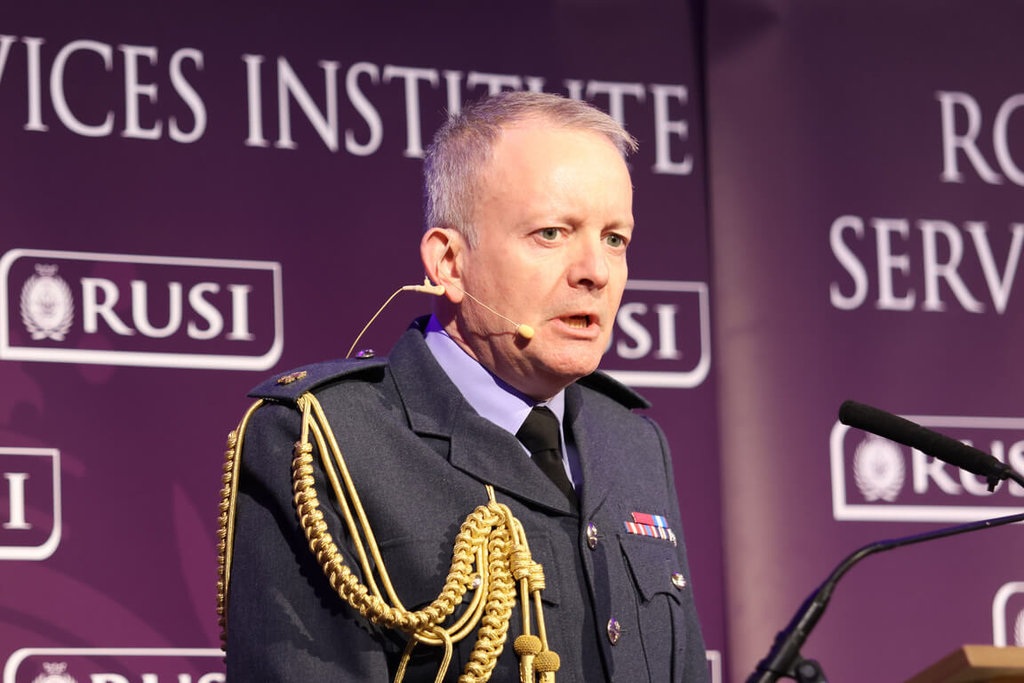
(Central News Agency, London, 6th by Chen Yunyu) UK Chief of the Defence Staff, Admiral Sir Richard Knighton, has warned that Russia is increasing the frequency of long-range missions by strategic military aircraft. The number of incursions into NATO airspace by such aircraft this year has already matched the total for all of last year.
Knighton said these aircraft have the capability to penetrate deep into NATO airspace. He stated that this is the "most dangerous period" he has seen in his 35-year military career.
Russia continues to test and challenge the defense capabilities of NATO countries, spanning traditional military defense, cyber attacks, technology theft, as well as subversion, sabotage, and assassination activities.
Knighton emphasized that Russia is increasing pressure, raising risks, and "could cross a red line."
Knighton made these remarks in an interview with BBC Radio 4 on the 5th. In a speech last December at the UK think tank Royal United Services Institute (RUSI), he mentioned that even if the probability of Russia using military force against a NATO country is only 5%, "it does not mean it will not happen at all." He noted that since no one can actually determine the exact probability, framing the question in extremes of "will" or "will not" happen can easily lead to excessive panic or complacency.
Knighton emphasized at the time that what truly matters is the "trend," i.e., whether the probability of conflict is increasing, and the evidence on this question is very clear, with the answer being yes.
Meanwhile, on the 5th, Knighton reiterated warnings from many military leaders in recent times, stating that the UK and its NATO allies need to prepare for larger, longer, and more complex wars.
He mentioned that over the past 20 years, UK operational planning often assumed wars would end relatively quickly, would not turn into wars of attrition, and that the scope of conflict could be limited to a specific region with controllable scale. However, the war in Ukraine reminds everyone of the need to adjust military preparation assumptions.
Knighton also pointed out that the threat landscape is constantly evolving, and the responsibility of the armed forces is to be ready to respond to these evolving threats, with autonomous and unmanned systems undoubtedly playing an increasingly important role.
However, he also mentioned that beyond professional soldiers, society as a whole also needs to recognize that the world has entered its most dangerous period in over 30 years, and therefore must adjust priorities and make choices that align with the changing situation.
The UK government is expected to release its 10-year Defense Investment Plan (DIP) shortly. The plan was originally scheduled for release in the second half of last year but was delayed due to a lack of consensus among government departments on issues such as fiscal resource allocation. With the next NATO summit scheduled for July 7-8 in Turkey, the UK government faces pressure to release the DIP before the summit.
The UK government released its Strategic Defence Review (SDR) in June last year. The DIP, delayed by nearly a year, plans investment and expenditure based on the reform and military building directions proposed by the SDR.
Despite criticism, one of the main reasons for the delay in releasing the DIP is a lack of decisiveness, although Prime Minister Keir Starmer continues to emphasize that defense spending is the government's top priority.
He also mentioned that intelligence from the UK and other countries suggests Russia "could launch a (military) attack on NATO as early as 2030."
Since Russia's full-scale invasion of Ukraine in February 2022, at least since 2023, senior representatives from military and intelligence units of various NATO countries have successively warned that Russia might attack NATO within the next 5 to 10 years and would not stop at Ukraine. However, over the past year, another layer of concern has emerged within NATO: that Russia might act sooner.
Moscow's domestic propaganda has long claimed that Russia is fighting against a hostile NATO and the "collective West." Russian Defense Minister Andrei Belousov stated in late 2024 that the Russian Defense Ministry should "prepare for a possible military conflict with NATO in Europe within the next 10 years."
Regarding Europe's enhanced defense efforts, NATO Military Committee Chairman, Italian Admiral Giuseppe Cavo Dragone, said in an interview with British media on the sidelines of the Shangri-La Dialogue in Singapore that merely proposing a defense investment plan is not enough to deter potential adversaries.
Dragone said, "Percentages, numbers, money, whether in dollars or euros, cannot deter anyone." Deterrence comes from actual "capability," which is inseparable from the actual delivery of military hardware.
Dragone pointed out that NATO needs to continue accelerating the acquisition of actual capabilities because "time is not on our side." (Editor: Chen Chenggong) 1150606
FACT BOX
- Source: CNA (Central News Agency)
- Category: 事件