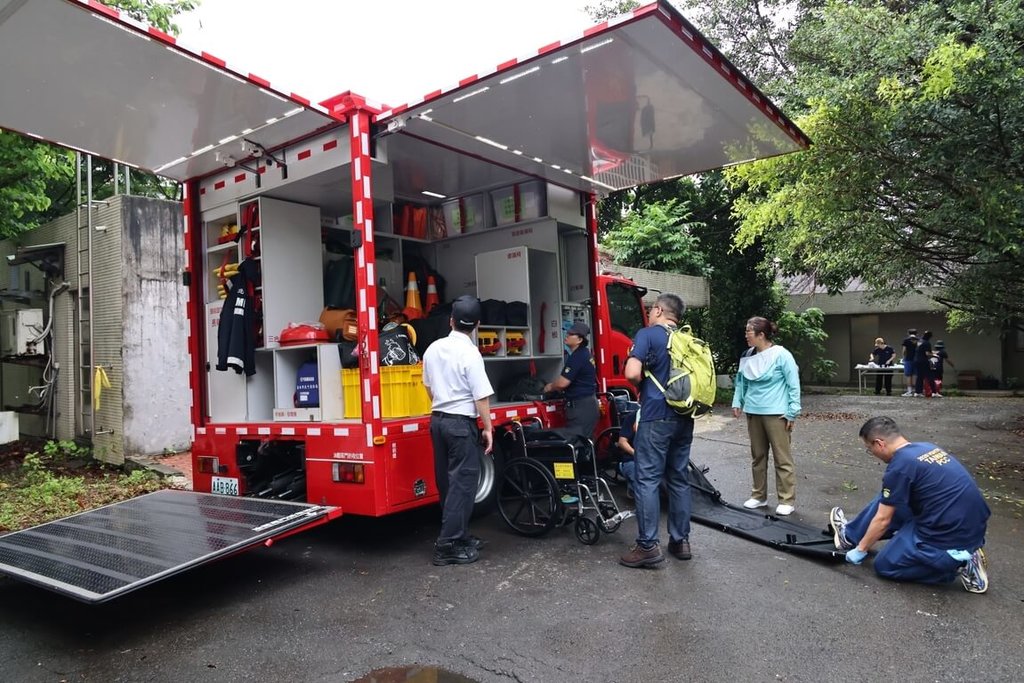
"Hospital moves underground, blood bags fly through the sky." This isn't a movie plot, but a drill co-hosted by Taipei Veterans General Hospital (TVGH) and Chunghwa Telecom, combining 5G, satellites, and drones to verify uninterrupted medical care during a major disaster. Despite outdoor wind and rain, the exercise demonstrated medical resilience.
Taipei Veterans General Hospital shared via a press release about its annual critical infrastructure protection exercise held yesterday. It partnered with Chunghwa Telecom for a high-tech joint demonstration of communication resilience, simulating a scenario where even if ground buildings are damaged and communication is cut off during a composite disaster like a major earthquake or war, the hospital can quickly transfer its medical capacity to an underground alternative space, ensuring life-saving services are not disconnected.
TVGH Superintendent Dr. Chen Wei-ming stated that Chunghwa Telecom is a crucial backbone for maintaining national resilience. The two parties have collaborated for many years, and this time they have expanded from smart healthcare to national security-level protection. He mentioned that the recent frequent incidents of submarine cable disruptions made him deeply realize that "communication is a lifeline." Through low-orbit satellites and multiple backup systems, the goal is to allow Taiwan's medical services to be "proactively deployed" under any extreme circumstances.
Although the drill site was battered by constant wind and rain, the "ground-air collaboration" was still executed with precision. Chunghwa Telecom demonstrated its relevant technologies, integrating a quadruple backup of microwave, 5G mobile network, low-orbit satellite, and wired network.
Chang Pen-Yuan, President of Chunghwa Telecom's Enterprise Business Group, described this as equipping the hospital with an "automatic uninterruptible power system," where the system can "switch in a second" if any line is disconnected.
In this exercise, the underground alternative medical space was not just a shelter but also a backup core for maintaining medical operations, responsible for functions such as patient assessment, first aid, medical command, resource allocation, and cross-site support. The forward medical station outside the hospital served as a vital medical node between the disaster site and the hospital, responsible for initial triage, stabilizing patients, reporting conditions, and initiating subsequent support.
Drones also played a key role in this exercise. When the frontline medical station urgently needed blood transfusions but roads were cut off by the disaster, a drone took on the transport mission, taking off from the TVGH helipad to deliver the blood products precisely.
TVGH emphasized that this drill proved that the "underground medical space" is not just a shelter but a backup core capable of first aid, remote consultation, and command. Through the 5G resilient network, frontline doctors can connect with experts in the hospital in real-time, making medical resilience no longer just a technical indicator, but the most reassuring protective force for the public when a disaster occurs. (Editor: Huang Ming-Hsi) 1150606
FACT BOX
- Source: CNA (Central News Agency)
- Category: 事件