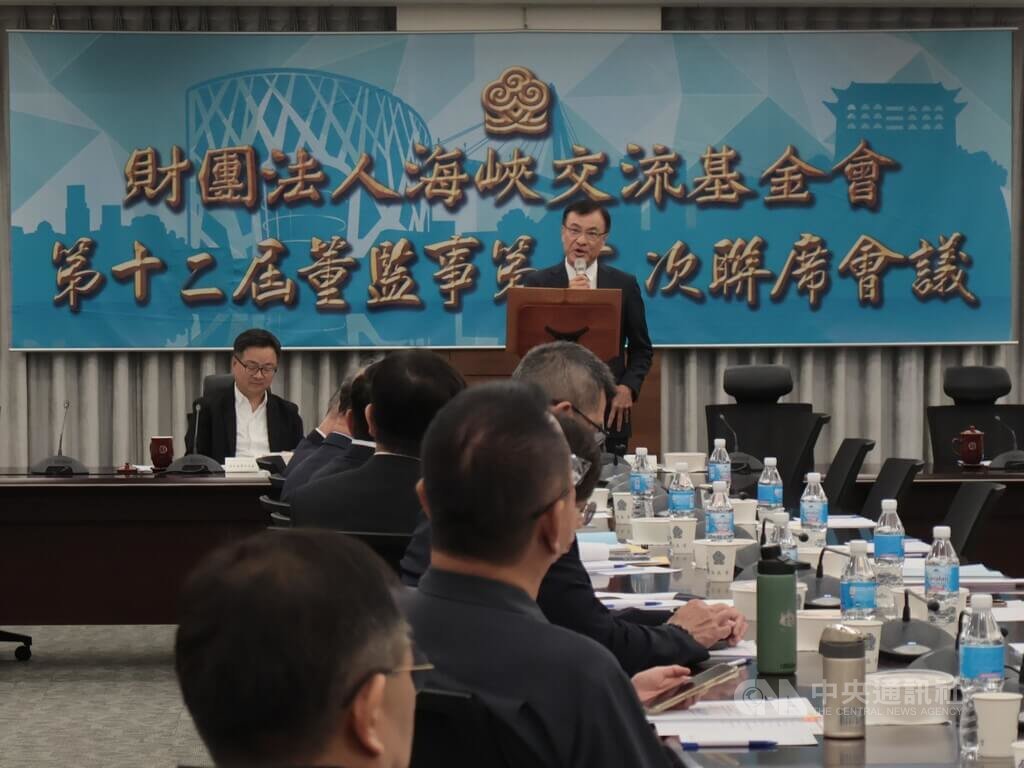
(Central News Agency, Reporter Li Ya-wen, Taipei, June 5) The Straits Exchange Foundation (SEF) held the 11th joint meeting of the 12th Board of Directors and Supervisors today. In his address at the meeting, SEF Chairman Su Jia-chyuan said that China's selective 'read' and its 'read' and 'reply' without systematic rules can easily harm the protection of the rights of people on both sides of the Taiwan Strait.
Su stated that SEF, as an important platform for cross-strait exchanges, handled a total of 306,745 service cases last year. From January to May this year, the cumulative number reached 117,673 cases, including notarization verification, services for Taiwanese businessmen, and public consultation cases, demonstrating the actual demand for exchanges between people on both sides of the strait.
He lamented that the SEF and the Association for Relations Across the Taiwan Strait (ARATS) have yet to resume institutionalized communication and consultation mechanisms because China has made the '1992 Consensus embodying the One-China principle' a prerequisite for resuming formal exchanges. However, the demand for exchanges between people across the strait has not stopped due to political factors.
'From a practical work perspective, it seems China is reading but not replying, but that's not actually the case,' Su said. He explained that China selectively 'reads' and 'replies' to cases, including those concerning people's rights, business operations, and livelihood matters. Some cases, such as those involving personal freedom, religious belief, and other human rights protection issues, rarely receive positive responses.
Su emphasized that such 'reading' and 'replying' without systematic rules can easily harm the protection of the rights of people on both sides of the strait. In recent years, some Taiwanese people have had their personal freedom restricted in China due to religious beliefs. Freedom of religious belief and personal safety are the most basic rights of the people and universal values. He expressed hope that China would uphold the spirit of humanity and value the people's freedom of belief and basic rights.
Su mentioned that Taiwanese businessmen are an important service target for SEF. SEF continues to strengthen its connection and exchanges with Taiwanese businessmen. It plans to organize a visit to Taiwan for Taiwanese businessmen based in China in Chiayi just before the Dragon Boat Festival, allowing more Taiwanese businessmen to gain an in-depth understanding of Taiwan's industrial resilience, innovation capabilities, and high-quality investment environment, helping them 'invest in Taiwan and expand globally.' (Editor: Yang Sheng-ju) 1150605
FACT BOX
- Source: CNA (Central News Agency)
- Category: 政策