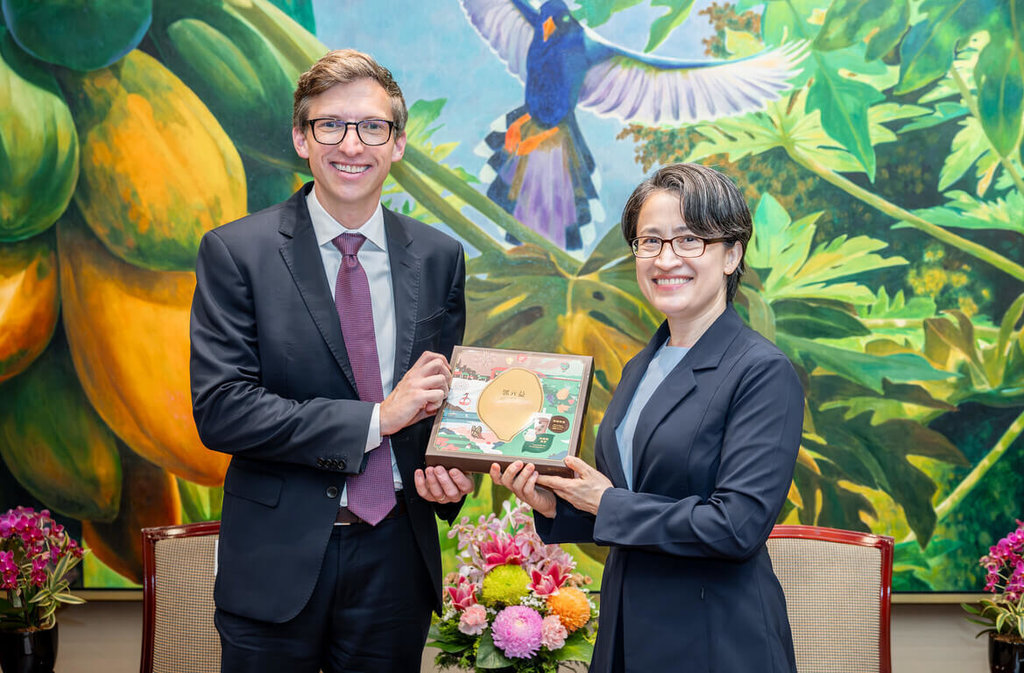
(CNA, Taipei, June 5) Vice President Hsiao Bi-khim today received a foreign delegation from the DSET (Center for Technology, Democracy, and Society) 'Supply Chain Resilience Strategy International Summit', which included 'Chip War' author Chris Miller (a professor at Tufts University). She stated that Taiwan is building trusted supply chains with international partners and looks forward to deepening international cooperation to jointly promote technological innovation, industrial development, and democratic resilience.
The Presidential Office issued a press release in the evening stating that Vice President Hsiao met with the DSET delegation, which included Professor Miller.
Vice President Hsiao noted that the delegation's visit coincided with the COMPUTEX Taipei trade show, which once again demonstrated the comprehensiveness and resilience of Taiwan's tech industry ecosystem. She said Taiwan not only maintains its advantage in hardware manufacturing but is also actively developing software and AI applications, further strengthening its overall technological capabilities.
The government is promoting the 'New AI Infrastructure' initiative, she said. In addition to investing in cutting-edge R&D, the government also aims to continuously enhance computing power and other infrastructure to strengthen national competitiveness. It will also focus on ensuring that the benefits of technological development reach more industries and social sectors, especially small and medium-sized enterprises and traditional industries, to promote industrial transformation and balanced development.
She mentioned that although some traditional industries are not directly involved in AI development, their importance is being re-evaluated in the context of global supply chain restructuring and the trend toward building secure, trusted supply chains. These industries should be integrated into a broader national security and industrial development framework and combined with technologies and AI from other fields.
Vice President Hsiao said Taiwan has achieved significant results in the drone industry in recent years, possessing an industrial ecosystem covering hundreds of companies, including system integrators and key component manufacturers. The government originally planned to invest more resources through a special defense budget to support related industries. Although it did not receive support from opposition parties, it will continue to strengthen communication with all sectors of society to gain more understanding and support.
Citing public opinion polls showing that a majority of people support enhancing self-defense capabilities and increasing defense spending, she stated that the government will continue to prioritize supporting domestic industries, especially in dual-use technology fields, to build autonomous development capabilities for various types of unmanned systems on land, sea, and air.
Regarding the DSET summit, Vice President Hsiao pointed out that it is an important platform bringing together technological innovation, industrial cooperation, and national security issues. She thanked the distinguished guests from around the world for gathering in Taiwan to discuss future directions for technology and security. She reiterated Taiwan's commitment to building trusted supply chains with international partners and deepening international cooperation to jointly promote technological innovation, industrial development, and democratic resilience.
Earlier, Vice President Hsiao also met with a visiting delegation from the UC Berkeley Institute of East Asian Studies' 'US-Taiwan-Europe Next Generation Working Group' project. She shared Taiwan's three major policy directions: strengthening democracy and national security, promoting economic development, and improving the social welfare and care system. She expressed hope that through these policies, Taiwan can become a resilient and sufficiently strong society, continuing to maintain peace and security in the Taiwan Strait. (Editor: Yang Lanxuan) 1150605
FACT BOX
- Source: CNA (Central News Agency)
- Category: 政策