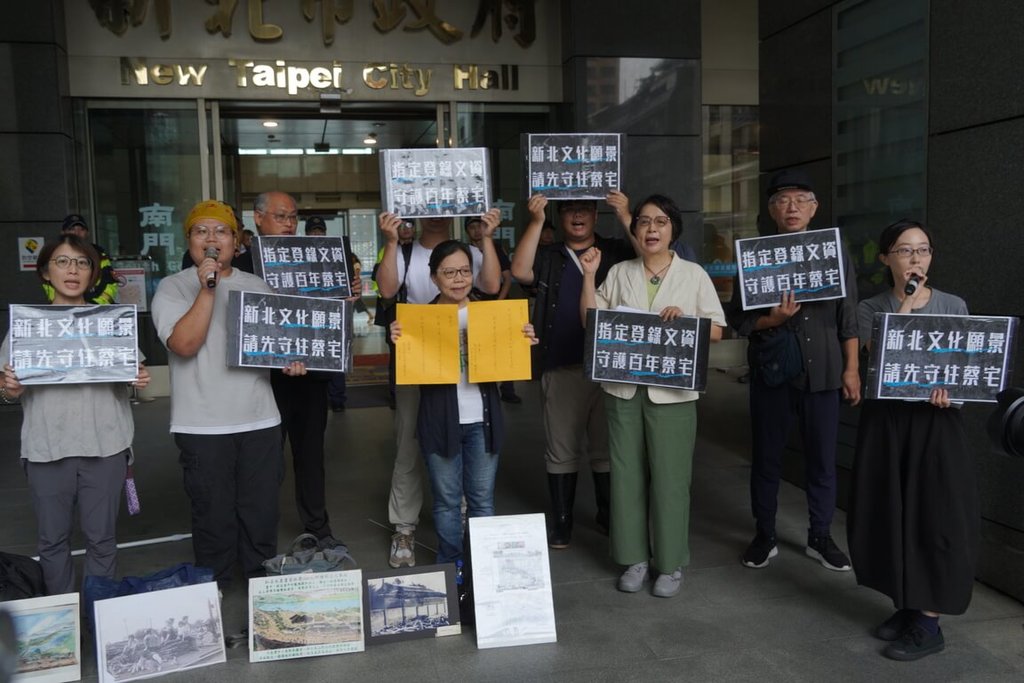
(Central News Agency reporter Cao Ya-yan, New Taipei City, 5th) The Cai Jinmu old house is about to undergo a cultural heritage review. If it fails to obtain heritage status, it will once again face the threat of demolition. The owner and heritage groups pointed out today that cultural heritage should not be limited to grand mansions; the history of laborers should also be remembered, and they called for the preservation of this historical textbook.
The Cai Jinmu old house in Xindian District, New Taipei City, was built on land belonging to the Liugong Canal. It was later sold by the Irrigation Association to a private developer, leading to a land dispute. In June of last year, it faced forced demolition. The Cai house immediately reapplied for preservation as a monument, historic building, and memorial building. The New Taipei City Cultural Affairs Department designated it as a provisional monument, halting the demolition. A review meeting will be held on June 8 to decide whether to officially designate it as a cultural asset.
Lai Bi-zhen, the current owner of the Cai Jinmu house, along with groups such as the Taiwan Association for Human Rights, held a press conference at the New Taipei City Government this morning. They demanded that the city government not hastily conclude the heritage review before completing investigative research and fully examining new evidence and related historical materials. They also called on Mayor Hou You-yi to see this matter through to a good end before leaving office.
Lai Bi-zhen stated that the Cai house is the last 'row-house combat-style residence' in the Taipei Basin. At the end of World War II, it served as a maintenance and management base for the Liugong Canal and temporary housing for laborers. It preserves a precious 'wartime labor and canal ecological landscape' and is the only remaining historical point that can identify the relative positions of the now-vanished Xindian Station and the Wanxin Railway.
Lai Bi-zhen said that after the Cai Jinmu house entered the provisional monument process last year, civil groups and scholars submitted supplementary materials and repeatedly requested further investigation. The Cultural Affairs Department stated in March of this year that it would assist in accessing relevant historical materials and evaluate another site visit. However, the city government has yet to conduct a field investigation or provide the relevant materials, yet plans to hold the review meeting next week. She criticized this as failing to fulfill the administrative obligation to provide consultation, information, or assistance, and it would force heritage committee members to make a decision based on incomplete information.
Lai Bi-zhen emphasized that regarding the property rights dispute mentioned by outsiders, the Control Yuan's investigation opinion has indicated that it was caused by the improper auction by the Liugong Irrigation Association. She expressed hope that Mayor Hou You-yi and the two candidates for New Taipei City Mayor would transcend individual legal disputes to preserve cultural assets and safeguard this ecological and historical textbook for New Taipei City.
Huang Zhi-hui, CEO of the Taiwan Hometown Cultural and Historical Association, pointed out that the people of Taiwan generally need to make up for history lessons, and the Cai house is the starting point for learning about the Liugong Canal culture. The Cai house possesses the unique characteristic of intertwining canals, railways, and industry. Although it is not a magnificent architectural form, cultural assets should not be limited to the mansions of the powerful and wealthy; the history of railway workers and canal keepers should also be remembered.
Li Ming-zhe, Project Manager of Wenshan Community University, stated that the Cai house witnessed the rise and fall of the Hemei Coal Mine and is adjacent to the starting point of the Wanxin Railway. He warned that if such a historical landscape disappears, future generations will find it difficult to see traces of history in their living environment, and memories will gradually degrade into text records in books.
The New Taipei City Cultural Affairs Department responded that after accepting the application, it has completed on-site inspections and convened a task force meeting, inviting experts and scholars in architecture, history, and cultural heritage. During the task force meeting, building and land owners were asked to provide explanations and supplementary materials regarding related questions. All opinions and investigation results were consolidated into an evaluation report, which will be submitted to the review meeting.
The Cultural Affairs Department emphasized that the cultural heritage review is based on professional investigation, on-site inspection, and independent deliberation by committee members. All related procedures are carried out in accordance with the law, and the review results will be decided by the review committee members based on their professional judgment. (Editor: Lung Po-an) 1150605
FACT BOX
- Source: CNA (Central News Agency)
- Category: 事件