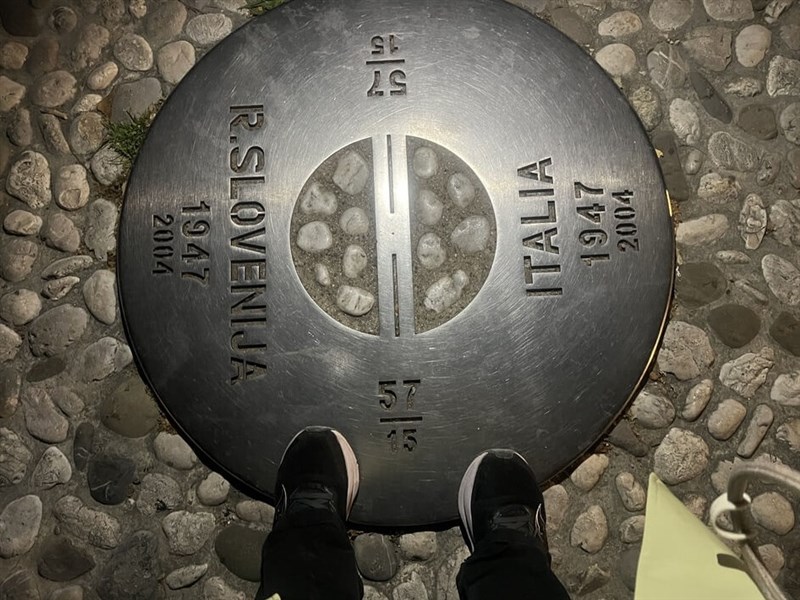
(Central News Agency correspondent Huang Yashi, Gorizia, 5th) Gorizia, an ancient town on the border between Italy and Slovenia, was torn in two by a wall during the Cold War. Now, it has not only broken down ideological barriers to be honored as the 'European Capital of Culture,' a symbol of international integration, but has also recently built one of Europe's largest digital art galleries, becoming a popular check-in spot for hundreds of thousands of tourists.
●Bidding Farewell to Iron Curtain Confrontation, Setting a Model for International Cooperation
The 1947 'Treaty of Paris' divided Gorizia in two: the city center belonged to Italy, while the new city of 'Nova Gorica' to the east belonged to Yugoslavia. The barbed-wire border even cut directly through some houses, forcibly separating communities and relatives on both sides, becoming a symbol of the East-West ideological divide in Europe, second only to the 'Berlin Wall.'
With the dissolution of communist Yugoslavia, the independent Slovenia joined the European Union. The former border, once marked by barbed wire, has become an open-air square for residents of both countries, and the two cities were jointly named the 'European Capital of Culture' for 2025. Supported by Italy's 'National Recovery and Resilience Plan' (PNRR), Gorizia has recently promoted several digitalization and economic revitalization projects. A Central News Agency reporter was invited to visit and witness the city's transformation.
'Gorizia not only boasts stunning castles, rivers, and history, but we have also successfully transformed a once-dividing border,' Mayor Rodolfo Ziberna told CNA. 'This border is proof that a place full of suffering and sorrow can be turned into an excellent opportunity for growth, cohesion, and international cooperation.'
Ziberna said he believes this is what everyone hopes for. 'We are a testament to integration in Europe and the world, approaching others without prejudice, striving to truly understand and appreciate them.'
●Embracing New Technology, Creating Europe's Largest Digital Art Gallery
Gorizia's new look is also reflected in its embrace of new technology. A recent viral spot on social media is the Digital Art Gallery (DAG). Using a massive LED screen, it creates a fantastical, aurora-like display of colors in a pedestrian tunnel, captivating visitors who praise it as the perfect spot for taking photos.
'The digital gallery welcomed 100,000 visitors in its first month, and we expect to reach 800,000 visitors by the end of the year,' Mayor Ziberna told CNA. The gallery's creator is renowned artist Refik Anadol, the master behind the landmark Sphere building in Las Vegas, USA, who has also exhibited at the Museum of Modern Art in New York and the Centre Pompidou in Paris.
Anadol created this 'Data Tunnel' specifically for Gorizia. The work is based on a large-scale natural model, using artificial intelligence to integrate millions of environmental images from international science museum archives, transforming them into pigments and visual materials to generate constantly changing organic forms, showcasing the relationship between nature, technology, and human perception.
●Castle Witnesses Historical Changes, Famous as a Cradle of Diplomats
Among its historical sites, Gorizia's representative attraction is the castle district (Borgo Castello), dating back to the 11th century. The castle's fortifications bear witness to the city's turbulent history, from rule by nobles to falling into the hands of the Austrian Habsburgs in the 16th century, and a brief occupation by the Venetian Republic in 1508, which is why a Lion of St. Mark still adorns the castle entrance.
The castle was bombed during World War I and rebuilt in a medieval style in the 1930s. The first floor houses a small restaurant and kitchen with classical tables, chairs, and sideboards, as well as a Knight's Hall displaying exquisite weapons from the 11th to 16th centuries. The second floor features a Count's Hall for meetings, a Council Hall, and a music room displaying models of medieval musical instruments.
Gorizia is also known as a 'cradle of diplomats' in Europe. Historian Vanni Feresin told CNA that notable local figures include Enrico de Calice, a legendary 19th-century diplomat of the Austro-Hungarian Empire. He was stationed in China and Japan, becoming the first Westerner to sign a commercial treaty with the Japanese Emperor. He also served in the 'powder keg of Europe,' the Balkans, for 26 years, maintaining regional peace with remarkable diplomatic skill.
●City of Arts and Culture, Fashion Museum, Old Street Embraces Creative Industries
Gorizia is also a city of arts and culture. The 'Museum of Fashion and Applied Arts' (Museo della Moda e delle Arti Applicate) in the old town is dedicated to collecting textiles, clothing, and applied arts, with a particular focus on the silk tradition that developed in the region from the 18th to 19th centuries. It aims to reflect the evolution of the city's economic and cultural history through the transformation of fashion.
A guide told CNA that the museum's most unique collection includes an ancient circular silk thread twisting machine dating back to the late 18th century. 'This machine still works perfectly and is used to twist fine threads into yarn.'
Via Rastello showcases Gorizia's contemporary artistic vitality. This street has been the city's most famous commercial street since the Middle Ages. It is now gradually transforming into an art colony, with many 'old shops' converted into cultural workshops, galleries, and creative labs. The blend of retro and creative atmosphere attracts many tourists. (Editor: Chen Huiping) 1150605
FACT BOX
- Source: CNA (Central News Agency)
- Category: 事件