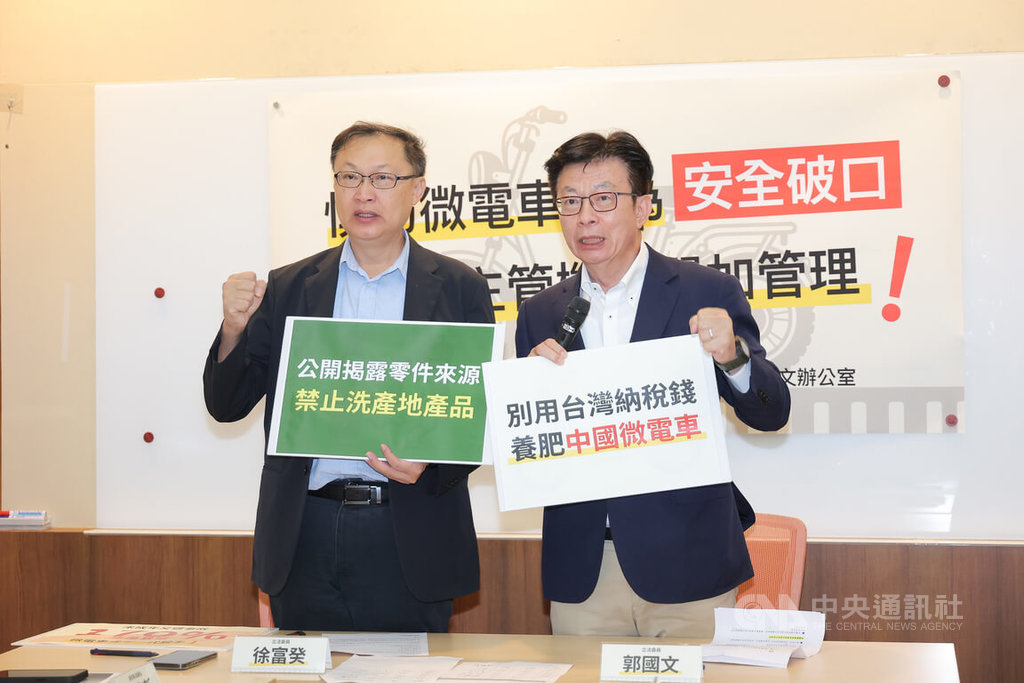
(Central News Agency reporter Wang Yang-yu, Taipei, 5th) DPP lawmakers Kuo Kuo-wen and Hsu Fu-kuei stated today that in recent years, micro electric two-wheeled vehicles (micro EVs) have rapidly become popular, but problems such as low registration rates, unlicensed riding, and illegal modifications are gradually forming road traffic and public safety concerns. They called on the government to strengthen inspection and registration management, and not to rashly expand subsidies for micro EVs.
Regarding the public's concern about whether micro EVs will be subsidized in the future, Tsou Yu-hsin, Deputy Director-General of the Industrial Development Administration of the Ministry of Economic Affairs, who was invited to the press conference, stated that they are currently evaluating whether to include micro EVs in the next electric motorcycle subsidy plan. If included in the future, they will refer to current practices and consider establishing regulations such as requiring certain key components to be "non-China-made."
Kuo and Hsu held a press conference at the Legislative Yuan today, demanding that the management of micro EVs should not stop at registration but should strengthen safety inspections, import management, source disclosure, violation audits, and subsidy thresholds. Furthermore, before traffic safety and supply chain sources are fully understood, the competent authorities should not rashly expand subsidies. They requested that the Ministry of Transportation and Communications, the Ministry of Economic Affairs, and related agencies propose a specific management plan within one month to prevent micro EVs from becoming a double gap in social safety and industrial policy.
Kuo stated that micro EVs do not require a driver's license and are relatively cheap, making them an important means of transportation for many teenagers, students, and migrant workers, which has also brought more attention to related traffic safety risks.
Kuo pointed out that when the government promotes the development of electric buses, electric motorcycles, and electric cars through subsidy policies, it sets requirements for localization, local cooperation, or non-China-made components. However, micro EVs currently only need to meet safety certification regulations to be sold and registered, with no requirements for the localization ratio of components or non-China-made regulations, clearly becoming an institutional exception.
Hsu stated that although the Ministry of Transportation and Communications has officially brought micro EVs under management, the actual management is still clearly insufficient. The most direct consequence is the continuous rise in casualty accidents. According to statistics from the Ministry of Transportation and Communications, as of March 2026, the number of registered micro EVs was 386,841. However, according to private estimates, the total number of micro EVs in Taiwan may be close to one million, meaning that the number currently grasped by the government is likely less than half. (Editor: Lin Hsing-meng) 1150605
FACT BOX
- Source: CNA (Central News Agency)
- Category: 政策